


Here’s the amici brief we filed today on behalf of the Owners’ Counsel of America and the National Federation of Independent Business Small Business Legal Center with the California Supreme Court in Property Reserve, Inc. v. Dep’t of Water Resources, No. S217738. In that case, the court is reviewing a decision of the Court of Appeal which held that the DWR’s attempts to enter private property to survey and study the land and the environment in anticipation of condemnation were beyond the minor intrusions allowed by California’s “entry statute.” The Court of Appeal concluded the proposed entries rose to the level of takings, meaning that if the DWR wanted to undertake them, it would have to exercise its eminent domain power to do so.

We posted background on the case here, but the short story is that the State of California is once again planning a massive public
Continue Reading Amici Brief: Precondemnation Entry That Goes Beyond “Innocuous” And “Superficial” Is A Taking

A couple of noteworthy conferences upcoming, one in-person, the other a “webinar” format:

  • The first is “Kelo: A Decade Later” at the U. Connecticut Law School, Friday, March 20, 2015, from 8:30 am – 4:30 pm. The conference promises to “look back at the decision and its repercussions,” and includes the lawyers for Ms. Kelo and the City of New London. “The conference will then explore the role of eminent domain in government planning generally. What role does and should eminent domain play in economic development?  What is the impact of post-Kelo changes to state law?  Does eminent domain have distinctive impacts on low income communities?  Leading scholars and practitioners in law, planning, sociology, and economics will explore these questions.” We note that our Connecticut Owners’ Counsel colleague Dwight Merriam is one of those “leading practitioners,” and will be moderating a panel entitled “Eminent Domain and Economic Development”


Continue Reading Upcoming Conferences – Kelo In Connecticut, APA And The ESA

Worth reading: “Legislative Exactions after Koontz v. St. Johns River Management District,” an article by colleagues Luke Wake and Jarod Bona, recently posted to SSRN. Here’s the abstract:

Decided in June, 2013, Koontz v. St. Johns River Management District settled a long-running debate among scholars as to whether the nexus test — first pronounced in Nollan v. California Coastal Commission — applies in review of monetary exactions. In the preceding years, the lower courts had largely resolved this question in the government’s favor — limiting Nollan to its facts, and holding the nexus test inapplicable if a challenged permit requires the applicant to pay or expend money as a condition of permit approval. Further, the trend among the lower courts held the nexus test inapplicable in review of legislatively imposed exactions, regardless of whether the contested condition requires a dedication of real property or money.

Without question

Continue Reading New Article: “Legislative Exactions after Koontz v. St. Johns River Management District”

Here’s the trial court’s opinion in one of the Jersey Shore “dune replenishment” cases we’ve been following.

These are the cases in which owners of beachfront property (or in one case, a municipality itself) objected to the state and local governments summarily taking easements on private property to be used to armor the shoreline against future hurricane damage. In response to Sandy, the federal government threw $3.461 billion at the shoreline in New Jersey and other states damaged by the hurricane, and as part of the package, the state and local governments were tasked with being “responsible for the rapid acquisition of property” needed.

As we posted earlier, the main issue in the cases is whether the government can take easements on private property by simply declaring that it has done so, without first condemning the easements under New Jersey’s eminent domain statutes. This was an “emergency”

Continue Reading NJ Court: There’s No Substitute For The Eminent Domain Process, Even On The Shore, Even In An “Emergency”

The Township of Ocean, New Jersey downzoned the plaintiffs’ residentially-and-commercially-zoned land to “Environmental Conservation.” The EC district allows “only very low density residential development or other low intensity uses,” with a minimum lot size of 20 acres. 

The plaintiffs, who own 34 acres subject the EC zoning, challenged the zoning ordinance, asserting it was “arbitrary, unreasonable, capricious and illegal,” and that it resulted in an inverse condemnation because it prohibited all uses.

In Griepenburg v. Township of Ocean, No. A-55-13 (Jan. 22, 2015), the New Jersey Supreme Court seemed to agree that there is little chance the property owners can make any use of their land: “[a]lthough plaintiffs’ single-family residence conforms to the ED district’s density requirement of one unit per twenty acres, no further development of their property within the EC district is permitted under the new zoning.” Slip op. at 13. 

The Supreme Court, however, held that the

Continue Reading NJ: Environmental Preservation Zoning Might Prohibit Development, But Owner Must First Try To Develop

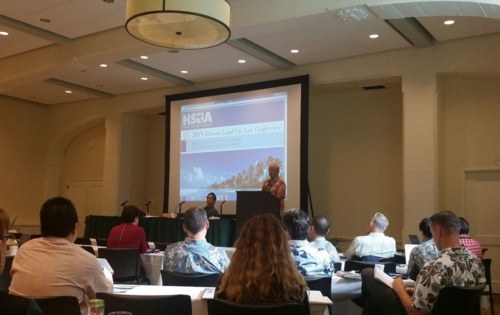
20150115_091355-1
Ben Kudo and David Callies, leading off

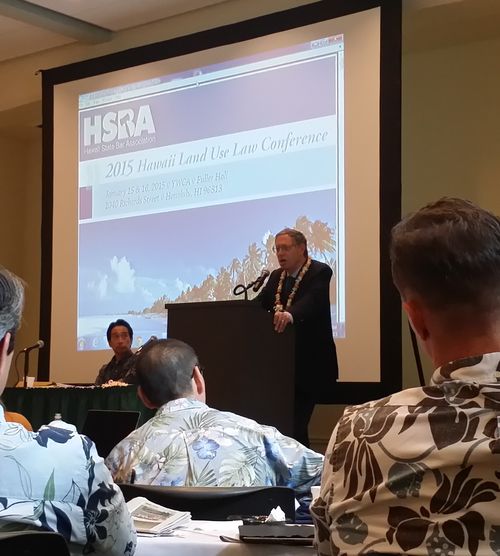
Professor Richard Epstein began the Hawaii Land Use Law Conference with the keynote presentation on “Stealth Takings: Exactions, Impact Fees, and More,” which was his usual comprehensive and non-stop takedown of takings law. 

20150115_100935

Our panel on Impact Fees and Exactions After Koontz followed, and here are the promised links and other materials which I mentioned:

Later today, I will also post up a recording of my short backgrounder on the exaction issue, to give you a flavor of the panel discussion (the Hawaii State Bar Assocation

Continue Reading 2015 Hawaii Land Use Law Conference

Here’s the final program and faculty list for the 2015 Hawaii Land Use Conference, coming up Thursday and Friday, January 15-16, 2015, in downtown Honolulu.

This is the bi-annual gathering of Hawaii’s land use mavens, and this year’s program has two very special presenters. Storied lawprof Richard Epstein (perhaps more than a “mere mortal”) will be presenting the keynote talk on “Stealth Takings: Exactions, Impact Fees and More,” and our ABA colleague Patty Salkin, Dean of the Touro Law School, will get us our Ethics CLE credits with her usual exciting program on ethics topics. (As someone who has attended more than few of her presentations, we can report that it is worth the price of admission alone, and even though “ethics CLE” and “exciting” are words we usually do not associate with each other, Dean Salkin’s presentation is the exception.)

Our panel on “

Continue Reading Still Time To Join Us For The 2015 Hawaii Land Use Conference (Jan. 15-16)

A short one (as usual) from the New York Supreme Court, Appellate Division.

The court’s opinion in New Creek Bluebelt, Phase 4 v. City of New York, No. D42909 (Nov. 19, 2014) is so brief, you should just read it yourself. But here are the highlights:

  • The city condemned a 19,500 square-foot vacant parcel on Staten Island.
  • The property had been designated “wetlands” before the current owners acquired it.
  • Applying a Penn Central analysis, the trial court determined, and the appellate division affirmed, that it was reasonably probable the wetlands designation was a regulatory taking. 
  • The regulations resulted in an 82% diminution of value.
  • That’s usually not enough, standing alone, but the regulations also were an “effective prohibition on development on any part of the property.”

For more, see this post (“Appellate Division Affirms 75% Increment Applicable to Wetlands Taking“) from our Owners’ Counsel colleagues at Goldstein,

Continue Reading NY: Reasonable Probability That Wetlands Designation Is A Regulatory Taking Under Penn Central

Here’s one of the decisions we’ve been meaning to post for a while.

In Schmude Oil Co., Inc. v. Dep’t of Envt’l Quality, No. 313475 (July 1, 2014), the Michigan Court of Appeals held that there was no wipeout per se taking, nor was there a Penn Central taking, when the DEQ refused to permit the plaintiff to drill for shale oil on its private property.

The plaintiffs’ land was partially in a “nondevelopment region” which absolutely banned drilling, while the other portion was in a “limited development region” in which “drilling could occur, subject to certain limitations.” The plaintiffs requested the DEQ issue 8 permits for the nondevelopment region, and 3 permits for the limited region. The DEQ denied all the applications. 

The court of appeals determined that within the nondevelopment region, the DEQ was required to have rejected the drilling requests (nondevelopment means no drilling), and that

Continue Reading Mich App: Denial Of Shale Oil Drill Permits Not A Taking

Here’s the Verified Complaint in a case recently filed in U.S. District Court in New Jersey:

Plaintiffs Jenkinson’s Pavilion, a corporation of the State of New Jersey and Jenkinson’s South, Inc., a corporation of the State of New Jersey, (collectively “Plaintiffs”), bring this action, inter alia, (a) for a declaration as a matter of law that the United States Army Corps of Engineers (“USACOE”) has not required, and does not require, for purposes of the “Manasquan Inlet to Barnegat Inlet Storm Damage Reduction Project,” the acquisition of perpetual rights in privateproperty for purposes of establishing recreational public beaches landward of the area already subject to public ownership and rights of public user pursuant to the New Jersey Public Trust Doctrine, and (b) enjoining the Defendants from taking actions in furtherance of the “Manasquan Inlet to Barnegat Inlet Storm Damage Reduction Project,” in advance of a determination on the relief

Continue Reading Federal Court Challenge To NJ’s Beach Replenishment Plan