


For those of us who were far, far away, and thus not able to be in D.C. for today’s oral arguments in person, here is the transcript in Koontz v. St Johns River Water Mgmt Dist., No. 11-1447 (cert. granted Oct. 5, 2012).

Here’s the first recap of the arguments, from Greenwire‘s Lawrence Hurley, “Supreme court: Justices weigh Fla. property rights dispute.”

More, after a chance to digest the transcript.
Transcript of oral arguments, Koontz v. St John’s River Water Mgmt Dist., No. 11-1447 (Jan. 15, 2013) 


Continue Reading SCOTUS Transcript In Koontz

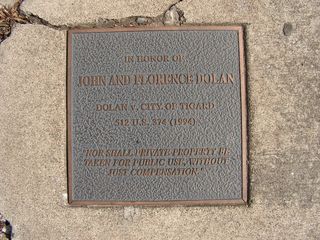
PICT0408

With the oral arguments in Koontz v. St Johns River Water Mgmt Dist., No. 11-1447 (cert. granted Oct. 5, 2012) at last here, we thought we’d go back and revisit our write-up of our visit to the Dolan site, complete with photos: Regulatory Takings Pilgrimage Part II.

Koontz, as you know, is about whether the Nollan nexus test, and Dolan‘s requirement of “rough proportionality” apply only to land exactions, or is a generally-applicable test for all exactions.

Continue Reading Exactions Flashback – Our Visit To The Dolan Site

Here‘s the Legal Information Institute’s preview of tomorrow’s U.S. Supreme Court arguments in Koontz v. St Johns River Water Mgmt Dist., No. 11-1447 (cert. granted Oct. 5, 2012). That’s the case in which the Court will be addressing whether the “essential nexus” and “rough proportionality” standards of Nollan and Dolan are applicable only to exactions for land, or whether they are generally-applicable tests for all exactions.

Disclosure: we filed an amicus brief in the case in support of the property owner/petitioner. The property owner’s brief on the merits is available here. The other amicus briefs supporting the property owner are available here, here, and here. The Water Management District’s merits brief is posted here. The amicus briefs suporting the Water District are posted here. The property owner’s reply brief is here.

The LII’s preview has a good “he said she said”

Continue Reading LII Preview: Koontz “has the potential to drastically modify takings jurisprudence with regard to exactions”

When we first read the Seventh Circuit’s opinion in Muscarello v. Winnebago County Bd., No. 11-2332 (7th Cir. Dec. 7, 2012), a case involving takings, due process, and other* challenges to a county zoning ordinance making it easier to build a wind farm, our first thought was “that case sounds familiar.”

It was. In this case, the same court ruled pretty much the same way, in a case about wind farms, against what appears to be the same plaintiff.

The recent opinion was covered in detail in Dean Patty Salkin’s Law of the Land blog here, so we won’t repeat it.

————————

*the opinion referred to the suit as “a blunderbuss of federal and state claims” 

Muscarello v. Winnebago County Bd., No. 11-2332 (7th Cir. Dec. 7, 2012) 


Continue Reading 7th Cir: If At First You Don’t Succeed…

Here’s a follow-up to our recent post about the U. Hawaii Law Review article authored by lawprof David Callies which summarizes the land use and property decisions of the Hawaii Supreme Court during the tenure of now-retired Chief Justice Ronald Moon. You know, the article setting out the stunning success rates of certain parties in the court, which chides the Justices for their often-lengthy opinions, and labels the Moon Court’s record on property rights “appalling.” Download the article here.

Today’s Honolulu Star-Advertiser has a follow-up interview with Professor Callies, most of which is behind a paywall. But if you don’t have an e-subscription (a real deal for those with mainland zip codes, by the way), here are the choice parts:

  • “Callies says he isn’t against planning in general, but thinks there must be legitimate police powers involved for the right of development to be abrogated.”
  • QUESTION: A recent


Continue Reading More From U.H. Lawprof On 1993-2010 HAWSCT’s “Appalling” Record On Property Rights

Here’s the preview of next week’s U.S. Supreme Court arguments in Koontz v. St Johns River Water Mgmt Dist., No. 11-1447 (cert. granted Oct. 5, 2012). That’s the case in which the Court will be addressing whether the “essential nexus” and “rough proportionality” standards of Nollan and Dolan are applicable only to exactions for land, or whether they are generally-applicable tests for all exactions.

In Wetlands regulation at heart of Fla. property rights dispute, Greenwire‘s Lawrence Hurley writes:

In late 1993 and early 1994, Coy Koontz Sr. applied for two permits from a Florida agency as he sought to build on wetlands he owned just east of Orlando.

Today, Koontz has been dead for 13 years, his family no longer owns the property and the permits have long been approved. And yet a legal dispute about the permitting process is about to be argued at the Supreme

Continue Reading Koontz Preview: Request For Exaction Is Not A “Suggestion,” But A “Velvet-Covered Hammer”

How, as an appellant, do you know you are in trouble? When an opinion starts like this, that’s how:

Although a residential subdivision proposed for construction in a bucolic Rhode Island town never saw the light of day, its ghost continues to haunt the parties. But apparitions rarely have substance, and this one is no exception. After careful consideration of the plaintiff’s complaint and the district court’s order of dismissal, we lay the ghost to rest.

The remainder of the opinion in Marek v. Rhode Island, No. 12-1460 (1st Cir. Dec. 27, 2012)  deals with whether a property owner suffered a taking when the State of Rhode Island and other parties granted a permit and approved construction by a neighboring owner of a road that allegedly encroached on the plaintiff’s land.

Among other arguments (as far as we can tell), the plaintiff raised a takings claim in federal court

Continue Reading First Circuit: Inverse Condemnation Claim In State Court An “Adequate Procedural Pathway” To Compensation

You know how we’re always saying that certain parties have an enviable record of success in the Hawaii Supreme Court? Well, now the statistics are official.

The latest edition of the University of Hawaii Law Review published an article by lawprof David Callies summarzing the decisions of the court during the tenure of now-retired Chief Justice Ronald Moon. The article sets forth the stark numbers (83% win rate, 65% reversal of the intermediate appellate court), and contains a sharp comment about the often-lengthy nature of the court’s opinions:

Second, the Moon Court decided some of thestate’s most important property and related environmental and Native Hawaiianrights cases in favor of the various non-governmental organizations bringingthem (Sierra Club, Earthjustice, Hawaii’s Thousand Friends, and the NativeHawaiian Legal Corporation) approximately eighty-two percent of the time,sixty-five percent of which reversed the Intermediate Court of Appeals (ICA).Third, the court increasingly rendered lengthy opinions, many triple the

Continue Reading U.H. Lawprof: HAWSCT’s 1993-2010 Record On Private Property Rights “Appalling”

Here’s petitioner’s reply brief in Koontz v. St Johns River Water Mgmt Dist., No. 11-1447 (cert. granted Oct. 5, 2012), which responds to the Water Management District’s merits brief.

In that case, the U.S. Supreme Court will address whether the “essential nexus” and “rough proportionality” standards of Nollan and Dolan are applicable only to exactions for land, or whether they are generally-applicable tests for all exactions.

Among other things, the reply addresses the argument made by the District and its amici that Nollan and Dolan aren’t really “takings” cases, but involve due process or equal protection:

Due process and equal protection claims are also inapt. A due process claim questions whether the exaction serves some legitimate purpose, and an equal protection claim asks whether the exaction is applied equally to similarly situated individuals. But neither claim addresses whether a particular individual has been targeted to bear a public

Continue Reading Reply Brief In Koontz: Money Is Property

…the Supreme Court’s opinion, isssued today, in Los Angeles County Flood Control Dist. v. NRDC, No. 11-460 (Jan. 8, 2013), in which the Court held that “the flow of water from an improved portion of a navigable waterway into an unimproved portion of the very same waterway does not qualify as a discharge of pollutants under the [Clean Water Act]”

We’d summarize the case, but that would take longer than you reading the five-page opinion.

More here from Greenwire’s Lawrence Hurley.Continue Reading Blink And You’ll Miss…