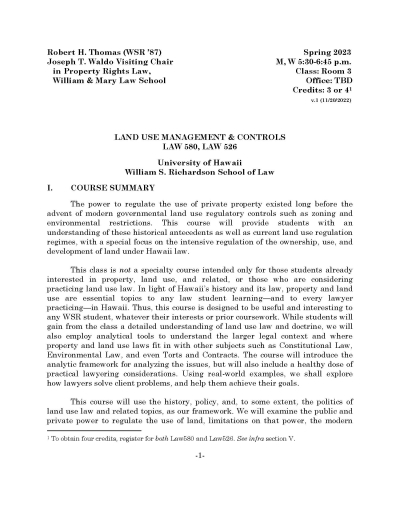
Syllabus

Starting in January, we’ll be teaching the venerated, and oh-so-important Land Use course (Law 580) at the University of Hawaii’s Law School.

We’re at least temporarily stepping into some mighty big slippers (this is Hawaii, so we don’t always wear shoes), as this is the course that our mentor Professor David Callies taught for decades. And is there a better venue in which to teach and study land use law and regulation, and its limits? After all, Hawaii may be the most heavily-regulated land on the planet, and is a focal point for every issue you can think of, from zoning to environmental restrictions to takings to public trust to subdivision to admin law to … well, you get the drift.

We’ll cover those topics, as well as the fundamentals. And we have a few surprises up our sleeve – some impressive guest lecturers, explorations of dirt law careers

Continue Reading Hawaii 5-80: Land Use Law At The University Of Hawaii

Here it is, the official agenda and program for the 40th ALI-CLE Eminent Domain & Land Valuation Litigation Conference, February 2-4, 2023 (with a special event the evening of Wednesday, February 1, 2023 to entice you to arrive early).

Screenshot 2022-11-18 at 13-35-13 ALI CLE PA NY VA TX FL Continuing Legal Education

Here’s the brochure with the complete agenda, schedule, and faculty listing. But to tempt you, here are some of the highlights of the program:

  • Everything Old is New Again: Why Today’s Practitioners Need to Understand the Original Meaning of the Takings and Just Compensation Clauses
  • Private Utility Takeovers – Lessons From a 67 Day Trial

  • Valuation Issues When Billboards and Signs are Condemned

  • Setting Client Expectations and Identifying Red Flags

  • Developing Property Right Issues in Texas – Questions and Answers from the Bench: A View From the Bench (with Texas Supreme Court Justice Jimmy Blacklock)

  • Eminent Domain and Regulatory Takings Updates: Important Decisions You Need to Know

  • Ethics:


Continue Reading Here’s The Program For The 40th ALI-CLE Eminent Domain & Land Valuation Litigation Conference, Feb 1-4, 2023, Austin

Well, that was quick. As we noted here, we recently argued a case in the Ninth Circuit (October 20, 2022) about whether a regulatory takings claim is ripe

Not long after we posted the argument recording, the Ninth Circuit panel issued a short memorandum opinion rejecting our arguments wholesale (November 1, 2022).

So earlier this week, we asked the entire Ninth Circuit to take a look. Here’s our en banc petition.

We’ll leave it to you to read it and see why we think this one is ripe.

Appellants’ Petition for Rehearing En Banc, Ralston v. San Mateo Cnty., No 21-16489 (9th Cir. Nov. 15, 2022…

Continue Reading Let’s Take A Deeper Look At Takings Ripeness, Ninth Circuit

Check it out: our Pacific Legal Foundation colleagues Jim Burling, Jon Houghton, and Jeff McCoy, along with Jeremy Hopkins (Cranfill & Sumner, North Carolina), share with us the latest on property rights, Sackett, takings, the future of Penn Central, and the upcoming SCOTUS arguments in Wilkins v. United States (is the Federal Quiet Title’s statute of limitations jurisdictional?).

Don’t miss it.Continue Reading Video: “The Future of Private Property Regulation in America”

October 20, 2022 was what one advocate noted was “land use day at the Ninth Circuit,” because three out of the four cases being argued in Courtroom 3 of the San Francisco courthouse were indeed land use — or perhaps more accurately, regulatory takings — cases.

Ours was one of those cases, Ralston v. San Mateo County.

Without going into too much detail, this is an appeal from the district court’s 12(b)(6) dismissal of our regulatory takings complaint. The crux of the claim is that Ralston’s R-1 zoned property is subject to an “overlay” district called the Montecito Riparian Corridor, a highly-restricted zone that allows only 5 environmental uses of land within the zone (none of which are consistent with the R-1 zoning). (Ralston’s property is labeled “076-19” on the County’s MRC map.)

Montecito Riparian Corridor

Absent some kind of special dispensation — what the County calls an “override” —

Continue Reading CA9 Takings Ripeness Oral Arguments: Must Property Owners Secure Govt’s Agreement That Property Is Subject To Challenged Regulations Before A Court Can Review?

Been meaning to post this one for a while.

The plaintiff in Northwest Landowners Ass’n v. North Dakota, No. 20210148 (Aug. 4, 2022), challenged North Dakota’s adoption of a statute about “pore space,” which is “a cavity or void, whether natural or artificially created, in a subsurface sedimentary stratum.” Whoa.

The problematic part of the statute “allows an oil and gas operator to use subsurface port space and denies the surface owner the right to exclude others or to demand compensation for this subsurface use.” Slip op. at 2. The statute also amended the definition of “land” to exclude pore space, and barred tort claims for injection or migration of substances into pore space. Frack!

The Association sued, asserting that the statute effected a facial taking because “it strips landowner of their right to possess and use the pore space within their lands and allows the State

Continue Reading Shades Of Mahon From North Dakota: Fracking Statute “constitutes a per se taking”

Now that the Supreme Court’s first arguments of this Term are in the books, you can read the transcript, or listen to the recording (mp3) (or stream it above). This is Sackett v. EPA, a case that has been to the Court before, where it unanimously held that the Sacketts could ask a court whether the government was correct when it claimed their land was covered by the Clean Water Act, and didn’t need to wait for the criminal charges shoe to drop.

Before we go on, a note that our law firm represented the Sacketts then, as we do now. So we’re not going to go into a great deal of detail, and leave it to you to check out the public commentary elsewhere.

That said, about the only thing we will comment on is the noticeable lack of owner-focused perspective in the arguments. As we

Continue Reading SCOTUS vs WOTUS: Oral Arguments In Sackett v. EPA

  Screenshot 2022-09-20 at 10-17-17 Amazon.com I'm with stupid

Coulda been worse.

When the Third Circuit’s published opinion in Yaw v. Delaware River Basin Comm’n, No. 21-2316 (Sep. 16, 2022) popped up in our feed we got a slight frisson in anticipation – a claim that the Commission’s banning of fracking was a taking.Thank you Knick for opening the federal courts back up to takings claims!

But alas, no decision on the merits. After all, one of the downsides of federal court is the higher justiciability barriers that must be overcome before the court deals with the merits of a takings claim. And so it is in this opinion:

Plaintiffs-Appellants—two Pennsylvania state senators, the Pennsylvania Senate Republican Caucus, and several Pennsylvania municipalities—filed this lawsuit challenging the ban. Among other things, they allege that, in enacting the ban, the Commission exceeded its authority under the Delaware River Basin Compact, violated the Takings Clause of the United

Continue Reading I Made A Takings Claim And All I Got Was This Lousy Opinion On Article III Standing

Screenshot 2022-09-11 at 21-59-15 Northwestern University Law Review Vol 117 Iss 1

Be sure to check out Northwestern Law Review’s symposium issue on “Reimagining Property Rights in the Era of Inequality.” which brought together “scholars of legal history, property, tax, land use, fair housing, environmental law, natural resources and water rights, family law, education, and constitutional law, to highlight new scholarship at the intersection of these fields.”

We found the essay by Professor Fennell (“Streamlining Property,” and the essay by Timothy Mulvaney (“Compulsory Terms in Property“) to be of particular interest. Full list of essays above, or here.Continue Reading New Symposium: Northwestern L. Rev.’s Property Issue

We recommend you review the North Carolina Supreme Court’s opinion in Anderson Creek Partners, L.P. v. County of Harnett, No. 63PA21-1 (Aug. 19, 2022). It’s long (70 page majority, plus 19 pages of concurring and dissenting opinions), but worth your time because the majority concludes that legislatively-imposed fees, applicable to all, are “exactions” that are subject to the nexus/rough proportionality requirements of Nollan/Dolan/Koontz.

The county adopted a requirement that residential property developers pay a per-lot, one-time water and sewer capacity use fee as a condition of the county accepting applications for a water or sewer permit. The details:

Section 28(h) of the ordinance provides for the collection of “capacity use” fees for the purpose of “partially recover[ing] directly from new customers the costs of capacity of the utility system to serve them.” More specifically, the ordinance provides that, for each new residential connection to

Continue Reading NC: Generally-Applicable Impact Fee Is Subject To Nollan/Dolan/Koontz