We’re hoping that someone can explain the Florida District Court of Appeal’s recent opinion in Bondar v. Town of Jupiter Inlet Colony, No. 4D19-2118 (May 5, 2021) in a way that makes sense other than the old apocryphal tale of “I don’t know why we do things this way, except that we’ve always done things this way.”

Before we get to the details, a slight detour. This is another one of those cases about substantive due process. Now don’t get us started on that one — we get that it might seem odd to suggest that the Fourteenth Amendment’s Due Process Clause limits the government’s power beyond requiring fair procedures. After all, the words are right there in the text: “nor shall any state deprive any person of life, liberty, or property, without due process of law.” But work with us here: we’ve always viewed the phrase much

Continue Reading Fla App Doubles Down On That Weird Property Isn’t “Property” Thing
Read the allegations in the complaint that the Illinois Appellate Court recounted in Strauss v. City of Chicago, No. 1-19-1977 (Mar. 5, 2021), and they will make your hair curl in horror.

In short: a family rented the ground floor of its mixed residential-commercial building in Chicago to Double Door Liquors (a live music venue). The local alderman “had a personal and financial relationship with the Double Door’s owners.” Slip op. at 3. He “told defendant that only Double Door would be allowed in the building.” Id. (It’s good to have friends, no?) But Double Door was not an ideal tenant, and the noise, drug and alcohol use, and property damage by patrons were a problem to the owners and neighbors. So the owners evicted the club. 

So, according to the family’s complaint, the alderman struck back. Read pages 3- 6 for the details. If true, the allegations are

Continue Reading Complaint Alleged That Chicago Pol Zoned The Chicago Way – But Still No Taking Because Family Owners Only Lost $1 Million

Goofus-gallant

Yes, it starts tomorrow, Thursday, January 28, 2021, but we’re “remote” this year, so it is not too late to register to join us for the 38th Annual ALI-CLE Eminent Domain & Land Valuation Litigation Conference. This is the “big one” where the nation’s best practitioners, scholars, jurists, and other industry professionals gather to talk shop about the subjects we know and love.

Details here (ALI-CLE’s page with faculty, agenda, and times), or here (a recent episode of Clint Schumacher’s Eminent Domain Podcast, where we preview the Conference). Here’s your chance to be a part of what is the best conference on these topics.

We have set it up to take advantage of the remote format, and tuition has been reduced (thank you to ALI-CLE for recognizing this, and for our sponsors for being so generous). We’re seeing a lot of first-time registrations, and this is a great opportunity

Continue Reading Still Time To Join Us: ALI-CLE Eminent Domain & Land Valuation Litigation Conference (Online!) This Thursday & Friday. Tuition Deals! #EminentDomain2021

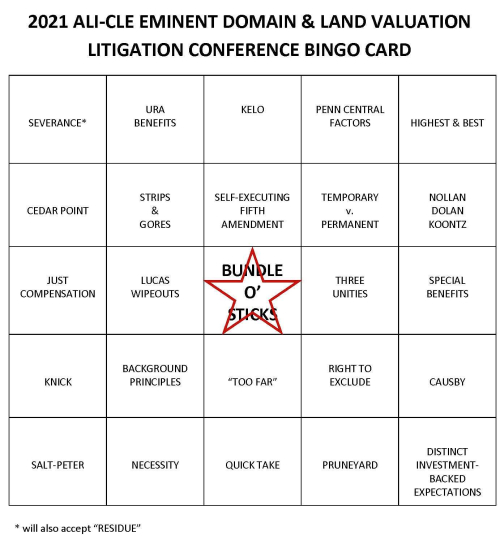
ALI-CLE 2021 Bingo card

If you “get” this, you should be registered for the 38th Annual Eminent Domain & Land Valuation Litigation Conference, to be held remotely on Thursday and Friday, January 28-29, 2021.

The list is growing rapidly, and you need to join us!

This is the “big one” where the nation’s best practitioners, scholars, jurists, and other industry professionals gather to talk shop about the subjects we know and love. We’re having programs with intriguing subjects such as “Planning to Win: Practical Strategies for a Successful Inverse Condemnation Case,” “How Do I Keep My Firm’s Doors Open When the Courthouse Doors Are Closed? Making Your Practice More Efficient When You Can’t Try Cases,” “Where Is the Supreme Court Headed on Takings Cases? Regulatory Takings Update and Cedar Point Preview,” “No Show and All Tell: Breaking News in Property Rights and Takings,” “More Than the Fifth Amendment: Other Tools for Upholding

Continue Reading Your 2021 ALI-CLE Eminent Domain & Land Valuation Litigation Conference (Jan 28-29, Remote) BINGO Card

We all know that despite the heightened Twombly/Iqbal federal pleadings standard, that it doesn’t mean a whole lot if a complaint survives a 12(b)(6) motion to dismiss. All this means that the court thinks it is plausible that the complaint states a claim. And that the plaintiff gets to keep going. That’s it.

But when takings claims are involved, we also know that courts can be dismissive, and a property owner surviving a motion to dismiss can be kind of a big deal.

In Hunters Capital LLC v. City of Seattle, No. C20-983 (Oct. 16, 2020), the U.S. District Court for the Western District of Washington dismissed the plaintiffs’ equal protection claims, but held that the procedural and substantive due process, and takings claims survived. This is the case on which we posted earlier, in which property owners in the part of Seattle known as CHOP (or

Continue Reading Federal Court: If It’s True That Seattle Provided Material Support To CHOP/CHAZ, That Could Be A Taking

As if to respond to a sibling federal court’s recent order upholding a covid-reaction shut down orders, the U.S. District Court for the Western District of Pennsylvania’s opinion in County of Butler v. Wolf, No.2:20-cv-00677 (Sep. 14, 2020) reaches an entirely different conclusion:

The fact is that the lockdowns imposed across the United States in early 2020 in response to the COVID-19 pandemic are unprecedented in the history of our Commonwealth and our Country. They have never been used in response to any other disease in our history. They were< not recommendations made by the CDC. They were unheard of by the people this nation until just this year. It appears as though the imposition of lockdowns in Wuhan and other areas of China-a nation unconstrained by concern for civil liberties and constitutional norms-started a domino effect where one country, and state, after another imposed draconian and hitherto untried

Continue Reading Fed Ct: “[T]he stay-at-home and business closure components of Defendants’ [COVID] orders violate the Due Process Clause” (Applying Rational Basis Review!)

The District Court’s bottom line in Lukes Catering Service, LLC v. Cuomo, No. 20-CV-1086 (Sep. 10, 2020)? The New York governor’s emergency orders aimed at coronavirus “imposing quarantines, mandating workforce reductions, closing schools, requiring face-coverings, and restricting activities of all types,” are not takings of the businesses of event, banquet, and catering services that have been shut down as a result. The specific emergency measure challenged was the order limiting gatherings to no more than 50 people.

The controlling authority? You guessed it, Jacobson v. Massachusetts, 197 U.S. 11 (1905). That’s the case in which the Court defined “real liberty,” and which has been most prominently applied in emergency order cases to reject due process challenges. But if you want the court’s takings analysis, jump to page 24. The court rejected the categorical (Lucas) claim:

Plaintiffs allege a categorical regulatory taking in their complaint. (Complaint, ¶¶

Continue Reading NY Fed Ct: “When faced with a society-threatening epidemic, state officials are empowered to … infringe federal constitutional rights. They may generally do so at their sole discretion and for so long as is necessary.”

Please join us and a panel of expert speakers including our friend and colleague Tony Della Pelle (see the flyer for the complete list), this Thursday, September 10, 2020 at 1pm Eastern Time for the ABA-produced webinar “Governmental Emergency Powers and the Constitutional Implications Arising from Pandemic Orders.”

Free to ABA members, a modest cost for those who are not. Register here.

Here’s the plan:

In the wake of the unprecedented global pandemic, every level of government has taken steps to address the public health crisis. These steps have manifested in orders which impact businesses and individuals alike including quarantine orders, travel restrictions, occupancy limitations, and restrictions on movement. This is the not the first pandemic, nor the first national crisis, faced by the United States. There have been several lawsuits filed challenging the constitutionality of the COVID-19 orders, including challenges based on the right to

Continue Reading This Thursday, Sept 10: “Governmental Emergency Powers and the Constitutional Implications Arising from Pandemic Orders” (Free to ABA Members)

Here’s the latest in the remaining federal court challenge to Hawaii Governor David Ige’s coronavirus-related series of orders which, among other things, suspended a wide range of statutes, ordered activities deemed “nonessential” to stop or be limited, imposed a two-week self-quarantine on interisland, mainland, and international travelers, effectively shut down one of the main engines of the Hawaii economy—tourism, and compelled most residents to remain at home as much as possible and avoid large indoor gatherings.

The plaintiffs sought a temporary restraining order, and the court scheduled a hearing for Thursday, July 2, 2020. Apparently, the hearing was originally planned to be “virtual,” with the lawyers and parties participating by Zoom, while the public could listen in (audio only) via telephone.

But then yesterday, the Hawaii Attorney General asked the court for “an adjustment to the format” of the hearing, to allow the AG to appear in person. The

Continue Reading Hawaii AG: For The Hearing At Which I Will Argue That Indoor In-Person Gatherings Are Dangerous, Let’s Gather Indoors In-Person!