
Here’s the transcript from today’s Supreme Court oral arguments in Horne v. United States Dep’t of Agriculture, No. 12-123 (cert. granted Nov. 20, 2012).
Here’s a recap of the arguments from Lyle Dennison at SCOTUSblog: “If only it were simple…“


Here’s the transcript from today’s Supreme Court oral arguments in Horne v. United States Dep’t of Agriculture, No. 12-123 (cert. granted Nov. 20, 2012).
Here’s a recap of the arguments from Lyle Dennison at SCOTUSblog: “If only it were simple…“
Here’s the Reply Brief in Horne v. United States Dep’t of Agriculture, No. 12-123 (cert. granted Nov. 20, 2012), the case asking whether in an enforcement action by the USDA, California raisin farmers can raise the defense that the requirement they turn over to the government a certain percentage of their yearly crop would be a taking.
The brief responds to the USDA’s brief, and argues that the issue before the Court is not “jurisdictional,” which means it could be raised any time, much like the USDA did here, even after the Ninth Circuit issued its opinion. Rather, this is a choice of remedies ripeness question subject to “forfeiture.” Barista’s note: we’re happy to see what is commonly referred to as “waiver” (a knowing and intentional relinquishment of a known right) properly labeled as “forefeiture” (relinquishment of a right by operation of law), because in civil litigation when
Yesterday, we posted our thoughts about the upcoming (March 20) Supreme Court oral arguments in Horne v. United States Dep’t of Agriculture, No. 12-123 (cert. granted Nov. 20, 2012), the case asking whether in an enforcement action by the USDA, California raisin farmers can raise the defense that the requirement they turn over to the government a certain percentage of their yearly crop would be a taking.
Here are a few more perspectives on the arguments:
Continue Reading More California Raisin Takings Case Previews
Hat tip to Dean Patty Salkin’s Law of the Land blog for bringing this case to our attention. We don’t have much to add to her comprehensive write up of the Georgia Supreme Court’s opinion in City of Suwanee v. Settles Bridge Farm, LLC, No. S12A1599 (Feb. 18, 2013), a case holding that a regulatory takings case was not ripe because the property owner had not exhausted available administrative remedies. But we do have one thought that she didn’t cover, so bear with us while we set the stage.
Settles Bridge obtained city approvals for a residential subdivision. Shortly thereafter, however, it sold the property to Notre Dame Academy, which, under the existing residential zoning could build a school on the site as a matter of right, and “Settles Bridge abandoned its subdivision plan.” Upon learning of the sale, the city first adopted a building permit moratorium, and followed
Koontz Sets The Stage
The apparent sticking point during the January oral arguments in n Koontz v. St Johns River Water Mgmt Dist., No. 11-1447 (cert. granted Oct. 5, 2012), came to light via Justice Scalia’s questioning of the property owner’s counsel about whether anything had been “taken” when a property owner refused to accept a development permit conditioned on him paying for improvements to public land miles away from his property, because doing so would violate the unconstitutional conditions doctrine of Nollan/Dolan. For how could the owner claim that his property was taken when he didn’t accept the permit? The issue was succintly stated by Justice Kagan when she asked point-blank, “where is the taking?” (see p. 11 of the Koontz transcript).
We’re still waiting for the opinion in that case so don’t have the Court’s answer just yet, but Part II of the
Here’s more about the Federal Circuit’s decision in Lost Tree Village, a case we covered here: US Army Corps Denies A § 404 Permit: Can A Takings Claim Be Based OnConsideration Of The Economic Affect On the Wetlands Parcel Only? from Abbott & Kindermann’s Land Use Blog.Continue Reading More On Federal Circuit’s “Relevant Parcel” Decision
Earlier, we posted the initial briefs in Big Oak Farms, Inc. v. United States, a case now pending in the Court of Federal Claims. Or, more correctly, perhaps being revived in the CFC because it was dismissed earlier.
The property owner in Big Oak Farms is seeking compensation for the flooding of its land in 2011 after the Corps of Engineers blew up a levee on the Mississippi River in order to, in the plaintiff’s words, “sacrifice Plaintiffs’ land to superimposed water, sand, and gravel in order to benefit the public diverting high water away from other personal and real properties in and around Cairo, Illinois.” Video here.
The Big Oak Farms briefs were the first briefs filed in which the parties attempted to apply the Supreme Court’s ruling in Arkansas Game and Fish Comm’n v. United States, No. 11-597 (Dec. 4, 2012). These were filed even
Continue Reading Response Briefs On Impact Of SCOTUS Flood Takings Opinion
Here’s one more amicus brief (Public Lands Council, National Cattlemen’s Beef Association, Oregon Cattlemen’s Association, Washington Cattlemen’s Association, and Nevada Cattlemen’s Association) supporting the cert petition in Estate of Hage v. United States, No. 12-918 (cert. petition filed Jan. 17, 2013).
Estate of Hage is the case in which the Federal Circuit held that a 22-year old takings case was not ripe because even though the agency denied Hage’s every application for a grazing permit, it might issue a special use permit that might allow the use of the water he alleges was taken. The issue in the case is whether it is a taking for the government to cut off physical access to a property owner’s vested right to use water.
Earlier, we posted two other amicus briefs supporting the granting of cert:
Continue Reading One More Amicus Brief In Western Water Rights Takings Case
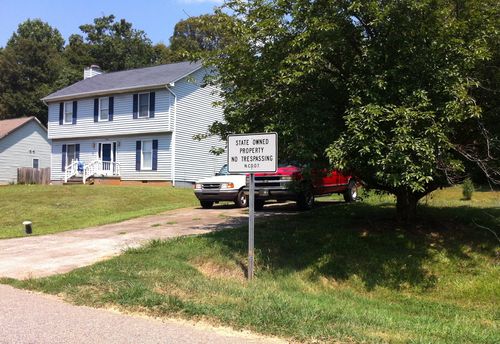
From North Carolina colleague Matthew Bryant comes a heads-up to this report from WFDD, the NPR affiliate, “Possible Twist in Winston Northern Beltway.”
It’s about an ongoing inverse condemnation fight in the Winston-Salem area over the N.C. Department of Transportation’s designation in the mid-to-late 1990’s of certain properties for acquisition for a bypass highway. But despite these designations — which, under the state’s Transportation Corridor Official Map Act meant that the property owners’ development options were limited — DOT acquired some, but not all of the properties. The DOT didn’t buy them all because “[w]e simply do not have enough funding.” For a scope of the acquisitions, see this map which shows the DOT-acquired parcels in red, the unacquired parcels in green, and the plaintiffs in the inverse condemnation case in yellow.
After more than a decade of waiting, the owners of some of the unacquired brought inverse
Here are two amicus briefs supporting the cert petition in Estate of Hage v. United States, No. 12-918 (cert. petition filed Jan. 17, 2013). That’s the case in which the Federal Circuit held that a 22-year old takings case was not ripe because even though the agency denied Hage’s every application for a grazing permit, it might issue a special use permit that might allow the use of the water he alleges was taken. The issue in the case is whether it is a taking for the government to cut off physical access to a property owner’s vested right to use water.
First up is the brief of Pacific Legal Foundation and the U.S. Cattlemen’s Association which argues that the property owner “has a protected property interest in the right to access and perform ordinary maintenance on ditches that carry his water on vested rights-of-way over federal lands.” The
Continue Reading Amicus Briefs In Western Water Rights Takings Case