


Here’s the federal government’s merits brief in Arkansas Game & Fish Comm’n v. United States, No. 11-597 (cert. granted Apr. 2, 2012), the case in which the Federal Circuit held that flooding caused by the Corps of Engineers was only temporary, and did not result in a compensable taking merely because it eventually stopped, and “at most created tort liablity.” The dissenting judge concluded that temporary flooding was no different in kind than more permanent flooding that occurs in other inverse condemnation cases, and regularly results in awards of compensation. The Federal Circuit’s opinion is here.

As you might expect, the brief phrases the Question Presented somewhat differently than the property owner/petitioner’s brief:

The Court of Federal Claims found that during several years in the 1990s, temporary and irregular changes in water releases from a flood-control dam operated by the United States Army Corps of Engineers marginally
Continue Reading Fed Govt’s Brief: “Temporary And Irregular Inundation Of Wetlands” (Read: Flooding) Is Not A Taking

Florida land use and environmental law attorney Jake Cremer has posted the Brief in Opposition in Koontz v. St. Johs River Water Management Dist., No. 11-1447 (cert. petition filed May 30, 2012), the case asking whether the Nollan/Dolan nexus and proportionality tests  apply to a land-use exaction that takes the form of a government demand that a permit applicant dedicate money, services, labor, or any other type of personal property. We posted the cert petition here.

Jake writes:

The U.S. Supreme Court has not yet given much more guidance on exactions, and confusion has been the result. The Florida Supreme Court forged its own path, holding that the Nollan-Dolan test only applies to (1) exactions of real property (2) where a permit was actually issued and imposed an exaction. Consequently, in Florida, there are now relatively few restrictions on what a local government can ask

Continue Reading BIO In SCOTUS Florida Exactions Case: Fla Supremes Ruled Only Under Fla Law

For those of you sticking around Chicago after the ABA Annual Meeting, there’s the opportunity for even more land use, zoning, takings, and condemnation programming. ALI-CLE (fka ALI-ABA) is putting on it’s annual Land Use Institute later this week. It looks like Planning Co-Chairs Gideon Kanner and Frank Schnidman have put together a wide-ranging agenda, and stellar faculty, as usual. 

Details, including registration information, here.Continue Reading Chicago Part II: Land Use Institute

This past week was the ABA Annual Meeting in Chicago. These things can often be endurance contests where you’re rushing from one meeting to another (is this the Executive Committee meeting or the Council meeting?), and it’s often hard to tell the players without a scorecard.

Sprinkled among these unexciting-but-productive sessions are the real meat of the Annual Meeting, the CLE sessions. Some are interesting and fun (but pretty useless as CLE). Others are timely. Some are just plain weird. But never let it be said that the State and Local Government Law Section (the one that we are active in) doesn’t put on relevant programming: two of the featured CLE’s this past week were of particular interest to our readers, one about eminent domain, and the other about the takings case currently pending before the U.S. Supreme Court (which will be argued on October 3, 2012).

Continue Reading Summary Of Flood Takings CLE – Lawprofs And Lawyers Discuss Pending SCOTUS Case

We are at the ABA Annual meeting this week, so don’t have a lot of time to keep up a long-distance practice and write up comprehensive blog posts, so we’re going to keep it short.

Here’s the latest takings decision from the Federal Circuit in a case we’ve been following, Estate of Hage v. United States, No. 2011-5001 (Fed. Cir. July 26, 2012). The property owners filed their case in 1991 in the Court of Federal Claims seeking compensation for the federal government’s taking of water rights in Nevada. In 2008, the CFC ruled in favor of the property owners, but the Federal Circuit reversed on Williamson County grounds because the case wasn’t administratively ripe. The federal agency, you see, has not reached a final decision on what the property owners might do with the land, and just might issue a permit (even if other similar permit applications

Continue Reading Federal Circuit: 22-Year Old Takings Case In Which The Landowner Is Already Dead Is Not Ripe

In a case that was probably doomed from the start because of an earlier precedential ruling, the Federal Circuit concluded that the government’s temporary seizure of the plaintiff’s computer “for review” at a border stop and the subsequent destruction of the computer hard drive and resulting loss of data was not a taking because the seizure was an exercise of the government’s power to control the border.

We’ve been down the road of Kam-Almaz v. United States, No. 2011-5059 (June 30, 2012) before, in AmeriSource, for example, where the government seized the plaintiff’s property as evidence in order to prosecute a third party, and by the time the government returned the property to its owner, it was worthless. In Kam-Almaz, the ICE agents took the laptop because Kam-Almaz was a “person of interest,” promising to return it shortly. However, during the time ICE had it, the

Continue Reading Federal Circuit: Taking As A Result Of Police Power Isn’t A Taking

Check out the latest brief filed in the Federal Circuit by our colleague Thor Hearne. Readers know Thor as our semi-regular updater of the latest from the Court of Federal Claims in “rails-to-trails” takings cases, and this appeal is from a CFC case on that subject.

In Ladd v. United States, the CFC dismissed the property owners’ Fifth Amendment takings claim stemming from a rail conversion in Arizona. The court held that the claim was filed past the six-year Tucker Act statute of limitations. A Trails Act case begins when the Surface Transportation Board issues an order (a NITU) that converts an otherwise abandoned railroad easement into a new federal rail-trail easement. The new easement can be used by the public for recreation and the STB retains jurisdiction to “railbank” the corridor, potentially allowing some railroad in the future to build a new railway line across the land. 

Continue Reading Can The Statute Of Limitations In Tucker Act Start Running Before The Govt Provides Actual Notice Of The Taking?

Today, on behalf of Owners’ Counsel of America, we filed this amicus brief in Arkansas Game & Fish Comm’n v. United States, No. 11-597 (cert. granted Apr. 2, 2012), the case in which the Federal Circuit held that flooding caused by the Corps of Engineers was only temporary, and did not result in a compensable taking merely because it eventually stopped, and “at most created tort liablity.” The dissenting judge concluded that temporary flooding was no different in kind than more permanent flooding that occurs in other inverse condemnation cases, and regularly results in awards of compensation. We posted the Federal Circuit’s opinion here.

Our brief argues:

This case presents the court with an opportunity to bring a measure of long-absent clarity to one part of takings law. A physical invasion of property – even that which is deemed “temporary” – is a taking and triggers the

Continue Reading Amicus Brief: Any Physical Invasion That “Directly And Substantially” Interferes With Use Is A Taking

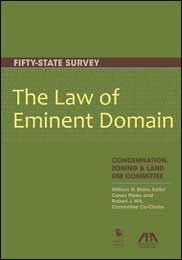
5310412_bigJust published: the ABA Section of Litigation (Condemnation, Zoning, and Land Use Committee) has released The Law of Eminent Domain — A Fifty State Survey (First Chair Press 2012). This book is a “single resource for eminent domain practitioners … a reference for questions about eminent domain and condemnation procedure in every state and the District of Columbia.” It’s a handy desk reference for how common issues in eminent domain are handled in each jurisdiction. Each state chapter covers the same topics:

  • Who is Eligible to Condemn?
  • What can be Condemned?
  • The Condemnation Proceedings
  • Procedure to Challenge Condemnation
  • Inverse Condemnation
  • Just Compensation Issues
  • How are Various Ownership Interests Treated?
  • Abandonment
  • Attorney’s Fees and Costs

We authored the Hawaii chapter. Our Owners’ Counsel of America colleague Bill Blake served as the editor, and many of our friends and colleagues from across the nation authored their state’s chapter. It’s a great reference

Continue Reading New Book: The Law of Eminent Domain (A Fifty State Survey)