


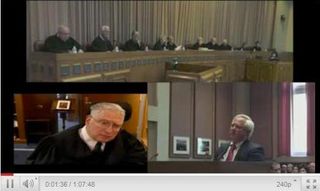
Guggenheim_enbanc

Last month, we attended the oral arguments in the rehearing en banc of Guggenheim v. City of Goleta, 582 F.3d 996 (9th Cir., Sep. 28, 2009).

The three-judge Ninth Circuit panel held 2-1 that a takings challenge was ripe under Williamson County, and ruled the City of Goleta, California’s ordinance was a facial taking by applying the three-part Penn Central test. The court remanded the case to the district court for a calculation of compensation owed to the property owners. On March 12, 2010, the court ordered en banc review.

Our summary of the oral argument is posted here. Today, the court posted the video from the hearing, complete with 24-style split screen. Check it out for a rare cameras-in-the-courtroom view of a federal appeals court in action. Continue Reading Ninth Circuit Posts Video Of Guggenheim (Rent Control Takings Case) En Banc Oral Arguments
Here’s a case from the North Carolina Court of Appeals that is similar to last week’s decision by the Kansas Supreme Court, in that it involves an inverse condemnation claim resolved by the burdens on the parties in the course of a summary judgment motion.

The public utility decided to install a sewer line in what it thought was the footprint of an existing public sewer easement. Eminent domain is not implicated since the easement map shows that “all sewer easements are public” and thus do not need to be condemned. Not so fast, the map is wrong, said Mr. Costa who claimed to be the owner of the land on which the sewer was installed. Both sides filed summary judgment motions, Costa supporting his with affidavits from an attorney and a surveyor, testifying that the map does not show true state of affairs, and that the sewer was

Continue Reading North Carolina App: When Opposing Summary Judgment, Make Sure Your Declarations State Facts, Not Conclusions (Applies In Inverse Condemnation Cases)

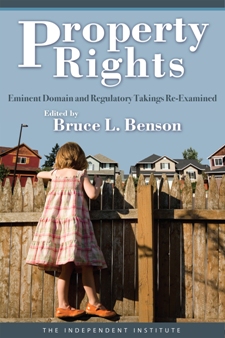
Property_1800 I recently picked up a copy of Property Rights – Eminent Domain and Regulatory Takings Re-Examined (Bruce L. Benson, ed., Independent Institute 2010), available on-line here.

At 299 pages and with 13 entries, I haven’t had a chance to read the whole thing yet. But after an initial skim, a few of the chapters stand out: Steven Eagle on Assembling Land for Urban Development – The Case for Owner Participation, Ilya Somin on The Limits of Backlash – Assessing the Political Response to Kelo, and Scott Bullock on The Inadequacy of the Planning Process for Protecting Property Owners From the Abuse of Eminent Domain for Private Development

We will post more as we get further into the book, but for now, here’s the publisher’s summary: 

The U.S. Supreme Court decision, Kelo v. New London, has become a dramatic focal point for the broad use of eminent

Continue Reading New Book: Property Rights – Eminent Domain and Regulatory Takings Re-Examined (2010)

More on the “judicial takings” case, Stop the Beach Renourishment, Inc. v. Florida Dep’t of Environmental Protection, No. 08-11 (June 17, 2010).

Remember that at the ABA Annual Meeting next month in San Francisco, the Section of State and Local Government Law is co-sponsoring a panel discussion of the case. I’ll be moderating, and Jim Burling (Pacific Legal Foundation), John Echeverria (Vermont Law School), Richard Frank, University of California Boalt Hall Law School), and Dan Stengle, (Hopping Green & Sams, Petitioner’s counsel) are on the panel. If you are coming to the meeting, mark your calendar for August 6, 2010 from 2:30 – 4:00 p.m. at the Hilton San Francisco Union Square. More information here.

Anyway, here are the links:


Continue Reading More On The “Judicial Takings” Case (Stop The Beach Renourishment)

Here at inversecondemnation.com we also cover eminent domain, regulatory takings, land use, and environmental issues. We even cover election law when it strikes our fancy.

But here’s one that’s in our core competency: in Frick v. City of Salina, No. 101,355 (July 9, 2010) the Kansas Supreme Court held that property owner-plaintiffs did not meet their summary judgment burden of opposing the city’s motion, and affirmed a judgment that the city did not inversely condemn their property by denying them the ability to construct driveways to access their land.

After the city condemned their property, the Fricks moved their businesses to another nearby site. The move, according to the Fricks, “was thwarted by the ‘inappropriate regulatory’ action of the City. Slip op. at 8. The regulatory actions complained of included:

(1) denial of reasonable access to the relocation site during the Project; (2) construction activities

Continue Reading Kansas: Inverse Condemnation Case Resolved By Summary Judgment Burdens

If you can figure out the syntax of this post’s headline, you’ve just figured out the rationale of the Wisconsin Supreme Court in E-L Enterprises, Inc v. Milwaukee Metropolitan Sewerage District, No. 2008AP921 (July 2, 2010). In that case, the court held that the removal of groundwater was not a compensable taking because the property owner did not seek compensation for the taken water, but for damage to its building which relied in part on the groundwater for support.

Many years ago, in the course of constructing a new pipeline, the local sewer company removed groundwater under a neighboring building. Removal of the water resulted in the wooden supports under the building rotting, which caused the building to settle. The cost to replace the wooden supports with concrete supports was approximately $300,000.

The property owner brought claims for negligence, nuisance and inverse condemnation because the sewer company “physically took

Continue Reading Wisconsin: Taking Groundwater Is Not A Taking Of A Building Damaged By The Taking Of The Groundwater

Heads up on a new article of interest to those of us who deal with exactions and Nollan/Dolan: Matthew Baker, Much Ado About Nollan/Dolan: The Comparative Nature of the Legislative Adjudication Distinctions in Exactions, 42 Urban Lawyer 171 (2010). Here’s a summary: 

Much has been made, by both commentators and courts, of the distinction between legislative and adjudicative land use exactions used to determine whether an exaction must meet the “essential nexus” requirement of Nollan v. California Coastal Commission and the “rough proportionality” test of Dolan v. City of Tigard. But practical application of the distinction has been anything but simple, only adding to the “mess” and “muddle” of Takings Clause jurisprudence. While exactions jurisprudence is admittedly messy, the apparent analytical incoherence results primarily from the confused and inconsistent application of the Nollan/Dolan test by lower courts, which would no doubt prefer

Continue Reading New Article On Legislative-Adjudicative Distinction In Nollan/Dolan Analysis

A rule of law set out over 100 years ago and which remains (as we say) good law qualifies as “well-established” by any standard. Village of Norwood v. Baker, 172 U.S. 269 (1898) set forth the rule that a special assessment for municipal improvements is only constitutional if the improvements result in the property being assessed enjoying special benefits, and then only to the extent of the benefit. If the benefits are merely those which inure to the public at large, or if the assessment exceeds the benefit conferred, the assessment is invalid.

Think of it as an “anti-givings” requirement: the cost of public benefits get absorbed by the public as a whole, but if property gets some benefit over and beyond those public benefits, it is fair to ask the property owner to pay. Otherwise, it’s a no-go.

In Hubbard v. City of Pierre, No. 25312-a-JKM (June

Continue Reading Curb Appeal In South Dakota: No Special Benefit To Property Means That Special Assessment Is A Taking

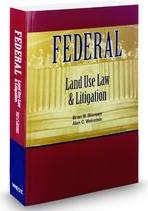
P13513986-160025L I’ve just received my copy of the 2010 revision of Federal Land Use Law & Litigation by Brian W. Blaesser and Alan C. Weinstein (West, $225).

Here’s the description of the book from West’s site:

Examines all federal, constitutional, and statutory limitations on local land use controls, discussing cases, regulations, liability, defense strategies, doctrines, and antitrust restrictions. Comprehensively reviews Supreme Court and lower federal court decisions that consider the constitutionality of land use regulations. Discusses complicated free speech issues affected by federal land use law, and municipalities exercising home rule powers. Examines issues such as: constitutional and statutory limits, First Amendment limitations on land use controls, federal remedies and attorney’s fees, liability and immunity issues, litigation guidelines, zoning, subdivision controls, growth management, model complaints, and selected constitutional and statutory decisions.

Federal Land Use Law & Litigation is an eminently useful single-volume research and reference guide. It’s well-organized, and although it

Continue Reading Book Review: Federal Land Use Law and Litigation, 2010 edition

Here are items we’re reading today, in no particular order:

  • Bill Ward’s thoughts on Klumpp v. City of Avalon, the recent New Jersey Supreme Court case about inverse condemnation and beach restoration. Our take here.


Continue Reading Wednesday Potpourri: Inverse Condemnation And Beaches, Rail Takings, And More “Adult-Oriented” Land Use