


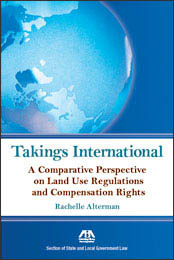
5330205_big My ABA State & Local Government Law colleague Andy Gowder has posted on his blog Grounded, a report and summary of the recent Miami panel discussion of Takings International: A Comparative Perspective on Land Use Regulations and Compensation Rights (Mar. 2010; $95 regular price; $75 for SLG members). 

Takings International is a comparative study of how 13 jurisdictions worldwide treat what we in the U.S. call “regulatory takings.” Visit this page for the Table of Contents and a pdf of Chapter I (scroll to the bottom of the page). Our book review is here.

I concur with Andy’s assessment that it was a fascinating and informative session (and I disclaim any bias resulting from the fact I served as moderator).

The panelists highlighted the issues discussed in the book, and Andy reports:

Professor Alterman began her remarks by pointing out that though no other country comes close to
Continue Reading “Takings International” Panel Report

Yesterday, we filed this motion for leave to file brief amicus curiae and a copy of the proposed brief in support of the application for writ of certiorari which asks the Hawaii Supreme Court to review the decision of the Intermediate Court of Appeals in Maunalua Bay Beach Ohana 28 v. State of Hawaii, 122 Haw. 34, 222 P.3d 441 (Haw. Ct. App. 2009).

In Maunalua Bay, the ICA held that “Act 73” (codifed here and here) was a taking. In the Act, the legislature declared that title to shoreline land naturally accreted cannot be registered by anyone except the State, and that only the State could quiet title to accreted land.

The ICA, however, held that the Act was a taking only of existing accreted land, but was not a taking of what the ICA called “future accretions.” The court held that because “future” accretion might

Continue Reading Amicus Brief In Hawaii Beach Taking Case: “Future” Accretion Is A Present Property Interest

The property owners have filed an application for a writ of certiorari asking the Hawaii Supreme Court to review the decision of the Intermediate Court of Appeals in Maunalua Bay Beach Ohana 28 v. State of Hawaii, 122 Haw. 34, 222 P.3d 441 (Haw. Ct. App. 2009).

Disclosure: we filed an amicus brief supporting the property owners in the ICA, available here, and will be submitting a motion for leave to file an amicus brief urging the Supreme Court to accept the application for cert.

In its opinion, the ICA held that “Act 73” (codifed here and here) was a taking. In the Act, the legislature declared that title to shoreline land naturally accreted cannot be registered by anyone except the State, and that only the State could quiet title to accreted land. The ICA held that the Act was a taking of existing accreted land, but

Continue Reading Cert Application In Hawaii Beach Taking Case: Legislative Reassignment To The State Of The Right To Future Accretion Is A Taking

At its upcoming April 30, 2010 conference, the U.S. Supreme Court is considering the cert petition in a case we’ve been following since it was decided by the Court of Federal Claims. In Palmyra Pacific Seafoods, L.L.C. v. United States, No. 09-766 (cert. petition filed Dec. 28, 2009), the Court is presented with the following Questions Presented:

1.  Are private contracts property protected by the Takings Clause of the Fifth Amendment to the Constitution?

2.  Assuming that private contracts are property protected by the Takings Clause, is the federal government liable for regulatory as well as appropriative takings of private contracts?

The CFC and the Federal Circuit both rejected the claim that the Secretary of the Interior’s designation of the waters surrounding Palmyra and Kingman Reef as National Wildlife Refuges and attendant commercial fishing ban was a taking of Palmyra Pacific Seafood’s exclusive licenses to operate commercial fish processing

Continue Reading Was Ban On Palmyra Commercial Fishing A Taking Of The Right To Operate Seafood Processing Facilities?

A new opinion from the Indiana Supreme Court that reminds us somewhat of the “bizarre condemnation” case now awaiting decision in the New Jersey Supreme Court. In Murray v. City of Lawrenceburg, No. 15S04-0907-CV-310 (Apr. 20, 2010), the court held the claims of a property owner who asserted that the government wrongly occupied her land and leased it to another are subject to Indiana’s six year statute of limitations for inverse condemnation claims. 

Update: here’s another summary of the opinion from the Indiana Lawyer Daily.

The plaintiffs alleged they owned a 3/4 acre parcel in Lawrenceberg. In 1995, however, the Central Railroad Company gave the city an affidavit that it owned the property, and quitclaimed its interest to the city. The city then leased it to a casino. In 2005, the plaintiffs filed a lawsuit seeking to quiet title in the parcel to themselves, and

Continue Reading Indiana Supreme Court: Inverse Condemnation Remedy Exclusive When Government Seizes Land Without Condemnation

To paraphrase comedian Jeff Foxworthy, if you understand the title of this post…you might be a regulatory takings lawyer.

And when you hear the terms “RookerFeldman” and “San Remo,” you know you are knee deep in the often-bizarre procedural maze where a regulatory takings claim in federal court may be too early (ripeness), too late (preclusion and full faith and credit), or completely barred (RookerFeldman).

The RookerFeldman doctrine posits that federal district courts do not have jurisdiction to review the decisions of state supreme courts, where it is alleged that the state court’s judgment itself violates the plaintiff’s federal rights. San Remo Hotel, L.P. v. City and County of San Francisco, 545 U.S. 323 (2005) is the Supreme Court’s most recent “ripeness” decision, affirming that property owners do not have to bring their federal takings claims

Continue Reading 8th Circuit: Rooker-Feldman Not Applicable, But Federal Claims Precluded Under San Remo

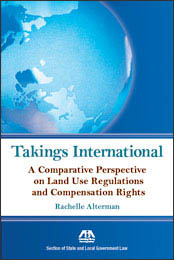
5330205_big I’ve finally had a chance to peruse the recently-published book Takings International: A Comparative Perspective on Land Use Regulations and Compensation Rights (ABA Section of State and Local Government Law 2010; $95 regular price; $75 for SLG members).

Takings International is about how 13 jurisdictions worldwide treat what we in the U.S. call “regulatory takings.” For those of us who have a keen interest in this area of law, this book is a goldmine of information about how the rest of the world deals with the issue. For those who may not be quite as interested, it is still a fascinating survey of how others treats the modern regulatory state’s impact on private property.

The book is headlined by Professor Rachelle Alterman (Technion-Israel Institute of Technology), and contains chapters authored by other experts on regulatory takings. It is divided up into several sections. In Part I, Professor Alterman provides an


Continue Reading Book Review: Takings International: A Comparative Perspective on Land Use Regulations and Compensation Rights

File this one in the obvious category. In Brown v. City of Pocatello, No. 35992 (Apr. 1, 2010), the Idaho Supreme Court held that a property owner’s complaint that her home was flooded as a result of roadwork by the city did not properly plead a cause of action for inverse condemnation.

Generally, if the government causes a physical invasion by water of property, it can be liable for compensation and damages on an inverse condemnation theory. The property owner’s complaint, however, asserted only a negligence claim against the city. Only after the city sought summary judgment did the property owner claim that the complaint also contained nuisance and inverse condemnation causes of action.

The Idaho Supreme Court held that even under its very loose “notice pleading” standards, a complaint which only identifies “negligence” as the theory of liability does not sufficiently put the defendant on notice of other claims against it. To make the point that neither nuisance nor inverse condemnation theories were raised, the court quoted the entire complaint on pages 6-8 of the slip opinion. While a complaint need not formally identify the theories of relief the court held, “the opposing party must be provided with notice of the underlying theories being pursued against them in order to adequately prepare for trial.” Slip op. at 8.

True enough, and in these situations the remedy would seem to be to allow for amendment of the complaint. The only question we have is why the plaintiff didn’t seek to do so. The opinion indicated that doing so might have made the failure to adequately plead a inverse condemnation cause of action harmless:

This Court also notes that when the decision was made to raise the issues of inverse condemnation and nuisance it would have been prudent to prepare an amended complaint alleging those causes of action and then seek permission to file that amended complaint. We express no opinion as to whether those claims have merit under the facts of this case, nor whether they would avoid the planning and design immunity provided by I.C. § 6-904(7), but at least those issues would have been preserved.

Slip op. at 11.
Continue Reading When Pleading An Inverse Condemnation Cause Of Action, You Should Probably Use The Term “Inverse Condemnation”

When one lawyer writes that another is “my friend and colleague,” watch out: what follows may not be exactly friendly or collegial. For legal academics, the rule is even more pronounced when the friend-and-colleague’s name shows up in the title of an article.

In that vein, we bring you the latest chapter in the ongoing debate about “background principles” in regulatory takings analysis. In Background Principles, Takings, and Libertarian Property: A Response to Professor Huffman (posted on SSRN here), lawprofs Michael C. Blumm and J.B. Ruhl respond to Professor James Huffman’s critique of their work.

A short refresher. The “background principles” issue was spawned by Lucas v. South Carolina Coastal Commission, 505 U.S. 1003 (1995), the case in which the Court held that a regulation takes property when it deprives a property owner of “economically beneficial or productive use of land,” even if the government’s reasons for enacting

Continue Reading Be Careful Of Lawprofs Bearing Praise: Another Chapter In The “Background Principles” Debate