The “Flint water crisis,” which, as the opinion of the Michigan Court of Appeals in Gulla v. State of Michigan, No. 340017 (Jan. 24, 2019), noted, is “the contamination of
plaintiffs’ water supply and their exposure to toxic and hazardous substances,” is all over the front pages. Which means it also spawned lawsuits.

The plaintiffs raised several claims across several cases, alleging (among other claims) inverse condemnation. In one series of cases, the defendants sought dismissal, arguing that the facts as alleged would not support takings liability. In the other, the court denied the defendants summary judgment. The court of appeals consolidated the appeals.

This is an unpublished opinion, so there’s not a whole lot of controversy or deep analysis by the court. But it is still worth reading because the court considered (and rejected) the defendants’ immunity argument. And the opinion gives a good rundown of Michigan takings

Continue Reading Mich App: Flint Water Plaintiffs Stated An Inverse Condemnation Claim
With the opinion in the Knick v. Township of Scott case to drop as soon as Tuesday (we’re guessing the opinion will be by Chief Justice Roberts, by the way), hold on. We’re about to get super nerdy here. Impossibly nerdy. Yes, we’re revisiting the Star Trek analogies. We’ve been down this road before, even going so far as to have a colleague (who is perhaps even further down the rabbit hole than we are) present a takings CLE in his Starfleet uniform

The bottom line is this (and if you are not into Trek, you can stop right here): to us the key question which the Court is grappling with is whether a state’s judiciary is part of the state’s compensation system. If the majority of the justices conclude that it is, then don’t expect an out-and-out overruling of Williamson County, only a modest trim

Continue Reading Shaka, When The Walls Fell: Knick Is Going To Be About Federalism, Not Takings

Psweather

If you didn’t register to attend the 36th Annual ALI-CLE Eminent Domain and Land Valuation Litigation Conference later this week in Palm Springs, California, well then, shame on you!

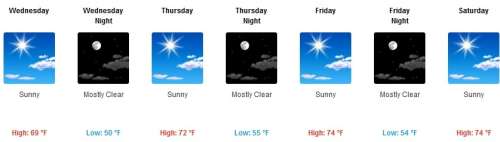
According to the National Weather Service, while you and the rest of the country is freezing, we’ll be enjoying the balmy desert climes, and discussing the topics we love: eminent domain, redevelopment, relocation, regulatory takings, trial and appeal strategies, doctrinal changes on the horizon, hot topics (border wall, pipelines, wildfires, and flooding), and others. 

Featuring a national faculty (many new to the ALI-CLE dais), and attendees from the entire spectrum of practice, academia, and the bench. 

If you are not joining us, be sure to follow along on the blog (we will post updates daily), and on Twitter (@invcondemnation, @ALI_CLE #EminentDomain2019). And plan on joining us in 2020, when we’ll be in a new city (by

Continue Reading ALI-CLE Palm Springs (72º, Sunny) Here We Come

Pay special attention to Justice Breyer’s questioning of Ms. Knick’s counsel, Dave Breemer. Yes, oral argument is the Court’s time to do with as it wishes, but was Justice Breyer actually trying to get at anything, or just running out the clock with a questions that didn’t seem to have any point. Does he really think that lawyers for municipal governments actually have the type of conversations that he was alluding to? Really? 

Also, if you can’t stream the above, go to the Supreme Court’s audio page for the Knick case and download the sound file directly.  Continue Reading Knick Oral (Re)Argument Recording Available

There’s been a lot written after the Supreme Court heard (re)arguments earlier this week in Knick v. Township of Scott, No. 17-647, most of it helpful in understanding what issues the Justices are considering, and how each of them might break on the ultimate question: should Williamson County be overruled, and should property owners who allege that a local government has taken their property be able to press their claim for just compensation in a federal court? 

Here’s what we’re reading on the subject:


Continue Reading Knick Post-Argument Round Up

CERTDENIED

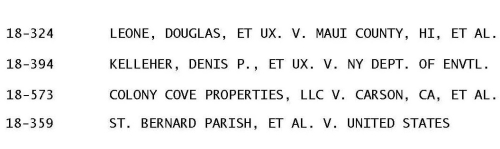
In case you have been following along, you can take these four cases off your watch list:

  • Leone: Hawaii Supreme Court concluded that holding property that has no present use in the hope that someday in the future the government might rescind the use-restrictive regulation, is “investment use,” and therefore no taking. 
  • Kelleher: Palazzolo revisited – if the owner purchased the property with the allegedly restrictive regulation already in place, does the owner lack investment-backed expectations of use? 
  • Colony Cove: Ninth Circuit voided a jury verdict in a Penn Central takings case in favor of the property owner, concluding that mere cash losses (even though the loss was millions of dollars) was not enough to support the verdict, because the overall value of the property didn’t decline substantially. 
  • St. Bernard Parish: The MR-GO case. The Federal Circuit concluded the Government cannot be liable for a taking


Continue Reading Cert Denied, Denied, Denied, Denied In Reg Takings Cases

Don’t Miss the 2019 Eminent Domain Litigation Conference from American Law Institute CLE on Vimeo.

Check out this sound blurb, produced by the good media folks at ALI-CLE, about the upcoming Eminent Domain and Land Valuation Litigation Conference. (And no, we didn’t record this in a jazz club; although I wish we had.)

There’s still time to register, and come and join us in Palm Springs. Continue Reading Hot (Eminent Domain) Topics, Cool Jazz

0116190650b_HDR

As Professor Gideon Kanner likes to remind us, eminent domain has been characterized as “the dark corner of the law.” We thought back to that phrase when we joined the queue outside of the Supreme Court this very dark (and very cold) morning, for the rehearing in the Knick v. Township of Scott case, this time with a full Court (Justice RBG was not present in the courtroom today, but will take part in the case).  

We soon got in the building, got warm, and got seated along with fellow takings geeks and the general public. 

We’ll have a detailed write-up once the written transcript is released, but for now, here are our initial thoughts. 

  • It was pretty clear right from the outset that the months intervening between October’s argument and now — and the various supplemental briefs and replies that have been filed — have not cleared things


Continue Reading Knick Argument Redux: Dark Corners, And A Lack Of Clear Consensus (Chief Justice Remains The Lynchpin)

It wasn’t going to be too hard to figure out what the U.S. Court of Appeals for the Sixth Circuit was going to do in Lumbard v. City of Ann Arbor, No. 18-1258 (Jan. 10, 2018). After all, the case involved a federal takings claim in federal court, which the district court dismissed because the plaintiff had already litigated her state takings claims in state court.

Yes, the plaintiff tried to make an England reservation in the earlier state court litigation to inform everyone that she was expressly not also litigating her federal takings claim. But ever since San Remo, you know what that means: diddly squat. Later, when the plaintiff came to federal court and asserted her federal takings claim, that court concluded full faith and credit, blah blah blah. 

The Sixth Circuit in just a few more words, affirmed. A short opinion (7 pages) with nothing

Continue Reading SCOTUS Shortlister Judge Kethledge Has Read The Knick Briefs: “[T]he Takings Clause does not say that private property shall not ‘be taken for public use, without just compensation, and without a remedy in state court.’”