Earlier this week, we spoke to Howard Mansfield, author of the recently-published book “The Habit of Turning the World Upside Down – Our Belief in Property and the Cost of That Belief.”

His book is about property, property rights, and how these ideas are processed by the American psyche. But instead of the usual scholarly (and very often dry) treatment of these topics that we might expect – especially those of us in the legal and academic world – Mr. Mansfield takes a slightly different approach. He relates stories of how property fits in with the culture – the different and often competing narratives that are attached to the notion of property – and the often-contradictory way in which we in the United States view the idea of ownership and possession.

Listen to our interview above (Sound Cloud stream), or if that does not work for you
Continue Reading Audio: Our Interview With Author Howard Mansfield – “The Habit of Turning The World Upside Down – Our Belief in Property and the Cost of That Belief”

Here’s the Petition for Review we’ve been waiting to drop since last week’s ruling by a California Court of Appeal declining to review the California PUC’s decision to turn down the electric company’s request for a rate increase to cover the compensation and damages that it must pay as the result of a southern California wildfire. 

Recall that under California law, a utility company with the power of eminent domain (such as San Diego Gas & Electric) can be liable under an inverse condemnation theory if it can be shown that “any actual physical injury to real property” was “proximately caused by [a public] improvement as deliberately designed and constructed” by the utilty, whether or not foreseeable.

Two California intermediate appellate courts have applied that general rule to wildfires, even though that state’s Supreme Court has not.

The petition argues that the two court of appeal opinions turn on the

Continue Reading Electric Company: We Can’t Be Liable For Inverse Condemnation For Cal Wildfires Unless We Can “Unilaterally Recoup Costs From The Benefited Public Through Taxation Or Rate Increases”

Reading the fact section of the Federal Circuit’s recent opinion in Katzin v. United States, No. 16-2636 (Nov. 19, 2018), will make your eyes glaze over. It’s all about some property on an island near Puerto Rico, and is full of maps, diagrams, history, and even a photo of some “Keep Out” signs the feds erected. Important, but for someone who isn’t involved in the case, somewhat of a slog to get through.

Give it a read and see if you don’t agree.

But here’s the short story: both the plaintiffs and the feds think they own the land, a ten-acre parcel whose most prominent feature is an old gun emplacement. The Court of Federal Claims after a trial concluded that the plaintiffs owned the property, and that it had been physically taken when a federal official sent a fax to a prospective purchaser claiming that the feds, not

Continue Reading Fed Cir: Feds Claiming Ownership Of Property And Killing The Market Isn’t A Physical Taking, The Statute Of Quia Emptores Notwithstanding

Get ready. In this and upcoming posts, we’re going to be featuring the items on our agenda for the upcoming ALI-CLE Eminent Domain and Land Valuation Litigation Conference, January 24-26, 2019, in sunny Palm Springs, California. 

ALI-CLE has released the brochure, which those of you on the mailing list should have received — or will be receiving — in your brick-and-mortar inboxes. If not, download it here. Looking it over, you will see that we have assembled a great faculty with expertise in the range of issues that are driving our branch of the law, locally and nationally.

And, as always, one of the best aspects of this conference is the collegiality. Our attendees and faculty find that one of the most beneficial parts of the conference is to meet your colleagues from across the country, and talk shop about the issues we love.  

Of course we

Continue Reading ALI-CLE Eminent Domain And Land Valuation Litigation Palm Springs Brochure Is Out

In the middle of the terrible news from the latest wildfires to hit California comes this order from the California Court of Appeal, Fourth District, declining to issue a writ to review the California Public Utilities Commission’s rejection of SDG&E’s request for a rate increase to cover the costs of settling inverse condemnation claims stemming from the Witch Fire

The order is really short and you can read it yourself in its entirety, so we will only say that the court concluded that the PUC didn’t stray outside of its delegated authority and discretion when it turned down SDG&E’s rate request. The court also made it a point to note that the utility settled the inverse cases and not litigate and “continue to advance its position that it could not be held strictly liable as a nongovernmental entity.” Order at 2.

Recall that the ability (or not) to recoup

Continue Reading Cal Appeals Court Rejects Utility’s Petition To Review PUC’s Denial Of Wildfire Inverse Condemnation Rate Increase – Hard Questions Remain

Retroactive continuity — or “retconning” — is, according to that authoritative source Wikipedia, a “literary device in which established facts in a fictional work are adjusted, ignored, or contradicted by a subsequently published work which breaks continuity.”

For example, compare the real-world explanation for why the 1960’s Star Trek show’s Klingons didn’t have butt heads, but the later-produced shows and movies did. The real-world reason was that the TV show had a bare-bones budget, so couldn’t afford the required intricate make-up. The later-produced stuff, having larger budgets, could. But to those concerned with an in-universe explanation that had to line up with the production realities, it turned out to be a big source of contention. Fandom as well as the later shows’ writers struggled to come up with a narrative that accounted for both Klingons with butt heads, and those without

Sorry for the impossibly nerdy

Continue Reading Knick And Klingon Foreheads: Retconning Williamson County

Knickrehearing

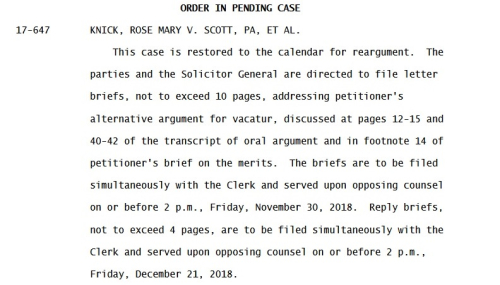
As we guessed immediately after arguments, today in this order the Supreme Court has set the Knick v. Township of Scott case for supplemental briefing, and reargument. 

Here’s the full text of the order:

This case is restored to the calendar for reargument. The parties and the Solicitor General are directed to file letter briefs, not to exceed 10 pages, addressing petitioner’s alternative argument for vacatur, discussed at pages 12-15 and 40-42 of the transcript of oral argument and in footnote 14 of petitioner’s brief on the merits. The briefs are to be filed simultaneously with the Clerk and served upon opposing counsel on or before 2 p.m., Friday, November 30, 2018. Reply briefs, not to exceed 4 pages, are to be filed simultaneously with the Clerk and served upon opposing counsel on or before 2 p.m., Friday, December 21, 2018.

This tells us that there was no clear

Continue Reading More Knick Briefing, Reargument

MRGO

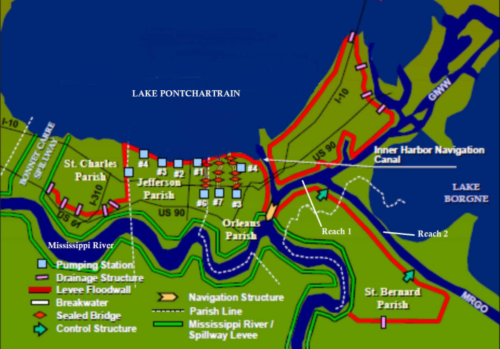
Here’s the amici brief filed late last week on behalf of a lot of us (me included, check it out) in the MR-GO case we’ve been following closely ever since it was filed in the Court of Federal Claims.

That court concluded the Corps of Engineers built MR-GO (the Mississippi River-Gulf Outlet) shipping channel, essentially a shortcut to New Orleans from the Gulf of Mexico, but then, despite its own knowledge that its lack of channel maintenance over the years would amplify the “hurricane attack” (the Corps’ words, not ours) when the next big one hit, the Corps did not respond. Well, as we all know, Katrina smashed the Gulf Coast in 2005, and sure enough, MR-GO was like a hurricane bowling alley, allowing the storm surge to barrel up the channel, amplifying its effect. New Orleans’ Ninth Ward and St. Bernard Parish were the pins at the end of

Continue Reading Amici Brief: There’s No “Direct” vs. “Indirect,” Action vs. Inaction Distinction In Takings

Would you pay, say $10 for an undeveloped Maui beachfront parcel that is zoned for hotel and residential purposes, but currently is not developable because the County in the past wanted to condemn the land and turn it into a public park (but then ran out of money)?

In furtherance of its acquisition plan, the County changed the parcel’s Community Plan (known as a “general plan” in most jurisdictions) designation to “park.” But it never amended the Hotel zoning, which allows lesser intensive uses such as single-family homes. But then the County didn’t have enough money — beachfront property, it turns out, was (and is) a lot more spendy than the government appraisers thought — so it never actually acquired the land. But having downplanned the parcel in order to take it, it never bothered uplanning it when it couldn’t: the County never reverted the CP designation to its former

Continue Reading New Amicus Brief In SCOTUS Hawaii Case: Takings Is About Denial Of *Use* Not Whether Property Has Value