


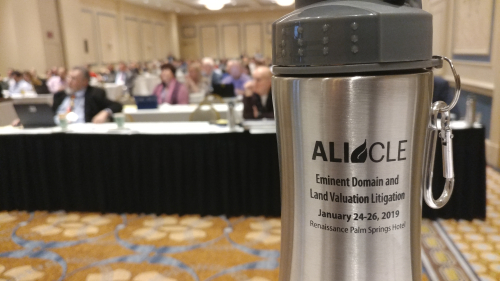
20180126_111558_HDR

You’ve known for a while that Palm Springs, California, specifically the Renaissance Palm Springs Hotel (a resort facility, but right in town, so you will have many options for “off campus” activities like art museums, the aerial tram, golf, and whatever suits your fancy, and close-in to the Palm Springs Airport), is the venue for our 2019 ALI-CLE Eminent Domain and Land Valuation Litigation, January 24 through 26, 2019.

Of course, you also knew that the programming would be the usual spread of topical and cutting-edge topics, presented by some of the nation’s experts. But we didn’t give you the details. So here are some of the programs we’re having: 

  • Keynote Address: “Property Rights: Foundation for a Free Society” – Taylor Revley, most recently the past President of the College of William and Mary, and also former law school Dean (as well as a
Continue Reading ALI-CLE 2019 Eminent Domain And Land Valuation Litigation Conference, Palm Springs Agenda – Register Now!

A quick one today because we’re offline (more on that later). Pacific Legal Foundation (the folks who are representing the property owner in the pending case challenging the continuing viability of the Williamson County ripeness doctrine), has posted this entry on their blog, “This monkey got his day in court. Property owners still can’t.”

The post focuses on the brief we filed in the case on behalf of the Citizens’ Alliance for Property Rights Legal Fund, which notes the disparity between a monkey having standing to bring a suit in federal court to protect its (alleged) (intellectual) property rights, but human property owners like Ms. Knick having no right to do the same when asserting her plain old property rights. 

Our brief didn’t focus on the monkey background, so here it is:

In 2011, nature photographer David Slater set up camera equipment for a group of wild

Continue Reading Monkey Selfies And Takings Ripeness

Back in April, we posted the Florida District Court of Appeal’s opinion in a case where landowners sued the state fish and wildlife commission because “deer dog hunters and their dogs” who had hunting licenses trespassed on the plaintiffs’ lands. The court, over a single judge dissent, affirmed the dismissal of the takings claims, because the physical invasions by the hunters and their dogs were not caused by the commission. 

The property owners sought rehearing, and although the majority revisited and revised the opinion, it didn’t change the outcome, which stayed the same. In Florida Fish and Wildlife Conservation Comm’n v. Daws, No. 1D16-4839 (Aug. 16, 2018), the court amended the majority opinion to clarify its takings analysis. 

We won’t go into a page-by-page redline (for a direct comparison of the two opinions, go here), but the opinion’s biggest change was a section in which the majority

Continue Reading Fla App: Takings Dog Still Doesn’t Hunt

Appeals from motions to dismiss can be very unsatisfying, even for the winner. Granted, from a doctrinal standpoint, they’re pretty good at clarifying the law. And from a practice standpoint, the courts’ opinions often help future lawyers and litigants figure out how to plead cases, and frame issues. And the party who wins the appeal can justifiably take back a trophy, often in the form of a published opinion. 

But for both the winning and losing litigant, an appeal from a dismissal without prejudice can get them nowhere fast (and in most cases, not for free). Because all that gets the parties in many cases is a do-over.   

The Federal Circuit’s opinion in Crow Creek Sioux Tribe v. United States, No. 17-2340 (Aug. 17, 2018) doesn’t contradict that sense. There, the court affirmed the dismissal by the Court of Federal Claims of the Crow Creek Sioux Tribe’s claim

Continue Reading Fed Circuit: Tribe’s Claim For Taking Its Water Rights Didn’t Allege Injury

Challenging an ordinance that the court characterizes as an “even-handed” zoning regulation, even if it outlaws an existing conditional use, is going to be a tough one for a plaintiff. In theory, it need not be, given the right conditions. But any zoning lawyer will tell you that it is tough to overcome most courts’ presumption that these things are ok. That’s just the way it is. 

The Minnesota Court of Appeals’ opinion in Minnesota Sands, LLC v. County of Winona, No. A18-0090 (July 30, 3018), confirms that vibe. There, the county adopted an ordinance that banned all “industrial-mineral mining, including silica-sand mining.” Slip op. at 1. If that sounds oddly specific, the backstory is that this is the stuff used in fracking. 

Mr. Frick (and here you might think we’d try to work in both “Frick” and “frack” into this post’s title) owned leases to mine silica-sand on

Continue Reading Ordinance Banning Industrial Mineral Mining Not A Regulatory Taking – But What About Palazzolo?

No surprises in the U.S. Court of Appeals for the Eleventh Circuit’s opinion in Checker Cab Operators, Inc. v. Miami-Dade County, No. 17-11955 (Aug. 6, 2018). As the caption suggests, this is another one of those takings claims brought by “traditional” taxicab operators against a local government for its refusal to keep ridesharing services from the market. 

As in other cases (see our article summarizing several of them here), the court came down on the side of “no taking.” The rationale was that owning a government-issued taxicab medallion, while “property,” does not give the holder a property right to exclude others because the point of the medallion system was to protect consumers, not to give the taxis a monopoly:

Moreover, the main purpose behind the County’s medallion policy was not to enrich medallion holders, but rather to enhance consumer welfare. The County sought to “license and regulate

Continue Reading 11th Cir: No Uber Taking – Taxi Medallion Does Not Give Right To Exclude Others From Transportation Marketplace

Doesnotsimply

We already knew from its amicus brief brief that the federal government supported the property owner in Knick v. Township of Scott, No. 17-647, the case in which the US. Supreme Court agreed to review the continuing validity of the “state procedures” rule of Williamson County Regional Planning Comm’n v. Hamilton Bank, 473 U.S. 172 (1985). The SG’s brief called for the Court to vacate and remand the dismissal of Knick’s case. We also filed an amicus brief in support of Ms. Knick

But recently, the feds have doubled down by filing a motion to participate in oral argument and to split time with the Petitioner, which notes:

The United States has filed a brief as amicus curiae supporting vacatur and remand. The brief argues that Williamson County correctly recognized that the Fifth Amendment does not “require that just compensation be paid in advance of, or

Continue Reading Federal Govt: Reject Williamson County! Property Owners Whose Property Is Taken By Local Governments Should Be Able To Enforce Fifth Amendment Rights In A Federal Forum

Clare Trapasso has a Realtor.com piece on what a Justice Kavanaugh could mean for real estate, property, and land use issues, “What Supreme Court Nominee Brett Kavanaugh Could Mean for Real Estate,” where she correctly notes that “while commentators have been scrutinizing Kavanaugh’s record on hot-button topics like abortion and immigration, there’s been little discussion of what a more conservative court could mean for home buyers, sellers, and owners.”

She asked us for input, and here’s what we said:

“The Supreme Court has done some very interesting things on land use law that affect homeowners,” says Robert Thomas, a real estate attorney specializing in land use and eminent domain at the Honolulu-based law firm of Damon Key Leong Kupchak Hastert.

Thomas expects more property-related cases will make their way to the Supreme Court, brought by people hoping that the new bench will increase their odds of a

Continue Reading What Might A Justice Kavanaugh Mean For Takings, Land Use, And Other Issues?

The City’s sewage pipe backed up into several residences. The City has known for decades that these pipes were “cracked, structurally unsound, and that they had significant root intrusion.” The City took measures, but apparently these were not enough, and after “an extremely intense rain and hail storm,” three million gallons of wastewater overflowed into adjacent streams, and backed up into the plaintiffs’ basements. 

They sued the City for negligence, trespass, and for physical takings. 

In Lorman v. City of Rutland, No. 17-158 (June 29, 2018), the court affirmed the dismissal of all of the claims. Slip to page 20 of the slip opinion for the takings analysis, where the court starts off by noting that the takings tests under the U.S. and Vermont Constitutions are “virtually the same,” and (unlike torts) the government is not immune. Slip op. at 20. For a loss of property to be compensable

Continue Reading Vermont: Sewage Backup Wasn’t Permanent, Therefore No Taking

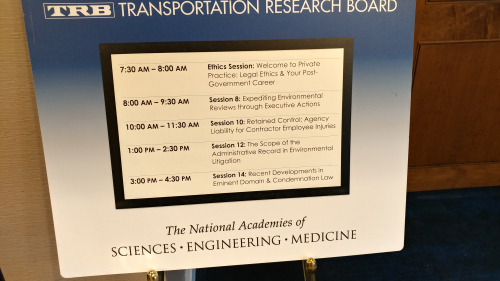
20180717_135234_HDR

Here are the cases and other items I either spoke about or mentioned at today’s Transportation Research Board‘s 57th Annual Workshop on Transportation Law in Cambridge, Massachusetts:


Continue Reading Links And Materials From Today’s Transportation Research Board Session