Here’s the cert petition, recently filed in a case we’ve been following from South Dakota

The statute at issue — the federal Uniform Relocation Assistance and Real Property Acquisition Act — isn’t one that gets a lot of attention, particularly at the Supreme Court. But it’s an area that is ripe for review. The issue in the case is whether a state may deny a property owner recovery of attorneys’ fees for a successful inverse condemnation claim resulting from a federally-funded SDDOT highway project.   

Here’s the Question Presented:

Congress, in 1970, established a uniform policy for compensation of legal costs as the result of unconstitutional takings of real estate. Congress required all federal agencies to pay a successful Plaintiff ’s legal costs when a citizen’s constitutional property rights were vindicated in an inverse condemnation action.

South Dakota refuses to comply with the policy Congress established. This Petition requests
Continue Reading New Cert Petition: Are The Relocation Act’s Attorneys’ Fee Provisions Merely Guidelines?

2018 LUI header Detroit-1

Mark your calendars, plan to come: Detroit, April 19-20, 2018. For what is perhaps the best deal in CLE (tuition as low as $400), the 32d Annual Land Use Institute, sponsored by our section of the ABA, the Section of State and Local Government Law.

The venue is the Detroit Mercy School of Law, and the conference hotel is the historic Westin Book Cadillac in downtown Detroit. The Land Use Institute is being held in conjunction with the Section’s Spring State and Local Law Conference. Register for one conference, and you are free to move between sessions (no additional registration fees).

Planning Chairs Frank Schnidman and Dean Patrica Salkin have assembled an excellent faculty and program for the two days. Topics include: “Nuts and Bolts of Land Use Practice: Vested Rights and Regulatory Takings,” “Public-Private Partnerships,” “Climate Change and Resilient Development,” “Client

Continue Reading 32nd Annual Land Use Institute: Detroit, April 19-20, 2018

Here’s the latest in a case we’ve been following since its inception, Brott v. United States, the case which asks the deceptively simple question of whether property owners who sue the federal government for a taking are entitled to both an Article III forum, and to have the issues determined by a jury.

The District court said no, as did the Sixth Circuit. The property owners’ cert petition asks this question:

Can the federal government take private property and deny the owner the ability to vindicate his constitutional right to be justly compensated in an Article III Court with trial by jury?

We filed an amicus brief in support, arguing that the “self-executing” nature of the Just Compensation Clause means that yes, property owner, you can bring a lawsuit for compensation if the government has taken your property: 

The government does not enjoy its usual sovereign

Continue Reading US BIO In Brott: No, The Fifth Amendment Isn’t Really “Self-Executing”

Here’s the cert petition, filed today by SCOTUS superstar Paul Clement in a case we’ve been following out of Northern California.

Here are the Questions Presented:

This case involves a stretch of private property along the California coast known as Martins Beach. The California Coastal Commission and the County of San Mateo want Martins Beach to be open to the public, but they do not want to pay to purchase the property, or even for an easement. Instead, they have taken the position that the owner of the property cannot exclude the public unless it first obtains a permit deemed necessary for any change, including a decrease, in the “intensity” of the public’s use of or access to the ocean under the California Coastal Act. In their view, because the previous owner of Martins Beach chose to allow members of the public to access the property upon payment of

Continue Reading New Cert Petition: Beach Access, Temporary And Permanent Takings, And Permits To Exercise The Right To Exclude

Update: thanks to Daniel Lehmann for keying us in to this case, now being reviewed by the Supreme Court, involving the foundational question of whether title to Equal Footing Doctrine submerged lands is a question of state or federal law. Scheduled for the Court’s 2/16/2018 conference.

* * * *

In our experience, rationality often takes a second chair when delving into the question of who may own various parts of beaches. It’s certainly true in our home jurisdiction, where any claims to private rights anywhere near a beach can be met with howls of protest, regardless of what the law might actually provide in any given circumstance. Trying to unwrap these cases can be an exercise in frustration, and if you don’t understand the background and politics — the “real story” — you can’t really say you understand a decision.

That is what we’re wondering about the

Continue Reading Indiana: Equal Footing Doctrine Means Public Owns Up To The Ordinary High Water Mark

Here is the video of last Friday’s oral arguments in a case we’ve been following, in which the owners of a mobile home park successfully challenged a California municipality’s rent control ordinance as a taking.

In Colony Cover Properties v. City of Carson, a U.S. District Court for the Central District of California jury awarded the park owner just compensation, concluding that under Penn Central, the rent control ordinance was a compensable taking. The total award to the park owner, including damages for lost rental income, attorneys’ fees, and interest, was over $9 million. As far as we can tell, this is the first case in which a mobile home park owner has succeeded in obtaining compensation for a taking for rent control.

Predictably, the city went ballistic, and its brief in the Ninth Circuit argues the City is the aggrieved party:

In April 2006, Plaintiff Colony Cove

Continue Reading Video: Ninth Circuit Penn Central Oral Arguments

In Sierra Palms Homeowners Ass’n v. Metro Gold Line Foothill Extension Const. Auth., No. B275241 (Jan. 29, 2018), a condomimium homeowners’ association sued a municipal transit authority and its private-entity partner, claiming that they built and maintained the Gold Line railway in such a way that it interfered with the association’s quiet enjoyment of their condo. They alleged inverse condemnation. The trial court sustained the demurrer without leave to amend (dismissed the complaint, for you non-Californians) for lack of standing because the homeowners’ association didn’t actually own the condo. 

The Court of Appeal reversed, in part, concluding the association might be able to amend the complaint to show standing. Although the usual rule in inverse cases is that the plaintiff must have an actual ownership interest in the property alleged to be taken, “multidwelling condominium projects present a special concern. Frequently, the common areas of the complex are owned

Continue Reading Cal App: Condo Association Has Standing To Assert Inverse Condemnation Claim

20180127_091506_HDR

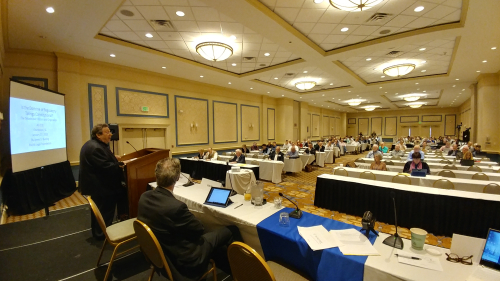
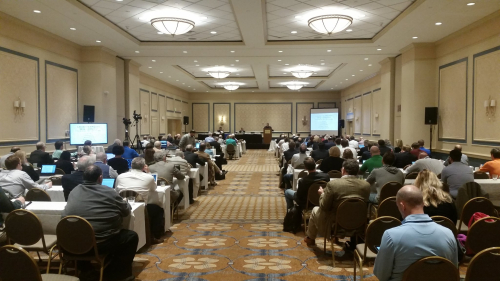
We’re on our third day at the 2018 ALI-CLE Eminent Domain and Land Valuation Conference in Charleston, SC, and as usual, we’re having our headline presentations by takings guru Michael Berger (pictured above), who is updating us on the most interesting and important cases of the past year, and Jim Burling, who will be answering the question, “Should We Rethink Regulatory Takings Law? The Takings Clause, Privileges and Immunities, and Due Process.”

DUjbnOtV4AEgwXW.jpg large

Here are links to the

Continue Reading ALI-CLE Eminent Domain Conference, Third Day: Berger And Burling On Takings

20180126_111558_HDR

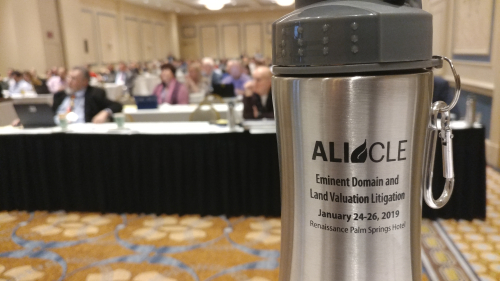
This morning, at the 2018 ALI-CLE Eminent Domain and Land Valuation Litigation Conference in Charleston, South Carolina, we announced the dates and venue for the 2019 Conference: Palm Springs, California.

The conference hotel is the Renaissance Palm Springs Hotel, which has the advantage of being a resort facility, but right in town (so you will have many options for “off campus” activities like art museums, the aerial tram, golf, and whatever suits your fancy). Plus, it’s a short hop from the Palm Springs airport.

This in-person registrations for 2018’s Charleston program sold out, as did our conference hotel, so for 2019 we chose a location and hotel which can accommodate the growth of the conference. But one of the lessons learned from this year’s conference is that you should hold the dates on your calendar now, and when ALI-CLE releases the registration page, you should not wait to

Continue Reading 2019 ALI-CLE Eminent Domain & Land Valuation Litigation Conference Venue Announcement: Palm Springs, CA, Jan 24-26, 2019