Update 7/24/2017: Here is our contribution to the article scene.

—————————————–

Someone (I think it was Professor Ilya Somin [update: confirmed – he noted it here]) recently noted that if nothing else, the U.S. Supreme Court’s decision in Murr v. Wisconsin will be a boon for law professors looking for something to fill up law journals. Sidebar: here’s a link to some of the commentary so far on Murr.

And not only for lawprofs, we hope. Their stuff can be useful, but we think there’s a need for those of us in the practicing Bar to contribute as well. We often complain that legal scholarship isn’t of much use to us down in the trenches, so here’s one chance to address that. Stop kvetching and start writing! I’ll do my part, and am currently underway with an article that I anticipate will make three main points:

First

Continue Reading Murr: The Law Review Editors’ Full Employment Act
A very short one from the Connecticut Appellate Court, Santos v. Zoning Board of Appeals, No. AC37281 (July 11, 2017) in a Penn Central-style takings challenge to local land use regulations. We’re going to set out the facts, then let you guess who prevailed.

The plaintiff purchased an unimproved parcel of land in Stratford at a tax sale conducted by the town in May, 2002. The prior owner had owned the property for approximately seventeen years, but had never attempted to develop the property. The town had never formally approved the property as a building lot. In noticing the sale of the property, the town included a warning that the property had not been guaranteed to be buildable under the town’s current zoning regulations. The property was sold to the plaintiff for approximately one half of its assessed value, and the prior owner made no attempt to exercise his

Continue Reading Conn App: Because Owner Can Easily Correct The Problem With Confiscatory Regulation, His Reasonable Expectations Have Not Been Thwarted

ALI 2018 header

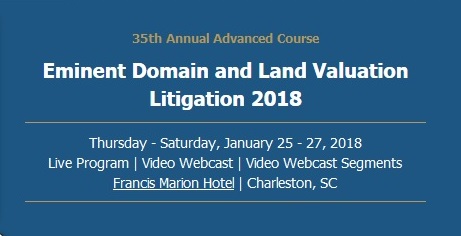
ALI-CLE has posted up the early bird registration page for the 2018 edition of the Eminent Domain and Land Valuation Litigation Conference, to be held January 25-27, 2018 in an exciting new venue, Charleston, South Carolina

We are putting the agenda and faculty together for the Conference (which, as always, will include the Condemnation 101 track for those new to eminent domain practice, or who could use a refresher course). There’s a lot going on in our field, and we will put out the details and ALI will update the site once we finalize everything.  

There’s a benefit to early registration: this year’s conference in San Diego was at capacity, and signing up now will both reserve your spot, and get a discounted registration fee. Continue Reading 2018 ALI-CLE Eminent Domain & Land Valuation Litigation (Charleston, SC) Early-Bird Discount Registration Open

20151204_140514

Now that the dust has settled somewhat, for your weekend reading, here are your links to some of the vast amount of commentary which the Murr v. Wisconsin decision has thus far generated:


Continue Reading Murr Round-Up

The Township of Scott, Pennsylvania, apparently has a problem of unregulated cemeteries. Who knew?

So it did what local government do when they think they have a problem, it passed a law. That law, Ordinance 12-12-20-001, required owners of all cemeteries, public or private, to maintain them. The ordinance also contained two troublesome provisions. First, it requires the owners of the cemeteries to keep them open to the public during the day. Second, it allows the Township’s code inspectors to enter “any property” to inspect and see if it is in compliance with the ordinance.  

Under the authority of the ordinance, a code inspector came on Knick’s property without a warrant, and told her “guess what, these stones are actually grave markers, and you better clean up this cemetery.” Knick’s response was “what cemetery? My land doesn’t have a cemetery on it.” Not buying it, the inspector wrote

Continue Reading Night of the Living Zombie Zoning Inspectors – Ordinance Allowing Searches For Unauthorized Cemeteries “Constitutionally Suspect,” But Not Yet Justiciable

Here are links to the cases and materials we spoke about today during our portions of the APA’s 2017 Planning Law Review webinar:


Continue Reading Cases And Links From Today’s American Planning Association’s 2017 Planning Law Review

SLG-Invitation-Chair-Reception-NYC-8-11-2017

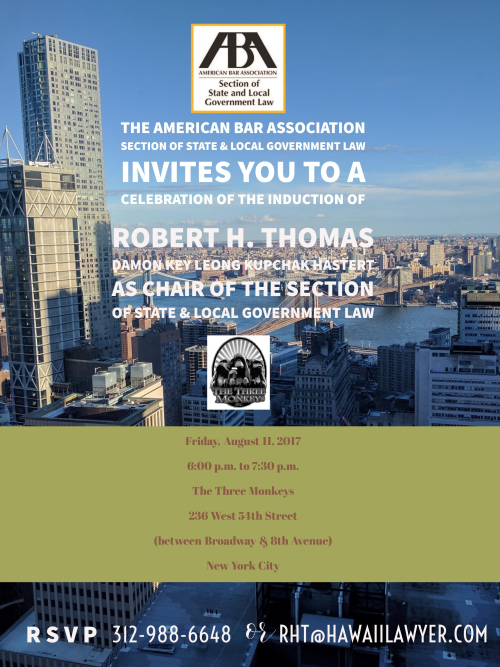
If my colleagues don’t wise up and change their minds before August, I am slated to become Chair of the ABA’s Section of State and Local Government Law (which, by the way, includes an Eminent Domain Committee, Chaired by Howard Roston, and co-Chaired by Kelly Walsh and John Peloso). On Friday, August 11, at the ABA Annual Meeting in New York City, we’ll be having a party to celebrate, and you are invited

Earlier that day, our Section is producing a CLE session about the US Supreme Court’s recent decision in Murr v. Wisconsin, “Murr and Beyond: Implications for Regulatory Takings,” featuring two of the arguing counsel in the case (John Groen (PLF), and Misha Tseytlin (Wisconsin SG), and commentary from me and Nancy Stroud (FL). Judge (ret.) Peter Buschbaum (NJ) is moderating. We’ll not only try and figure out what the majority did in Murr,

Continue Reading Friday, Aug 11, 2017, New York City: Chair-Elect Reception, Unpacking Murr – ABA State & Local Govt Law Section

There’s a lot of buzz about “what’s next” after Murr v. Wisconsin, and what this case may augur for regulatory takings. There are already quite a few discussions and analysis panels scheduled, including these three in which we’re participating:


Continue Reading Your Post-Murr Reading List

Here’s the opinion of the Connecticut Supreme Court in a case we’ve been following, Barton v. City of Norwalk, No. SC 19671 (July 4, 2017). 

As we noted in our earlier post where we detailed the facts, the case involved two non-contiguous parcels, one of which was used for a parking lot which the City later condemned to build a police station. The parking lot had provided parking for the commercial building on the other parcel (the City had required the owner to build the lot, after the City curtailed street parking). In the eminent domain case taking the parking lot, the owner claimed damage to the commercial operation and lot, but the court prohibited evidence of that damage.

So the owner instituted a separate inverse condemnation claim, seeking recovery for damage to the commercial operation and lot caused by the loss of parking across the

Continue Reading The Connecticut Supreme Court “Gets” The Larger Parcel Issue: It’s About Joint Use Of The Two Parcels

If you are within striking distance of Madison next month, consider attending the “Property Rights and Land Use in Wisconsin” symposium at the U. Wisconsin Law School. 

This is a one-day conference, and as you might expect, one of the big focuses of the day will be the U.S. Supreme Court’s decision in Murr v. Wisconsin. The speakers will also cover legislative developments, as well as the Wisconsin Supreme Court’s decision in McKee v. Fitchburg (which reminds us to get this opinion out of our queue and onto the blog, which we will do shortly). 

Register here (a very modest $100 for the entire day). 

Brochure, U. Wisconsin’s “Property Rights and Land Use in Wisconsin” Symposium (July 20, 2017) 

Continue Reading U. Wisconsin Property Rights & Land Use Symposium (July 20, 2017)