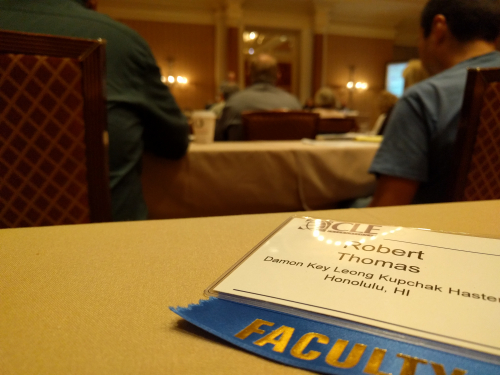
IMG_20160929_102807
During. Good crowd.

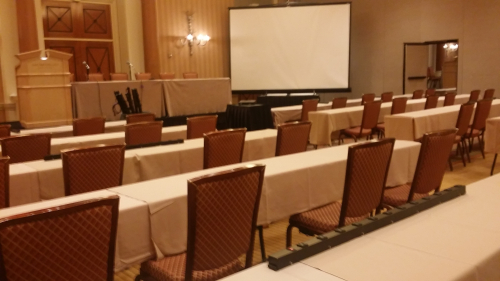
20160929_074511
Before. Note the power strips on the tables.
Well played, Caesar’s, well played
.

To supplement your written materials, here are the decisions and other materials which we spoke about this morning at the CLE International Eminent Domain seminar:


Continue Reading Links And Notes From Today’s Las Vegas Eminent Domain Seminar
The speed of the internet: we were all set to post our thoughts on the opinion of the Court of Appeals of Indiana in Bellwether Properties, LLC v. Duke Energy Indiana, LLC, No. 53A-04-1511-CR-1880 (Sep. 13, 2016), when the Indiana Lawyer beat us to the punch with “COA: Discovery rule applies in inverse condemnation action against Duke Energy.”

We can’t report on this decision any better than they did, so check it out. 

Bellwether Properties, LLC v. Duke Energy Indiana, LLC, No. 53A04-1511-CT-1880 (Ind. App. Sep. 13, 2016)

Continue Reading Indiana App: Statutes Of Limitation And Inverse Condemnation

This one reminds us of a recent decision by the Texas Court of Appeals, because the Mississippi Supreme Court, like the Texas court, concluded that an inverse condemnation plaintiff lacked standing because it didn’t own the property at the time of the taking. Russell Real Property Services, LLC v. Mississippi, No. 2015-CA-01306-SCT (Sep. 15, 2016).

But where the Texas court’s analysis failed to satisfy, we think the Mississippi court’s approach was much more sound.

Russell claimed it owned a half interest in property which the State leased to the City of Pass Christian for use as a harbor and related development, and sued both for inverse condemnation. But Russell had only been quitclaimed its interest from the prior owner after the city and the state had entered into the lease. It claimed the taking occurred when the Secretary of State executed the lease. 

But even applying Mississippi’s “liberal” standing rules

Continue Reading Mississippi: No Ownership At Time Of The Taking = No Standing

A new article worth your time by economist William Wade, “Theory and Misuse of Just Compensation for Income-Producing Property in Federal Courts: A View From Above the Forest,” 46 Tex. Envtl L. J. 139 (2016).

Bill is familiar to regular readers, as he has been a frequent guest poster, and a prolific author. This article is his latest, and focuses on how compensation should be calculated in regulatory takings cases, and contrasts how lawyers view economic losses, and how economists view the same thing (not necessarily the same way). 

We are grateful to the Texas Environmental Law Journal and the Environmental and Natural Resources Section of the Texas State Bar for their permission to post the article. Continue Reading New Article: “Theory and Misuse of Just Compensation for Income-Producing Property in Federal Courts: A View From Above the Forest”

2016 BrighamKanner Property Rights Conference Program_Page_01

As we noted here, this year’s Brigham-Kanner Property Rights Conference honoring Hernando de Soto will to be held in The Hague, Netherlands, at the International Court of Justice on October 19-21, 2016.

To push out word, the Owners’ Counsel of America kindly produced a press release announcing our participation in two of the panel discussions, “Property’s Role in the Fundamental Political Structure of Nations,” and “Defining and Protecting Property Rights in Intangible Assets.” 

We mention it here only to note, as this post’s headline states, this may be the only press release (ever?) to mention Hugo Grotius. Left unanswered: how to pronounce “Grotius.”

“I am honored to have been invited to speak at the Brigham-Kanner Conference, especially when the Conference is honoring Hernando de Soto, whose work on property rights has had such international influence,” said Thomas. “I’m also glad the Conference will be held at

Continue Reading Maybe The Only Press Release Ever To Cite Hugo Grotius

Denials of rehearing and motions for en banc review from a state intermediate appellate court generally do not catch our attention. But Ganson v. City of Marathon, No. 3D12-777 (Sep. 14, 2016) is the exception to that rule.

This is a long-running regulatory takings dispute between property owners in the Florida Keys — who are making a Lucas claim that the City’s regulations prohibit economically beneficial use of their island — and the appropriately-named City of Marathon (see here and here, for example). 

The majority ruling is just what you’d expect in a disposition such as this: a one word per curiam “Denied,” with 6 judges concurring. The reason we’re posting the ruling, however, is the 3-judge dissent, which starts off like this:

This is a significant regulatory takings case, the holding of which is that a local government can regulate private property to an extent that is

Continue Reading Wasting* Away Again In Margaritaville: En Banc Denied In Lucas Takings Case, Over Compelling Dissent

Eminent Domain Las Vegas print brochure--final - Copy

Do you really need an excuse to visit Las Vegas in the interregnum between its brutally hot summers and the winter high season? Probably not.

But if so, here’s your opportunity. Plus, you can earn CLE credit.

CLE International is putting on “Eminent Domain 2016: Current and Emerging Issues for Litigators” at Caesar’s Palace, September 29-30, 2016.

The Planning Chairs for the program, our colleagues Darius Dynkowski, Autumn Waters, and Kermitt Waters, have assembled a great lineup of topics and speakers, including panels on highway projects, power lines, pipeline takings, and municipal takeovers of local utilities. As if to prove the “international” part of its name, the program will also include a session on “Injurious Affection and the Canadian Approach to Damages for Partial Takings” presented by our Toronto colleague Shane RaymanWe’ll kick off the conference, speaking about “Eminent Domain

Continue Reading Eminent Domain Conference, Las Vegas (September 29-30, 2016)

Here’s a newly published article from University of Virginia lawprof Maureen Brady, “Property’s Ceiling: State Courts and the Expansion of Takings Clause Property” 102 U. Va. L. Rev. 1167 (2916). We think it is worth your time reading.

What particularly caught our eyes about the article was its focus on municipal “regrade” projects (such as Seattle’s famous “Denny Regrade” (see our recent post on that here), and how they influenced state courts’ development of constitutional property rights.  

Here’s the abstract:

The Federal Constitution and nearly all state constitutions include takings clauses providing that private property shall not be taken for public use without just compensation. To the extent that scholars have considered the role of state courts with regard to these takings clauses, they have focused around constitutional limits on judicial restrictions of what constitutes property. Little attention has been paid, however, to how

Continue Reading New Article: “Property’s Ceiling: State Courts and the Expansion of Takings Clause Property”

A long title for today’s post, but there’s a lot that needs to be captured.

In Texas Dep’t of Transportation v. Hankins, No. 01-14-00299-CV (Aug. 31, 2016), the Texas Court of Appeals threw out a jury verdict in an inverse condemnation case, concluding (sua sponte) that the property owner plaintiff didn’t have standing. 

Hankins owned a building, and after he tore it down because it had been damaged, he discovered the cause was an underground drainage pipe which apparently had been installed by the Highway Department decades before Hankins purchase. The prior owner had conveyed and recorded an easement to the Department, even though it was unclear whether that owner also authorized installation of the pipe. 

Hankins brought an inverse condemnation lawsuit alleging a physical invasion taking because the pipe was not authorized, and alleged that until the demolition of the building, he had no idea the

Continue Reading Tex App: Inverse Condemnation Plaintiff Didn’t Have Standing Because He Didn’t Own The Property At The Time Of The Government Action

On one hand, we don’t care for attorneys’ fee fights. They are satellite litigation, almost always after the merits have been resolved. They can get tedious (does anyone like going over years of timesheets and billing records, and haggling over whether a motion should have reasonably taken 1 hour or 5 hours?), many judges don’t really like fee requests (even where the law requires fee shifting), and some judges are not really tuned in to the real-world financial realities of funding litigation and believe their job is to cut down fee requests to whatever level the judge thinks is acceptable. It can be a remarkably capricious process. 

On the other hand, however, these things are obviously vitally important, and really worth the tedium. In many jurisdictions, (Hawaii, for example), property owners in eminent domain or inverse cases generally cannot recover attorneys’ fees and costs, either as part of just compensation

Continue Reading New Cert Petition: Does The Court Have To Say Why (And How) It Cuts Down A Property Owner’s Attorney Fee Recovery?