There’s not a lot new to report in the U.S. Court of Appeals for the Seventh Circuit’s opinion in Kreuziger v Milwaukee County, No. 22-2489 (Feb. 13, 2023). But there’s a bit of old that make it worth posting.

The issue the court considered was whether riparian property owners have any protectable interest in the level of the water which their property abuts. After the County demolished a long-standing dam on the Milwaukee River resulting in a four-foot lowering of the water next to Kreuziger’s upriver property, he sued for a taking. Slip op. at 3 (“The lower surface level of the river exposed a ten-foot strip of marshy land between Kreuziger’s seawall and the water’s edge that had previously been submerged.”).

You probably already understand the general rule in these situations: riparian owners have no compensable property interest in any particular water level, as long as the waterway

Continue Reading CA7: Riparian Owner Has No Property Right In Water Level On Navigable River
40th ALI-CLE

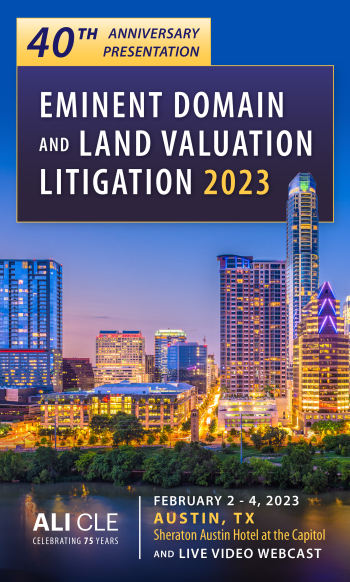
We were eagerly anticipating 40th American Law Institute-CLE Eminent Domain and Land Valuation Litigation Conference. The 2022 Conference in Scottsdale was one of the first meetings where everyone was back in-person (and was a smashing success), but that conference was early in the game so not everyone could or would attend. But in the past year most of us got back to some semblance of “normal,” and the turnout promised to be good.

We had record registrations: with over 300 attendees, faculty, and staff signed up, things were shaping up.

Plus, we were headed to Austin, Texas. The last time we held the Conference there in 2016, we loved it so much it has been in-demand for a return visit. And this year is the debut Conference for some new planning co-chairs for both the main tracks as well as the “Condemnation 101” tracks, so the buzz for the

Continue Reading Ice Ice Baby: A Report From The 40th ALI-CLE Eminent Domain & Land Valuation Litigation Conference, Feb 1-4, 2023, Austin

LUI

Land users: come join us online for the 36th Annual Land Use Institute. Yes, the venerable program is back again, with the usual line up of dirt law experts covering all you need to know and bringing you up to speed on the latest. Here’s the description of the program:

This Annual Land Use Institute program is designed for attorneys, professional planners, and government officials involved in land use planning, zoning, permitting, property development, conservation and environmental protection, and related litigation. It not only addresses and analyzes the state-of-the-art efforts by government to manage land use and development, but also presents the key issues faced by property owners and developers in obtaining necessary governmental approvals.

This outstanding program features:

• Preeminent faculty of practitioners and academics who provide nationwide perspective without losing sight of state-specific issues.
• Critical review and analysis of the most important new cases;
• Practice-oriented discussion

Continue Reading We’re Remote, So It’s Easy To Join Us For The 36th Annual Land Use Institute

Screenshot 2023-02-07 at 09-17-30 Emerging Issues in Property Rights

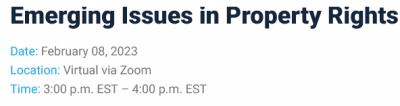
Join our Pacific Legal Foundation colleagues Jon Houghton, Daniel Woislaw, Kady Valois, and Sam Spiegelman (moderating) tomorrow, Wednesday, February 8, 2023, at 3:00 – 4:00 p.m. ET for a free webinar, “Emerging Issues in Property Rights.”

Here’s the agenda:

Protecting private property rights has been at the heart of PLF’s work since our founding in 1973. Our view, and that of the American Founders, is that property rights are foundational to all other constitutional rights.

Our relentless defense of property rights has secured many precedented victories, including 12 property rights wins at the U.S. Supreme Court—and counting.

Unfortunately, even today, the need for property rights champions remains critical.

Government officials too often relegate property rights to second-class status among Americans’ constitutional rights—cloaking their assaults in erroneous assertions of environmental protection or cleverly constructed land use restrictions.

To learn more about property rights’ legal landscape in

Continue Reading “Emerging Issues In Property Rights” – Wednesday, February 8, 2023, 3-4pm ET (Free!)

If your first reaction to the Texas Court of Appeals (First District)’s decision in City of Houston v. The Commons of Lake Houston, Ltd., No. 01-21-00369-DV (Jan. 12, 2023) is scratching your head, then please come join us in bewilderment.

After all, the court held that a takings claim failed because the city is immune from inverse condemnation. Say what? We thought that the self-executing nature of the just compensation requirement of the U.S. Constitution (and the Texas Constitution) means that claims of sovereign immunity don’t hold water in inverse cases.

The Commons wants to develop “The Crossing,” one of those big master-planned communities. The usual development activities entailed: master plan, subdivision plats, city approvals for infrastructure, and even some actual site work. “By April 2018, The Commons had invested millions of dollars in planning and infrastructure for The Crossing.” Slip op. at 2.

But in

Continue Reading An Ordinance Isn’t A Taking Because It’s A Valid Exercise Of Police Power?: What The Heck Is Going On In The Texas Court Of Appeals (First District)?

Today’s post is by our Pacific Legal Foundation colleague Kady Valois, writing about last week’s opinion by the Florida District Court of Appeal (Second District) in Lake Lincoln, LLC v. County of Manatee, No. 2D21-2826 (Jan. 13, 2023),

+++++++++++++++++++++++++++++++++++++++++

Divide and Conquer (Or Not): Florida’s Test
For The Regulatory Takings Larger Parcel

by Kady Valois

It is highly likely that anyone who follows this blog, at least as religiously as I do, groaned when the Supreme Court issued its decision in Murr v. Wisconsin, 137 S.Ct. 1933 (2017). After all, what could be more accessible and pro- private property than creating a balancing test within a balancing test and expanding the “parcel as a whole analysis” to encompass not only the regulated property but also any other property owned by the plaintiff (in the case of the Murr family, a parcel abutting the property they asserted was

Continue Reading Guest Post – Kady Valois, “Divide (Or Not) and Conquer: Florida’s Test For The Regulatory Takings Larger Parcel”

We really want you there…

One (nearly) last reminder that there’s still time to register for your space at the 40th ALI-CLE Eminent Domain & Land Valuation Litigation Conference, February 1-4, 2023, in Austin. In the past several years, we have sold out due to the conference room capacity and the conference hotel block. But there’s still space, although we are nearly full. So register now – don’t delay any further! 

Here’s the brochure with the complete agenda, schedule, and faculty listing. But to tempt you, here are some of the highlights of the program:

  • Everything Old is New Again: Why Today’s Practitioners Need to Understand the Original Meaning of the Takings and Just Compensation Clauses
  • When the SWAT Team Comes (No) Knocking: Police Power Takings
  • Private Utility Takeovers – Lessons From a 67 Day Trial

  • “Contraband”: How Property Rights Helped Pave the Way for Civil Rights

  • Valuation


Continue Reading (Nearly) Last Call: There’s Still Time To Join Us For The 40th ALI-CLE Eminent Domain & Land Valuation Litigation Conference, Feb 1-4, Austin

Screenshot 2022-12-29 at 16-48-24 il buono brutto il cattivo poster at DuckDuckGo

Here’s the latest from a case we’ve featured here before.

There’s something for everyone in the Florida District Court of Appeal (Second District)’s opinion in Jamieson v. Town of Fort Myers Beach, No. 2D21-2722 (Dec. 29, 2022).

Let’s start with the outcome: the court reversed the trial court’s summary judgment in a wetlands takings case, sending the matter back for a trial. Sounds good.

But let’s back up a sec. The case started a long time ago, when Jamieson’s seven-acre residentially-zoned property was designated as a wetland, resulting in a use density decline from 40 buildable lots to zero (wetlands density is one residence per 20 acres). For a decade, Jamieson tried to “change and/or correct the wetlands designation[.]” Slip op. at 3. The opinion lists out his efforts. He tried for

an application for boundary clarification regarding the extent of the wetlands, a request to transfer the

Continue Reading The Good The Bad And The Ugly: There’s Something For Everyone In This Florida Takings Opinion

Syllabus

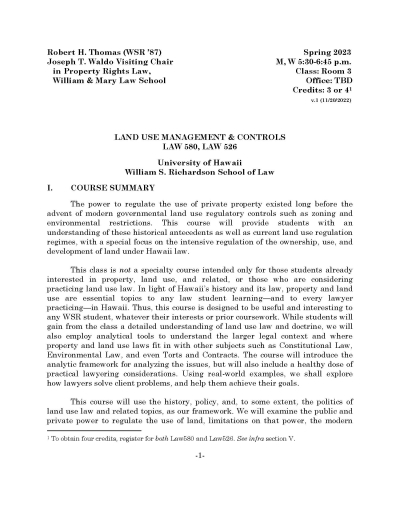
Starting in January, we’ll be teaching the venerated, and oh-so-important Land Use course (Law 580) at the University of Hawaii’s Law School.

We’re at least temporarily stepping into some mighty big slippers (this is Hawaii, so we don’t always wear shoes), as this is the course that our mentor Professor David Callies taught for decades. And is there a better venue in which to teach and study land use law and regulation, and its limits? After all, Hawaii may be the most heavily-regulated land on the planet, and is a focal point for every issue you can think of, from zoning to environmental restrictions to takings to public trust to subdivision to admin law to … well, you get the drift.

We’ll cover those topics, as well as the fundamentals. And we have a few surprises up our sleeve – some impressive guest lecturers, explorations of dirt law careers

Continue Reading Hawaii 5-80: Land Use Law At The University Of Hawaii

A quick one (2 page, per curiam) from the U.S. Court of Appeals for the Fifth Circuit to send you into the holiday.

In Devillier v. Texas, No. 21-40750 (Nov. 12, 2022), the court summarily concluded that “the Fifth Amendment Takings Clause as applied to the states through the Fourteenth Amendment does not provide a right to action for takings against a state[.]” Slip op. at 1-2.

This is a very short opinion. Here’s the entirety of the decision (minus footnotes):

The State of Texas appeals the district court’s decision that Plaintiffs’ federal Taking Clause claims against the State may proceed in federal court. Because we hold that the Fifth Amendment Takings Clause as applied to the states through the Fourteenth Amendment does not provide a right of action for takings claims against a state, we VACATE the district court’s decision for want of jurisdiction and REMAND with instructions

Continue Reading CA5: No Jurisdiction Over Federal Takings Claims Against A State