A short one from the U.S. Court of Appeals for the Eighth Circuit. 

The caption of WBI Energy Transmission, Inc. v. 189.9 rods, No. 24-1693 (Mar. 24, 2025), should tell you that this is a private-delegation federal taking, and indeed it is. Another Natural Gas Act taking by a private pipeline company. 

After WBI and a property owner couldn’t agree on selling a strip of land for a natural gas pipeline, WBI filed a federal condemnation action under the NGA. Eventually the parties settled on the amount of just compensation owing for the land. 

Under North Dakota law, a property owner is entitled to attorneys fees. So the owner here asserted it was entitled to such fees as part of the property. After all, full indemnity is part of its property rights, no? The District Court agreed, concluding that WBI was on the hook. 

If this all sounds

Continue Reading CA8: Private Delegee Of Federal Eminent Domain Power Does Not Owe Attorneys Fees Even If State Law Requires

Virginia eminent domain 2025

Virginians: now is a good time to register for the Virginia Eminent Domain Conference, May 8-9, 2025, at the Kingsmill Resort in Williamsburg.

We have spoken and attended the Conference in past editions, and can report that it is excellent. We’re looking forward to joining friends and colleagues again in The Burg in the spring. Check out the faculty and agenda, and then register and reserve your spot.

We’ll see you there.Continue Reading Virginia Eminent Domain Conference: May 8-9, 2025, Williamsburg

TX Em Domain 2025 Austin

Texans: now is a good time to register for the 24th Annual Texas Eminent Domain Superconference, March 27-28, 2025, at the Austin Country Club in Austin.

We spoke at the Conference a couple of years agolast year and in other editions, and can report that it is excellent. Check out the faculty and agenda, and then register and reserve your spot.Continue Reading Texas Eminent Domain Conference – Austin, March 27-28, 2025

Like a lot of residential communities these days, Foothills Reserve was developed under a master plan, and you know what that means … a homeowner’s association and CCRs (covenants, conditions, and restrictions). 

The HOA owned common areas, in which the homeowners had easements under the CCR’s. A “positive” easement to enter and use the common areas, and a “negative” easement which limited the common areas to use as open space. These easements ran with each homeowner’s land.

As part of a highway project, the State of Arizona used eminent domain to take the common areas and the homeowners’ easements. It provided just comp to the HOA for the common areas, while the HOA, on behalf of the homeowners, “sought both the value of the easements themselves and damages for the reduction in home values due to the new freeway’s proximity.” The State agreed it was obligated to provide comp for

Continue Reading Arizona: Damages For Proximity To Highway Project Available When An Easement – And Not Just Land – Is Severed

In our earlier post today, we noted that on the same day last month, the U.S. Court of Appeals for the Fourth Circuit issued two published opinions about the admissibility of evidence in federal eminent domain cases under the Natural Gas Act

In our post about the other case, we focused on the admissibility of the owner’s testimony regarding the value of her land, and noted that the second issue in that case — the admissibility of expert valuations — relied on the case we’re delving into in this post, Mountain Valley Pipeline, LLC v. 9.89 Acres of Land, No. 23-2129 (Jan. 27, 2025).

These are takings under Fed. R. Civ. P. 71.1. The district court excluded the valuation opinion of the owner’s appraiser. That opinion might have passed muster for admissibility under Federal Rules of Evidence 702 and Daubert, but the court concluded

Continue Reading District Court: Fed R Civ P 71.1 Increases Discretion To Exclude Experts. CA4: No It Doesn’t

As the title should inform you, Mountain Valley Pipeline, LLC v. 0.32 Acres of Land, No. 23-1935 (Jan. 27, 2025) is a federal taking. Here, a taking where a private pipeline condemnor is exercising the delegated federal power of eminent domain under the Natural Gas Act.

The issue we’re focusing on in this case is the district court’s exclusion of the property owner’s testimony about the value of her land. As you courtroom lawyers are keenly aware, a judge’s decision to allow or exclude evidence is, generally speaking, a discretionary matter and subject to the very deferential “abuse of discretion” standard of review on appeal.

But here, the Fourth Circuit concluded that the district court abused its discretion. Slip op. at 8. We won’t be going into great detail in this post, but instead urge you to review the opinion starting at page 8. “The threshold for admissibility of

Continue Reading CA4: Owner With Personal Knowledge Can Testify About Value Of Her Land

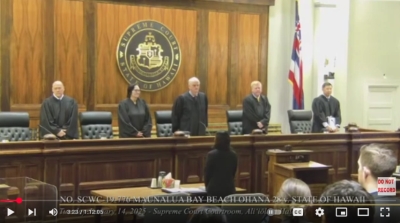
Screenshot 2025-01-18 at 14-58-03 No. SCWC-19-0000776 January 14 2025 10 30 a.m. Maunalua Bay v. State of Hawaiʻi - YouTube

Here’s the latest in a case we’ve been following for a long time.

As we previously noted, the Hawaii court of appeals affirmed a trial verdict that the just compensation owed to littoral property owners for the State’s regulatory taking of small portions of accreted beach is zero.

Last week, the Hawaii Supreme Court heard oral arguments. Here’s the video (sorry, can’t embed it here). Worth watching, if only because questions of just compensation and how it is calculated rarely are presented to this court (which is a frequent flyer in regulatory takings cases).

Here’s a description of the case and issues from the Hawaii Judiciary:

Petitioners Maunalua Bay Beach Ohana 28, Maunalua Bay Beach Ohana 29, and Maunalua Bay Beach Ohana 38 brought an inverse condemnation action against the State of Hawai‘i in 2005. At that time, they argued that the State effected a taking of accreted lands via Act 73 of 2005. In 2009, the Intermediate Court of Appeals (ICA) held that Act 73 “effectuated a permanent taking of littoral owners’ ownership rights to existing accretions to the owners’ oceanfront properties that had not been registered or recorded or made the subject of a then-pending quiet-title lawsuit or petition to register the accretions.” Maunalua Bay Beach Ohana 28 v. State, 122 Hawai‘i 34, 57, 222 P.3d 441, 464 (Ct. App. 2009).

On remand from the ICA, Petitioners sought just compensation for the alleged temporary taking of their accreted lands between 2005 and 2012. At trial, the circuit court concluded that $0 was just compensation for the alleged temporary taking of the accreted land and no nominal damages should be awarded to the petitioners. It also determined that the petitioners were not entitled to attorney’s fees.

The ICA affirmed the circuit court’s decision. With regard to attorney’s fees, the ICA held that the petitioners’ “claim for attorneys fees against the State for obtaining declaratory relief is barred by sovereign immunity.” The ICA further held that the Ohanas were not entitled to attorney’s fees under the private attorney general doctrine.

In their application for certiorari, the petitioners argue that the ICA erred in affirming the circuit court’s award of $0 in just compensation with no nominal or severance damages. Petitioners also contend that the ICA erred by concluding that sovereign immunity bars an award of attorney’s fees, and that they would not be entitled to fees under private attorney general doctrine. The State contends that the ICA did not err in affirming the circuit court’s award of $0 in just compensation or declining to award nominal damages to petitioners. It also argues that the ICA correctly held that sovereign immunity bars petitioners’ claim for attorney’s fees, and that even if it did not, petitioners would not be entitled to attorney’s fees under the private attorney general doctrine.

We watched live, and have a couple of thoughts:

  • Justice McKenna’s questions indicate she recalls that in an earlier regulatory takings case, the court concluded that even “speculation value” was enough to place a regulatory takings claim outside a Lucas wipeout analysis, an indicator that in this court’s view, property always has value, even if it has no use. Is that enough to say the owners here were entitled to, at the very least, nominal just compensation?
  • Does obtaining a decision holding the State to its constitutional obligation (after which the State repeals the unconstitutional statute) qualify the plaintiff for fee recovery from the State under the private attorney general doctrine, even where the adjudicated compensation is zero? We think so, because suing to keep the State in line when it has acted beyond its authority is exactly the kind of thing that the Attorney General should do (but didn’t here, because it has been too busy defending the State’s action). What about the advocate for the State who argued that there was no constitutional wrong here, because of the zero compensation verdict (the notion that the Takings Clause does not prohibit takings, only uncompensated takings)? The fact that the State withdrew the offending statute after the plaintiffs won the takings claim seems to contradict that argument because at the heart of it, the court ruled that the State should have used its eminent domain power to take future accreted land, and not the police power.

Stay tuned. We’ll continue to follow along and will post the court’s opinion when issued.

Continue Reading Hawaii Supreme Court Arguments: Is Just Compensation For Even A Small Slice Of A Primo Hawaii Beach Zero?

With our tongues firmly planted in cheeks, the Planning Chairs for the upcoming 42d edition of this popular and venerable Conference bring you this “breaking news” report from San Diego!

As you know, in addition to being the best nationally-focused conference on the subjects that we love and a venue that is nearly certain to have some of the warmest winter weather in the continental United States, and we went on-location from some of the local highlights: the beaches, Torrey Pines, the Zoo, Balboa Park, the Gaslamp Quarter, and Coronado to name but a few.

More about the Conference here, including registration information.

Here are some of the highlights:

  • Property Rights at the Supreme Court: DeVillier and Sheetz and What’s Next
  • Slow Take: Possession, Rent, Relocation, and Offset
  • The Jury’s View: How Jurors See Your Case
  • From Penn Coal to Penn Central: How to


Continue Reading Breaking News: Come Join Us For The 42d ALI-CLE Eminent Domain & Land Valuation Litigation Conference, San Diego, Jan 30-Feb 1

A short one from the Ohio Court of Appeals.

In City of North Canton v. Brown, No. 2024-CA00030 (Dec. 16, 2024), the court held the trial court in a just compensation action wrongly excluded the owner’s evidence of the County’s property tax valuation.

Hang on. Doesn’t the owner usually want to exclude evidence of property tax valuation in a just compensation case? Even though an appraisal for just compensation purposes and an appraisal for property tax purposes look at “value,” we know that the goals and methods of each are different, so that’s an apples-to-oranges comparison no?

Not always. Here, the court didn’t conclude that the tax valuation was conclusive, merely “‘some’ proof of value, and is thus relevant evidence.” Slip op. at 7. Moreover, this “is not a case in which a city or governmental entity is arguing the tax assessment should be admissible because the taxpayer or

Continue Reading Ohio Ct App: Tax Assessment May Be Admissible To Prove Just Compensation

A short one today, but worth reading because the Kentucky Supreme Court’s opinion in Kentucky Transportation Cabinet v. Atkins, No.2023-SC-0173 (Dec. 19, 2024) highlights an important point: when offering evidence of the compensation owed for the taking of income-producing property–and “[d]etermining the value of condemned real property is not a science”– it isn’t “speculative” to consider what a hypothetical purchaser in a market free of project influence would pay for the anticipated income stream.

If that conclusion seems kind of obvious to you, it wasn’t to the Kentucky Transportation Cabinet, which asserted the trial court abused its discretion by allowing the owner’s appraiser to testify that the Cabinet’s taking for a highway project of the fee simple interest of land containing subsurface coal obligated it to pay compensation based on the potential income from coal royalty payments for the coal.

The Supreme Court disagreed, concluding that the trial court

Continue Reading Kentucky: There’s More Than One Way To Prove Just Comp, Esp For Income-Producing Property