


Mark your calendars for next Tuesday, July 17, 2012, at 1:00 p.m. Eastern (noon CT, 11:00 a.m. MT, 10:00 a.m. PT, 7:00 a.m. Hawaii Time) for “Recent Developments in Eminent Domain,” a live audio program sponsored by Lorman Education.

It’s a 1.5 hour teleconference discussing some of the more important recent court decisions about our favorite topics, eminent domain, inverse condemnation, and regulatory takings.

I’m the sole faculty member, so you get to hear me chatter for about an hour and fifteen minutes, and we’ll save 15 minutes or so for questions. I’ll be covering the latest in public use, just compensation, and related topics. Here is the registration and CLE credit information. Hope you can join us. Continue Reading Upcoming Teleconference: Recent Developments In Eminent Domain
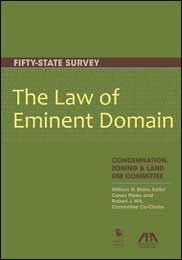
5310412_bigJust published: the ABA Section of Litigation (Condemnation, Zoning, and Land Use Committee) has released The Law of Eminent Domain — A Fifty State Survey (First Chair Press 2012). This book is a “single resource for eminent domain practitioners … a reference for questions about eminent domain and condemnation procedure in every state and the District of Columbia.” It’s a handy desk reference for how common issues in eminent domain are handled in each jurisdiction. Each state chapter covers the same topics:

  • Who is Eligible to Condemn?
  • What can be Condemned?
  • The Condemnation Proceedings
  • Procedure to Challenge Condemnation
  • Inverse Condemnation
  • Just Compensation Issues
  • How are Various Ownership Interests Treated?
  • Abandonment
  • Attorney’s Fees and Costs

We authored the Hawaii chapter. Our Owners’ Counsel of America colleague Bill Blake served as the editor, and many of our friends and colleagues from across the nation authored their state’s chapter. It’s a great reference

Continue Reading New Book: The Law of Eminent Domain (A Fifty State Survey)

UtahblogCheck this out: my Owners’ Counsel of America colleague Kevin E. Anderson has a blog on eminent domain and related issues, forcusing on decisions from the Utah state and federal courts, Eminent Domain Review.

It’s not a new blog (Kevin has been posting since at least 2011), but it’s new to us, so we though we would pass it along to you.

Among the categories he covers are the latest cases from the Utah Supreme Court, just compensation issues, and regulatory takings.

We’re subscribing, and so should you.Continue Reading New(er) Eminent Domain Law Blog Worth Following

Another short one from New York’s Appellate Division (Second Department). In In re Village of Port Chester, No. D34768 (May 1, 2012), the court held that several parcels of land the Village condemned should be treated as a single unit for valuation purposes, and that “unity of use” was established by the property owners because they showed they acquired the parcels in order to put them together to build a CVS store.

The claimants also established unity of use. The record contains testimony as to the claimants’ intention and efforts to acquire the properties as an assemblage for the development of large retail establishment before they had knowledge of a possible condemnation. The record also contains an executed lease (hereinafter the subject lease) between the claimants and Port Chester CVS, LLC (hereinafter CVS), pursuant to which CVS was to construct a new CVS pharmacy (hereinafter the CVS project). Additionally

Continue Reading Latest Chapter In the Port Chester Takings Case (p.s. You Can’t Destroy Draft Appraisal Reports)

The Supreme Court will not be reviewing the case in which a Manhattan property owner and developer was challenging the compensation awarded by New York courts for a taking near Lincoln Center. River Center LLC v. Dormitory Auth. of the State of New York, No. 11-922 (cert. petition filed Jan. 23, 2012). 

New York’s Appellate Division denied the property owner the right to present and have considered evidence about the valuation of the property because in order to be admissible, the property owner must be able to show the use it claims is the highest and best use is “established as reasonably probable and not a ‘speculative or hypothetical arrangement in the mind of the claimant,'” and that these plans will “come to fruition” in the near future. The property owner, represented in the Supreme Court by Harvard lawprof Laurence Tribe, argued in its cert petition that the

Continue Reading Cert Denied In Manhattan Just Compensation Case

Here is the Petition for Rehearing En Banc, in Bywaters v. United States, No. 2011-1032 (Fed. Cir. Mar. 1, 2012), an opinion we detailed here. In that case, a split panel of the Federal Circuit held that the property owner’s request for attorneys fees under the Uniform Relocation Assistance and Real Property Acquisition Policies Act was reasonable, but halved it because the amount of compensation sought and awarded was not that large. Here’s how the brief summarizes the issues:

In a 2-1 opinion, the panel majority construed the URA for the first time and set new standard for trial courts to follow when calculating reasonable attorneys’ fees pursuant to the URA, 42 U.S.C. § 4654(c), the fee-shifting statute that applies to reimbursement of attorneys’ fees for both Little Tucker Act and Big Tucker Act cases. Slip op. at 8-9. The panel majority, over a strong dissent by

Continue Reading Petition For Rehearing En Banc In Fed Cir Attorneys’ Fees Case: Small Property Owners Are Entitled To The Same Fee Awards As Large Property Owners

Here’s a short one for your just compensation files. In County of Dakota v. Cameron, No. 19HA-CV-09-3756 (Mar. 26, 2012), the Minnesota Court of Appeals held that Minnesota’s “minimum compensation” statute, “is ambiguous and that statutory intepretation is appropriate.” Slip op. at 7. The statute provides:

When an owner must relocate, the amount of damages payable, at a minimum, must be sufficient for an owner to purchase a comparable property in the community and not less than the condemning authority’s payment or deposit under section 117.042, to the extent that the damages will not be duplicated in the compensation otherwise awarded to the owner of the property. For the purposes of this section, “owner” is defined as the person or entity that holds fee title to the property.

The court defined “comparable property” according “to its common usage,” meaning something “similar or equivalent.” It rejected the property

Continue Reading Minn App: Relocation, Comparable Property, And Minimum Compensation

Last we checked in, the case we’ve been referring to as the “bizarre condemnation” (Klumpp v. Borough of Avalon) was decided by the unanimous New Jersey Supreme Court in favor of the property owners, and remanded to the trial court for a determination of the compensation owed to the property owners, who had their land taken by the Borough in 1965. 

A few days ago, the trial court issued its decision, concluding that the compensation owed to the property owners were owed the fair market value of the property in 1965 ($5,400) plus interest at 8-9%, for a total of $284,802. The property owners claimed the value of what they lost was considerably more, since the Borough offered other property owners whose properties were taken different beachfront parcels in exchange, but never notified the Klumpps of that option. If they had been able to acquire

Continue Reading The Bizarre Follow Up To New Jersey’s “Bizarre Condemnation”

Here’s the final cert stage brief (Petitioner’s Reply) in River Center LLC v. Dormitory Auth. of the State of New York, No. 11-922 (cert. petition filed Jan. 23, 2012), the case in which a Manhattan property owner and developer is challenging the compensation awarded by New York courts for a taking near Lincoln Center. This brief responds to the Dormitory Authority’s Brief in Opposition (posted here).

The Fifth Amendment’s Takings Clause will be eviscerated if the government is able to water down the Just Compensation guarantee to the point of meaninglessness. Property rights require vigilant enforcement of both the Takings and Just Compensation Clauses, and the instant petition provides a perfect vehicle for the reinvigoration of the latter.

Br. at 2. We filed an amicus brief supporting the property owner on behalf of Owners’ Counsel of America, posted here.

New York’s Appellate Division denied

Continue Reading Petitioner’s Reply Brief In Manhattan Eminent Domain Case: Time To Reinvigorate The Just Compensation Clause

Here’s the BIO in in River Center LLC v. Dormitory Auth. of the State of New York, No. 11-922 (cert. petition filed Jan. 23, 2012), the case in which a Manhattan property owner and developer is challenging the compensation awarded by New York courts for a taking near Lincoln Center.

The Appellate Division denied the owner the right to present and have considered evidence about the valuation of the property because the court held that in order to be admissible, the property owner must be able to show the use it claims is the highest and best use is “established as reasonably probable and not a ‘speculative or hypothetical arrangement in the mind of the claimant,'” and that these plans will “come to fruition” in the near future.

The property owner, represented in the Supreme Court by Harvard lawprof Laurence Tribe, argues in its cert petition that the

Continue Reading BIO In SCOTUS Just Compensation Case