Screenshot 2024-02-27 at 16-35-17 Post Feed LinkedIn

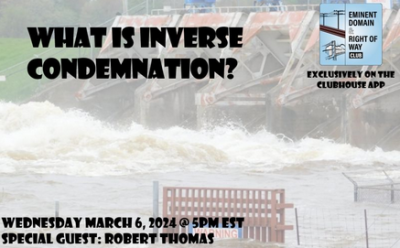
Save the date (and time): next Wednesday, March 6, 2024, at 5:00 p.m., Eastern Time, as we rejoin our friends and colleagues Patrick McAllister and Beth Smith, as they co-host the Eminent Domain and Right of Way Club.

We’ll be joining them to try and answer that question, “What is Inverse Condemnation?” As Patrick and Beth note, “[w]e will find out what it is, how it works and when does it happen….and probably a lot more.” Sounds intriguing.

For those of you who may not have participated in one of these sessions before, you may be wondering “what is this ‘Clubhouse’ thing?” Here’s the description, straight from their site:

The Eminent Domain & Right of Way Club is on the Clubhouse Drop in audio app. This Club is geared toward right of way professionals & anyone interested in the acquisition of land rights for infrastructure projects.

In short, it

Continue Reading “What is Inverse Condemnation?” Join Us In the EDROW Clubhouse, March 6, 5pm, To Find Out (And More)

ALI-CLE brochure cover page

When it comes to the longstanding ALI-CLE American Law Institute-CLE Eminent Domain and Land Valuation Litigation Conferences, we’re always ready to go. You know that. But this year’s version — the 41st — was buzzing like no other in recent memory.

Maybe it was the New Orleans venue with its atmo, food, and music for our after-class activities, or even the timing (the second-to-last week on the Mardi Gras parade season, and our conference hotel was right on the routes). It might have been the nice weather (oh, it rained buckets one evening, but there wasn’t an ice storm like we experienced in Austin in 2023). Or maybe it was the capacity crowd, and new topics and speakers on the agenda. Or maybe it was just the prospect of seeing our friends and colleagues again after a year.

Here’s a photo essay of some of the Conference highlights.

And

Continue Reading Pass A Good Time: Our Report From The 41st ALI-CLE Eminent Domain & Land Valuation Litigation Conference, Feb 1-3, 2024, New Orleans

DSCF3357

If you dream such dreams as this photo, read on.

My law firm, Pacific Legal Foundation, is on the hunt for lawyer to join our Property Rights group (yours truly is the Director of Property Rights Litigation, so you will be working with me and the other takings and con law mavens in our practice). Here’s the full description of the spot:

You: An entrepreneurial freedom fighter with a passion for property rights litigation. You work with more senior-level attorneys to find and win cutting-edge property rights cases in trial and appellate across the country. You work as a part of a collaborative team, but are also self-motivated and able to work independently with minimal supervision. You are eager to learn, relentless, and a focused lawyer.

Them: Bureaucrats, city councils, mayors, governors, and federal agencies stripping Americans of their rights every day. There’s a lot of government overreach out there

Continue Reading Dig Property Rights? Join Our Firm As A Courtroom Property Rights Lawyer

A quick one from the South Carolina Supreme Court.

In Applied Building Sciences, Inc. v. South Carolina Dep’t of Commerce, No. 28184 (Jan. 17, 2024), the court held that the $50,000 cap on relocation benefits provided to ABS by South Carolina’s version of the Relocation Act was enough, and did not deprive ABS of just compensation.   

Applied Building Sciences was a tenant in a building taken by the South Carolina Division of Railways, and was listed as an “Other Condemnee” in the eminent domain action. The taking forced it to relocate its business, which triggered its right to seek relocation benefits. South Carolina offers those displaced up to $50,000 in benefits, even if the taking isn’t federally funded (and thus not covered by the federal URA). 

ABS thought the cap was unconstitutional and asked for $560k in expenses, and raised an inverse condemnation claim. The Department said no

Continue Reading South Carolina’s Relocation Act Benefits Are Not “Just Compensation”

One week ago today, the U.S. Supreme Court heard oral arguments in Devillier v. Texas.

We wrote up our thoughts in this post, “Rogue States: Today’s Argument In Devillier v. Texas – ‘Aren’t the Courts supposed to do something’ About Violations Of The Constitution?,” and now bring you other reports:

  • Niina H. Farah, “Supreme Court leans toward landowners in Texas flooding case” (Politico E&E News) (we were quoted in this piece: “Robert Thomas, director of property rights litigation at the Pacific Legal Foundation, said critiques of Texas appeared to cut across the ideological spectrum on the court. ‘Even those justices who you might not usually think of as viewing property rights favorably, they didn’t seem to appreciate what I would call the gamesmanship [from Texas],’ said Thomas, who wrote a friend of the court brief to the Supreme Court in support of landowners.).
  • Lydia Wheeler,


Continue Reading Devillier Oral Argument Round-Up

Don’t miss out!

We promise: this is the last time we’re going to try to entice you to the upcoming ALI-CLE Eminent Domain & Land Valuation Litigation Conference in New Orleans. We are getting close to capacity, but there is still room. In recent years, we have standing room only in the Conference halls, and have sold out the hotel block. After all, this is a pretty niche area of law. So what gives?

When we were in Austin last year, we thought it might be nice to try and answer that question. We asked Conference participants why they come, year-after-year (and in Austin, despite massive travel disruptions). Yes, it is the various venues (Nashville, Austin, Scottsdale, Palm Springs, to name a few recent locations), and yes, it is the excellent and useful programming.

But as we suspected it is more than that.

Continue Reading No FOMO: There’s Still Room For You To Join Us In New Orleans Feb 1-3, 2024 For The 41st ALI-CLE Eminent Domain & Land Valuation Litigation Conference

We’d guess that most people, if asked whether the courts can “do something” when the government acts beyond the authority delegated to it in the Constitution, would respond that “doing something” is exactly what courts are for. 

Bottom Line Up Front

And that is what drives our BLUF on today’s Supreme Court oral arguments in Devillier v. Texas: we’re predicting that the property owner’s arguments in will convince a majority of the Justices, and that the Court will answer the Question Presented with a “yes” –

May a person whose property is taken without compensation seek redress under the self-executing Takings Clause even if the legislature has not affirmatively provided them with a cause of action?

Courts Exist to “Do Something” When Government Violates Rights, Right?

Justice Kagan, as if often the case, drove right to the heart of the matter. For the “money quote” in the transcript or

Continue Reading Rogue States: Today’s Argument In Devillier v. Texas – “Aren’t the Courts supposed to do something” About Violations Of The Constitution?

“No need to ask, he’s a smooth operator…”

On Tuesday, January 16, 2024, the Supreme Court will hear arguments in a case we’ve  been following closely because it involves the fundamental limitation on the sovereign power to take private property. In our system, the sovereign indeed has the power to take private property against the will of the owner, but only if the taking is accompanied by just compensation.

Before we go on, a disclosure: we filed an amicus brief supporting Devillier’s arguments, so we’ve have an obvious bias. Special kudos to our law firm colleagues — and self-executing Just Compensation mavens — Deb La Fetra and Kady Valois for this brief.

Texas Flooded Devillier’s Property

Here are the facts in Devillier v. Texas. As part of a road project, the Texas Department of Transportation caused Devillier’s property to flood. The state flooding someone’s property is one of those

Continue Reading Devillier v. Texas Argument Preview: Do Courts Need Congress’ Permission To Enforce The Right To Just Compensation?

HAWSCT

We’re not going to go into very much detail or provide commentary on the Hawaii Supreme Court’s unanimous 88-page opinion in an eminent domain case we’ve been following, City and County of Honolulu v. Victoria Ward, Ltd., No. SCAP-22-0000335 (Dec. 29, 2023), because before we departed private practice for public interest law a couple of years ago, this was our client and our case (so we still have a bias).

Update: more on the decision from Jesse Souki, “Hawai’i Court Holds that Consideration of Severance Damages in Honolulu Rail Case Should be Left to the Jury” (“The HSCT was critical of the circuit court’s granting of summary judgment motions where there were genuine issues of material fact that should be decided by the jury[.]”).

Short story: the Honolulu rail agency (we’re still calling it “HART” and not the weird “Skyline” although the latter is

Continue Reading Hawaii SCT: Most Of Those Eminent Domain Issues (Esp. Severance Damages) Are For Juries