


If you understand the title of this post, congratulations: you are a regulatory takings wonk.

The property owners have filed a cert petition asking the Supreme Court to review the Tenth Circuit’s decision in Alto Eldorado Partnership v. County of Santa Fe, 634 F.3d 1170 (10th Cir. 2011). The Questions Presented explain the background and the issues:

A New Mexico county ordinance forces landowners who seek permits to subdivide their properties to construct and sell “affordable housing” units to County-approved buyers. Petitioners Alto Eldorado Partnership, et al., (collectively, “Alto”) are property owners who brought a Fifth Amendment claim in federal district court under 42 U.S.C. § 1983, seeking to have the ordinance enjoined on the grounds that it imposes an unconstitutional permit condition in violation of Nollan v. California Coastal Commission, 483 U.S. 825 (1987). Citing Williamson County Regional Planning Commission v. Hamilton Bank of Johnson City
Continue Reading New Cert Petition: Are Nollan Claims Subject To Williamson County (And If So, Should Williamson County Be Overruled)?

Here’s how the California Court of Appeal, Third District began today’s opinion in a case involving the California Environmental Quality Act:

This is a case where CEQA worked. The City of Rocklin (the City) in 2007 approved a residential development project for an undeveloped area of the City known as Clover Valley. The approval culminated more than 10 years of planning and environmental review for the site’s development. Since 1981, zoning authorized nearly 1,000 homes for the site. The site’s owners applied to develop a project for that size in 1991, and environmental review began in earnest in 1995. As a result of environmental concerns analyzed since then, the approved project is roughly half the size it could have been. The amount of open space has increased by a factor of five. The project owners have already paid millions of dollars to the City to construct needed infrastructure. The approved

Continue Reading “This Is A Case Where CEQA Worked”

The technical legal question before the Court in Nevada Comm’n on Ethics v. Carrigan, No. 10-568 (June 13, 2011) was whether legislative voting by an elected official was “speech” and if so, whether the First Amendment allowed him to vote for a casino development proposal in which his campaign manager and personal friend was the developer’s paid “consultant.”

The Court’s opinion, however, revealed that what was at stake in the case was much more than metaphysical First Amendment questions and “good government” laws, because the heart of the opinion reaffirmed the core principle of representative government: when casting votes, elected and appointed officials are not speaking for themselves, but are exercising power “that belongs to the people.”

Justice Scalia, writing for CJ Roberts, and Justices Kennedy, Thomas, Ginsburg, Breyer, Sotomayor, and Kagan, concluded that a legislator’s vote is not speech because a city council member is not “saying”

Continue Reading Legislators’ Voting Is An Exercise Of “Power,” Not “Speech”

A new case worth watching has been filed in Hawaii state court (Third Circuit, the Big Island) that involves allegations of vested rights and estoppel, Nollan/Dolan exactions, state and federal due process and takings, inverse condemnation, and equal protection.The

See below, the Complaint in Bridge Aina Le’a v. State of Hawaii Land Use Comm’n, No 11-1-1145-06 (KKS), filed last week, in which the plaintiff asserts that the Land Use Commission changed the land use boundaries from “urban use to agricultural use while affordable housing was being constructed on the property.”

More here, from West Hawaii Today.

Complaint, Bridge Aina Le’a v. State of Hawaii Land Use Comm’n, No. 11-1-1145-06 (KKS) (filed 6-7-2011)Continue Reading New Lawsuit To Watch: Land Use Commission, Vested Rights, Civil Rights

This just in.

In a case we’ve followed closely, the U.S. Supreme Court has concluded that Nevada’s Ethics in Government Law is not unconstitutionally overbroad, and that a state may regulate apparent conflicts of interest in legislative voting without infringing upon an elected official’s First Amendment speech rights.

In an opinion by Justice Scalia and joined by CJ Roberts and Justices Kennedy, Thomas, Ginsburg, Breyer, Sotomayor, and Kagan, the Court concluded that legislative voting is not “speech,” and when voting, an elected official is acting as trustee for his constituents, and not for herself. The Court reversed the Nevada Supreme Court’s contrary conclusion, and upheld the Nevada Commission on Ethics’ censure of a city council member for not recusing himself from voting on a casino development proposal when the council member’s personal friend and campaign manager was the developer’s “consultant.” The council member disclosed the relationship, but voted to

Continue Reading SCOTUS: Legislative Voting Is Not “Speech,” State May Require Recusal For Legislators’ Conflicts Of Interest

“Kelo, Parents and the Spatialization of Color (Blindness) in the BermanBrown Metropolitan Heterotopia” by Denver lawprof Tom Romero II.

This article utilizes interdisciplinary methodology and resources to describe the manner by which legally enforced color lines on a local scale became paradoxically proscribed, yet essential to what I call the multi-racial heterotopia. As a consequence of scholars largely having failed to make the link between eminent domain and school integration jurisprudence in the construction of the modern metropolitan United States, the article makes a timely and important intervention to the combined analysis of these most recent Supreme Court cases.

Posted on SSRN here. Topic seems worthy of examination, but what a title!Continue Reading Winner: Best Title For Law Review Article About Kelo (I Think)

Today, Honolulu Civil Beat features our piece on Nevada Comm’n on Ethics v. Carrigan, “Do Elected Officials With a Conflict of Interest Have a Right to Vote Anyway?

We’ve written about the case recently in the Zoning & Planning Law Reporter (Supreme Court Preview: Voting as Speech When a Government Official Has a Conflict of Interest — “Analogy Gone Wild” Or First Amendment Right?, 34 Zon. & Plan. L. Rptr (Apr. 2011)), but the Civil Beat piece is less law-wonky:

In a perfect world, we wouldn’t need ethics laws to regulate the conduct of government officials. We could trust that by simply following their consciences, the personal morality of government officials would coincide with “doing the right thing” and we’d end up with a result everyone would agree was “ethical.”

But because we don’t live in a perfect world, an elected official’s view of what’s

Continue Reading Op-Ed On SCOTUS Carrigan Case: Do Elected Officials With a Conflict of Interest Have a Right to Vote Anyway?

Civil Beat‘s recent report on the mayor’s plan to demolish the Waikiki Natatorium War Memorial, a salt-water swimming pool erected to honor those who served in “the Great War,” not only brought back some childhood memories (I swam there as a kid) but reminded us of the cost of preservation. When the thing or property sought to be preserved  — or, to use the bumper-sticker vernacular, “saved” — is public property like the Natatorium, the discussion usually involves the cost of doing so balanced against the desire to keep it.

But when the property involved is private property, you usually hear very little about the burdens placed on the owner, or the cost to the public of preservation. Which brings us to the tile of this post, which was inspired by a recent column by Howard Dicus “What do you want to save in Honolulu that’s old?

Continue Reading What Do You Want To Save In Honolulu (And How Much Will It Cost?)

PICT0408
Last week, after we concluded the spring meeting of the ABA’s Section on State and Local Government Law in Portland, Oregon (more about that in a subsequent post), we could not resist paying a brief visit to the neighboring City of Tigard.

Yes, that City of Tigard.

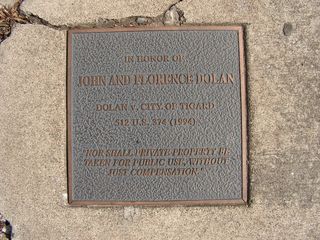
In the early 1990s, the city was home to John and Florence Dolan, who owned A-Boy Plumbing & Electrical Supply. They asked the city for a permit to expand their store and pave their parking lot. The city saw this as an opportunity to expand its network of bike paths, and conditioned its approvals on the Dolans “dedicating” (giving) the city land for a public “greenway” along the adjacent Fanno Creek, totaling approximately 10% of the parcel.

PICT0407

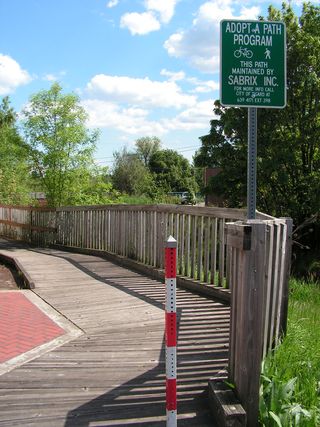
            The entrance to the “greenway” from the street.

The Dolans objected, arguing that requiring them to donate land as a condition of land use

Continue Reading Regulatory Takings Pilgrimage, Part II

Honolulu attorney Jay Fidell (who also produces Think Tech Hawaii) writes a regular column in the Honolulu Star-Advertiser. This week, he focuses on eminent domain in “Governor must insure wind farm moves forward,” where he writes about the proposed wind farm on Molokai, and urges the state to use eminent domain aggressively to take the needed land:

When Abercrombie threatened eminent domain against Molokai Ranch, he unleashed the genie, and the possibility of condemnation is now in play. He gave us a glimpse of a powerful solution to our energy security predicament, and we can’t let it pass.

In our state of islands, land is scarce, and NIMBY is in every back yard. Large landowners want to hold on to their land in hopes of appreciation and because it’s so difficult to find other parcels. So they refuse to sell.

Hawaii has traditionally been reluctant to

Continue Reading “Make Eminent Domain Imminent” – Fidell On Wind Power