


In Alto Eldorado Partnership v. County of Santa Fe, No. 09-2214 (Mar. 16, 2011), the U.S. Court of Appeals for the Tenth Circuit held that a regulatory takings challenge to an affordable housing exaction was not ripe under the second prong of the Williamson County test.The “final decision” prong was not at issue in this case, where the plaintiffs challenged the County’s up-to-30% affordable housing exaction on subdivisions, where the subdivision is for resale. Continue Reading 10th Circuit: Affordable Housing Exaction Claim Not Ripe Under Williamson County
Cert Petition In Guggenheim: Can A Post-Regulation Purchaser Bring A Takings Claim?
Last Friday, the property owners filed this cert petition, which asks the U.S. Supreme Court to review Guggenheim v. City of Goleta, No. 06-56306 (9th Cir., Dec. 22, 2010) (en banc). In that opinion, the Ninth Circuit held that Goleta’s mobile home rent control ordinance did not work a regulatory taking under Penn Central. The core of the majority opinion is based on the notion that the Guggenheims did not have “investment-backed expectations” because the regulations were in place when they purchased their property.
We covered the en banc oral arguments here, and our resource page on the case is here
The petition presents a single question:
In Palazzolo v. Rhode Island, 533 U.S. 606 (2001), this Court rejected the proposition that “postenactment purchasers cannot challenge a regulation under the Takings Clause.” Id. at 626. In this case, a divided en banc panel of the Ninth Circuit distinguished Palazzolo on the basis that the plaintiff there had acquired the property by operation of law (instead of purchasing it) and held that the fact that petitioners had purchased the property subject to the challenged regulation was “fatal to [petitioners’] claim.”
Is the purchaser of property subject to a regulatory restriction foreclosed from challenging the restriction as a violation of the Takings Clause?
More to come.
Cert Petition, Guggenheim v. City of Goleta, 10-1125
Continue Reading Cert Petition In Guggenheim: Can A Post-Regulation Purchaser Bring A Takings Claim?
Cal Ct App: Shopping Center Cannot Allow Labor Protests, But Restrict Other Protests
 Thousands of years from now, when future archaeologists and historians are reconstructing our civilization from the ruins, it is easy to imagine how they might misinterpret the function of shopping malls. Rather than climate-controlled centralized temples of consumerism, or teen hangouts with abundant parking, the historical record might suggest that malls were august civic centers — fora for political debates complete with speaker’s corners, which even included centralized feeding areas to insure the debaters’ sustenance.
And if they are reading the California Reports, they might be right.
Revisiting the issue of speech at shopping malls, the California Court of Appeal (2d District) held in Best Friends Animal Society v. Macerich Westside Pavilion Property LLC, No. B221067 (Mar. 2, 2011) that a shopping center’s rules giving preferential treatment to labor speech violate the California Constitution’s free speech clause. The shopping mall’s rules could not favor speech about labor issues
Fidell: “Labyrinthine land-use laws suffocating isle economy”
Honolulu attorney Jay Fidell (who also produces Think Tech Hawaii) writes a regular column in the Honolulu Star-Advertiser. This week, he focuses on land use in “Labyrinthine land-use law suffocating isle economy,” where he writes:
Everyone knows our state, like others, is in a fiscal and economic crisis. We need to revitalize our sagging economy, and fast. The governor has made this an absolute priority, and he’s right — we all have to work together to improve the economy, and that frankly includes all three branches of government.
The elephant in the room is land use, which was clear at a recent Hawaii land-use law seminar. Developers have to run a backbreaking gantlet before they can build anything. Environmental laws are increasingly used to stop projects, even if the real motivation isn’t environmental but just NIMBY (“not in my backyard”). The result: Projects have become prohibitively
Continue Reading Fidell: “Labyrinthine land-use laws suffocating isle economy”
What Advantage Do Environmental Plaintiffs Have In The Hawaii Supreme Court? According To UH Lawprof, A 90% Win Rate
At yesterday’s debate (video archived here) sponsored by Honolulu Civil Beat, “Knowing the Past, Shaping the Future” about the problems that have arisen in Hawaii in the time since the publication of the book The Price of Paradise 20 years ago, U. Hawaii lawprof David Callies revealed a stunning statistic. He noted that the Hawaii Supreme Court “has managed to find in favor of Sierra Club, Friends of the Earth, Earthjustice … 90% of the time, 70% of those decisions overturning the [Hawaii] Intermediate Court of Appeals.”
Whoa.
Callies began by questioning the conclusion reached by most of the book’s essayists that Hawaii is not regulated enough — and that even more government is called for:
I don’t think that’s the problem, folks. The notion that the problems that have arisen over the past 35 or 40 years — or the last 20 years since The Price
“You Mean After You Call Mike Berger?” Appellate Lawyer Honored By Owners’ Counsel
Anyone who is a regular reader of this blog knows Mike Berger. If you don’t immediately recognize his name just check the reports of decisions because you certainly know his cases, which include: Tahoe-Sierra Preservation Council v. Tahoe Regional Planning Agency (2002), City of Monterey v. Del Monte Dunes at Monterey, Ltd. (1999), Preseault v. ICC (1990), and First English Evangelical Lutheran Church v. County of Los Angeles (1987) in the U.S. Supreme Court, and countless cases in the Federal and California Reports. A frequent speaker and law review author, Mike has been representing property owners in eminent domain, regulatory takings, and inverse condemnation cases for decades. I have considered Mike a guide who helped me start down the land use law path ever since I read his article “Happy Birthday, Constitution: The Supreme Court Establishes New Ground Rules for Land-Use Planning,” 20 Urban Lawyer 735 (1988).
Continue Reading “You Mean After You Call Mike Berger?” Appellate Lawyer Honored By Owners’ Counsel
Eminent Domain & Property Law Blogs From Today’s ALI-ABA Session
 At today’s ALI-ABA annual conference on eminent domain law in Coral Gables, Florida, Tony Della Pelle (NJ Condemnation Law blog) and I (in a session moderated by Nancy Myrland) presented “The ‘Social’ Lawyer: New Media Strategies for Marketing Your Eminent Domain Practice,” about how eminent domain attorneys can use social media for business development or simply to keep up on the latest cases. For those of you who were with us in person or on the webcast, here are some of our favorite law blogs. And, if you couldn’t join us, you really should consider it next year since the conference features stellar faculty, all experts in the field of condemnation and eminent domain law.
These are the essential blogs in our area of practice:
- Gideon’s Trumpet – this blog, published by Gideon Kanner, is the equivalent of a nonstop eminent domain conference, since Gideon shares his
Continue Reading Eminent Domain & Property Law Blogs From Today’s ALI-ABA Session
U.S. Supreme Court To Decide Whether A Councilmember With A Conflict Of Interest Has a First Amendment Right To Vote Anyway
The U.S. Supreme Court has agreed to decide a case about whether state laws which require elected officials to recuse themselves from considering matters on which they appear to have conflicts of interest, impermissibly infringe upon the officials’ First Amendment rights.
This issue has wide-ranging importance to the players in the land use arena since the Court’s ruling has the potential of invalidating (or subjecting to serious challenge) state and local regulations nationwide which govern conduct of members of city and county councils and boards of supervisors, planning commissions, zoning boards of appeals, and similar state and local government bodies.
In Comm’n on Ethics of the State of Nevada v. Carrigan, No. 10-568 (cert. granted Jan 7, 2011), the Nevada Supreme Court invalidated a Nevada law which required a Sparks, Nevada city councilmember to recuse himself from considering an application to develop a hotel/casino because the developer’s “consultant” was
Greg Kugle To Speak To HSBA On Shoreline Issues (2/18/2011)
On Friday, February 18, 2011 from noon to 1:00 p.m., my Damon Key colleague Greg Kugle will be speaking to the Hawaii State Bar Association’s Real Property and Financial Services Section on Shoreline Issues. Greg chairs our firm’s real estate and construction law practice group, and has been representing property owners on shorelines issues across the State of Hawaii for many years.
The presentation is free for HSBA members and will take place at the HSBA Confrerence Room, 1100 Alakea Street, Suite 1000. HSBA members from the neighbor islands can call in to a toll-free conference line (contact us for the instructions). Continue Reading Greg Kugle To Speak To HSBA On Shoreline Issues (2/18/2011)
Vermont Law Review: Essay Reflections From The Amicus Curiae In The Judicial Takings Case
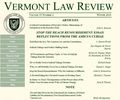 As we noted here (when we posted our article), the latest issue of the Vermont Law Review deals with the U.S. Supreme Court’s “judicial takings” case, Stop the Beach Renourishment, Inc. v. Florida Dep’t of Environmental Protection, 130 S.Ct. 2592 (June 17, 2010).
In eight essays, the authors of several of the many amicus briefs add their post-opinion thoughts. Authors include Ilya Shapiro (Cato Institute), Professor John D. Echeverria (Vermont Law), and Julia Wyman (Marine Affairs Institute). The groundwork is laid in the first article, by Professor L. Kevin Wroth:
If hard cases make bad law, bizarre cases may make no law at all. The recent Supreme Court decision, Stop the Beach Renourishment, Inc. v. Florida Department of Environmental Protection is a case in point. In the Essays that follow, the Vermont Law Review has brought together the reflections of seven lawyers, or teams of lawyers, for amici curiae