


In Navajo Nation v. United States, No. 2010-5036 (Jan. 10, 2011), the U.S. Court of Federal Claims concluded that the Nation’s claim that a development moratorium resulted in a taking was barred by the six year statute of limitations.

The Nation asserted that a 1934 federal statute created a property interest in an area known as the “Bennett Freeze area,” and that the federal government took that right when it precluded the Nation from any development within the area. The facts and legal background of the case are somewhat convoluted, and you can read the opinion if you are interested, but here’s the essence of the court’s analysis:

Here, the Navajo Nation’s takings claim, if any, accrued when the United States precluded it from developing land within the Bennett Freeze area without Hopi Tribe ap-proval. This was the only governmental action that served to restrict any right the Nation

Continue Reading Federal Circuit: Takings Claims By Navajo Nation Barred By Statute Of Limitations
What we’re reading today:


Continue Reading Friday Round-Up: Takings Ripeness, Defining “Hawaiian” Cultural Practices, Penn Central, and Judicial Takings

Honolulu Civil Beat reports this exclusive “Obama’s Winter White House an Illegal Rental” (complete CB stories are usually behind a paywall, but they’ve posted this one in its entirety). According to the Civil Beat story:

President Barack Obama’s two-week stay at his Hawaii Winter White House was illegal under a long-standing Honolulu ban on short-term rentals.

Obama did not break the law by staying at the house, but the property owner who rented his house to the Obamas does not have the permit that would allow a stay of fewer than 30 days.

“They were here for about two weeks, approximately, but I don’t want to get into the contractual issues,” Weinberg said. “They don’t have to rent it for 30 days but you have to leave a 30-day window. I had to make sure that during that period, either 15 days after them or 15 days

Continue Reading Is POTUS’ Hawaiian Vacation Rental “Illegal?” Here’s Official City Policy

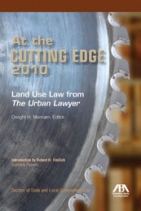
Cutting_edge_2010

The ABA has announced the forthcoming publication of a new book by the State and Local Government Law Section: At the Cutting Edge 2010: Land Use Law from The Urban Lawyer, edited by my colleague Dwight H. Merriam, and which is “[a]n essential resource for practitioners, planning professionals and students, this book provides information and insight into timely issues impacting land use law.”

It’s not available just yet, but is scheduled for publication on December 31, and is available for pre-order here (the usual discounts for ABA/Section members, and for law student members, apply).

I contributed a chapter, Recent Developments in Challenging the Right to Take in Eminent Domain. I received my advance copy today, and it’s a handy little volume that has the latest developments in the law relating to (among other subjects):

  • Cellular telecommunications facilities
  • Exactions and impact fees
  • Trends in green buildings laws
  • Ethical


Continue Reading New Book: At The Cutting Edge 2010: Land Use Law From The Urban Lawyer

11.LULHI On January 13 and 14, 2011, I’ll be leading two sessions in the fifth Hawaii Land Use Law conference. This one only comes around every two years, so this is your chance to get updated on the hottest topics by a stellar faculty.

My sessions will cover Coastal Issues (which includes shoreline boundary, takings, and the U.S. Supreme Court’s Stop the Beach Renourishment case), and Water Issues (which will cover instream flow standards, public trust and private rights, and the Maui Water cases).

The keynote speaker will be Professor Gideon Kanner, who will present “Taking a Critical Look at 30 Years of the Supreme Court’s Takings Jurisprudence.” That alone will be worth the admission price.

Also of note: the seminar includes 3.25 Hawaii MCPE ethics credits, so you can fulfill your 2011 requirements in one sitting (you can attend the ethics portion for only $195). Members of the HSBA

Continue Reading January 13-14, 2011: Fifth Hawaii Land Use Conference

This just in: the en banc Ninth Circuit, in an opinion by Judge Kleinfeld (the dissenter from the panel opinion) has concluded that the City of Goleta’s mobile home rent control ordinance is not a regulatory taking. In Guggenheim v. City of Goleta, No. 06-56306 (Dec. 22, 2010), the majority “assumed without deciding” that the case was ripe under Williamson County, but that the property owners did not establish a regulatory taking under Penn Central. We covered the en banc oral arguments here, and our resource page on the case is here.

There’s a lot of opinion to churn through, but the core of the majority opinion is based on the notion that the Guggenheims did not have “investment-backed expectations.” Imposing what can only be called a bizarre economic and appraisal theory, the majority concluded:

Whatever unfairness to the mobile home park owner might have

Continue Reading En Banc 9th Circuit Decides Guggenheim: Mobile Home Rent Control Ordinance Is Not A Regulatory Taking

In County of Sonoma v. Superior Court, No. A128734 (Dec. 15, 2010), the California Court of Appeal, First District concluded that an equal protection challenge to the requirement in Sonoma County’s zoning code that medical marijuana dispensaries obtain a permit to operate must have been brought within 90 days of the enactment of the requirement. The court concluded that a challenge brought only after the County ordered a dispensary to stop operations was filed too late.

Since 1996, California law law has permitted “seriously ill Californians” to have access to medicinal marijuana “when recommended by a physician.” Slip op. at 2 n.2. Before 2007, the County’s zoning ordinance did not address marijuana dispensaries, which were therefore technically prohibited. In 2007, the County made dispensaries a permitted use within certain zoning districts, and required them to obtain a Use Permit.

In 2008, a dispensary that had been operating since 2003

Continue Reading Cal Ct App: Facial Equal Protection Challenge To Zoning Ordinance Cannot Tag Along With Invalid As-Applied Challenge, Man

The Vermont Law Review has published an article authored by me and my Damon Key colleagues (and fellow law bloggers) Mark M. Murakami and Tred Eyerly. The article is an essay with our thoughts about the U.S. Supreme Court’s decision in Stop the Beach Renourishment, Inc. v. Florida Dep’t of Environmental Protection, No. 08-11 (June 17, 2010).

That’s the “judicial takings” case involving accretion rights and Florida’s “renourished” beaches. Disclosure: we filed an amicus brief supporting the property owners in the case. We argue in the article that despite eight Justices concluding the Florida Supreme Court’s decision in the case was not a judicial taking, the doctrine remains viable. The article suggests a roadmap for how future cases can be analyzed.

Download the pdf here, or get it below.

Of Woodchucks and Prune Yards: A View of Judicial Takings From the Trenches, 35 Vt. L. Rev.

Continue Reading New Article – Of Woodchucks and Prune Yards: A View of Judicial Takings From the Trenches

The court has posted the recording of yesterday’s oral argument in Leone v. County of Maui, No. 29696, a case that we’ve been following closely involving federal regulatory takings claims, Williamson County ripeness, and the practical effect of the Hawaii Supreme Court’s decision in GATRI v. Blane, 88 Haw. 108, 962 P.2d 367 (1998) regarding zoning and planning for land in the Special Management Area.

We live blogged the argument, and now you can listen and follow along. Be warned, the file is an 84 mb mp3, so be prepared for a long download. Still not scared off? Download it here.

Briefs in the case are posted here.Continue Reading Oral Argument Recording In HAWICA Takings And Ripeness Case

troubleinparadise

(Click on the image to enlarge)

A colleague pointed out Dave Swann’s Trouble in Paradise strip from the Sunday Star-Advertiser that puts a comic twist on what Professor Paul Boudreaux has called “drawbridge protectionism.”

There’s more than a touch of reality in Swann’s strip, because having a bumper sticker on your car that you are down with the cause is just short of what you need to get standing to bring an environmental lawsuit in Hawaii’s courts. A bumper sticker alone might not be enough, but it’s close.Continue Reading “I Got Mine” Fits On A Bumper Sticker