


My Damon Key colleagues Mark Murakami and Tred Eyerly and I have posted our forthcoming essay Of Woodchucks and Prune Yards: A View of Judicial Takings From the Trenches on SSRN here, containing our thoughts on Stop the Beach Renourishment, Inc. v. Florida Dep’t of Environmental Protection, No. 08-11 (June 17, 2010), the “judicial takings” case. Mark, Tred, and I filed an amicus brief supporting the property owners in the case.

Here’s an excerpt from the Introduction to the article:

Justice Breyer must either (a) grapple with the artificial question of what would constitute a judicial taking if there were such a thing as a judicial taking (reminiscent of the perplexing question how much wood would a woodchuck chuck if a woodchuck could chuck wood?), or (b) answer in the negative what he considers to be the “unnecessary” constitutional question whether there is such a thing as a

Continue Reading Of Woodchucks and Prune Yards: A View of Judicial Takings From the Trenches
My Damon Key colleagues Mark Murakami and Tred Eyerly and I have posted our forthcoming essay Of Woodchucks and Prune Yards: A View of Judicial Takings From the Trenches on SSRN here, containing our thoughts on Stop the Beach Renourishment, Inc. v. Florida Dep’t of Environmental Protection, No. 08-11 (June 17, 2010), the “judicial takings” case. Mark, Tred, and I filed an amicus brief supporting the property owners in the case.

Here’s an excerpt from the Introduction to the article:

Justice Breyer must either (a) grapple with the artificial question of what would constitute a judicial taking if there were such a thing as a judicial taking (reminiscent of the perplexing question how much wood would a woodchuck chuck if a woodchuck could chuck wood?), or (b) answer in the negative what he considers to be the “unnecessary” constitutional question whether there is such a thing as a

Continue Reading Of Woodchucks and Prune Yards: A View of Judicial Takings From the Trenches

In County of Hawaii v. Ala Loop Homeowners, No. 27707 (July 9, 2010), the Hawaii Supreme Court held that certain state zoning laws are “environmental” laws that may be enforced by private plaintiffs. The court held “[w]e further conclude that article XI, section 9 of the Hawai’i Constitution creates a private right of action to enforce chapter 205 in the circumstances of this case.” Slip op. at 4. In What Does Right to Clean Environment Mean, Honolulu Civil Beat‘s Michael Levine reports on the case, and various reactions (including ours):

The right to challenge zoning rules in court will not be totally unfettered. Courts must still decide whether a plaintiff has standing. The majority opinion explained the difference between a right of action and standing:

“The private right of action inquiry focuses on the question of whether any private party can sue to enforce a statute, while

Continue Reading State Zoning Statutes As “Environmental” Laws – More On HAWSCT’s Ala Loop Decision

In County of Hawaii v. Ala Loop Homeowners, No. 27707 (July 9, 2010), the Hawaii Supreme Court held that certain state zoning laws are “environmental” laws that may be enforced by private plaintiffs. The court held “[w]e further conclude that article XI, section 9 of the Hawai’i Constitution creates a private right of action to enforce chapter 205 in the circumstances of this case.” Slip op. at 4. In What Does Right to Clean Environment Mean, Honolulu Civil Beat‘s Michael Levine reports on the case, and various reactions (including ours):

The right to challenge zoning rules in court will not be totally unfettered. Courts must still decide whether a plaintiff has standing. The majority opinion explained the difference between a right of action and standing:

“The private right of action inquiry focuses on the question of whether any private party can sue to enforce a statute, while

Continue Reading State Zoning Statutes As “Environmental” Laws – More On HAWSCT’s Ala Loop Decision

Mark you calendars: from August 25-28, 2010 in Santa Fe, New Mexico, ALI-ABA is putting on the annual program, Land Use Institute: Planning, Regulation, Litigation, Eminent Domain, and Compensation.

We won’t be able to attend this year, but we have in the past, and the program and the faculty is first-rate. Go here for details, agenda, faculty list, and registration information. Continue Reading Land Use Institute – ALI-ABA Program – Aug. 25, 2010, Santa Fe

Mark you calendars: from August 25-28, 2010 in Santa Fe, New Mexico, ALI-ABA is putting on the annual program, Land Use Institute: Planning, Regulation, Litigation, Eminent Domain, and Compensation.

We won’t be able to attend this year, but we have in the past, and the program and the faculty is first-rate. Go here for details, agenda, faculty list, and registration information. Continue Reading Land Use Institute – ALI-ABA Program – Aug. 25, 2010, Santa Fe

The State (actually Waiola Waters of Life, the defunct charter school) has asked the Hawaii Supreme Court to reconsider its decision in County of Hawaii v. Ala Loop Homeowners, No. 27707 (July 9, 2010). In that case, the court held “[w]e further conclude that article XI, section 9 of the Hawai’i Constitution creates a private right of action to enforce chapter 205 in the circumstances of this case.” Slip op. at 4. 

The State argues:

Wai’ola asks for reconsideration for three reasons. First, the Court has made new law that will significantly affect multiple sectors of our community, all levels of state and county government, and countless administrative and judicial proceedings that are pending in the courts and before state and county land use and environmental regulatory agencies.

Given the present procedural posture of the case, the principle of judicial restraint counsels again addressing the argument the Ala Loop

Continue Reading Motion For Reconsideration Of HAWSCT’s Opinion In Ala Loop: Are Zoning Statutes “Environmental Laws?”

This Friday, August 6, 2010 from 2:30 – 4:00 p.m. as part of the ABA Annual Meeting in San Francisco, the Section of State and Local Government Law is co-sponsoring a panel discussion of what was, in my opinion, the most fascinating case of the Supreme Court’s recently-concluded term, Stop the Beach Renourishment, Inc. v. Florida Dep’t of Environmental Protection, No. 08-11 (June 17, 2010).

This Term, the Court dealt with corporate speech, guns, “crush videos,” process patents, and Sarbanes-Oxley, but in Stop the Beach Renourishment, the Court attempted to tackle the most metaphysical of questions: can a state supreme court decision “take” property by changing the law? In the case, the Court came tantalizingly close to holding that a state supreme court decision can run afoul of the Fifth Amendment’s Takings Clause and take property without just compensation. The Court concluded that the Florida Supreme Court’s

Continue Reading Upcoming ABA Panel On The Judicial Takings Case (San Francisco 8/6/2010)

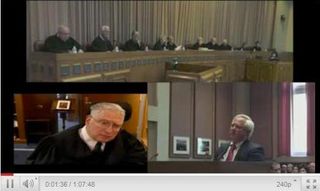
Guggenheim_enbanc

Last month, we attended the oral arguments in the rehearing en banc of Guggenheim v. City of Goleta, 582 F.3d 996 (9th Cir., Sep. 28, 2009).

The three-judge Ninth Circuit panel held 2-1 that a takings challenge was ripe under Williamson County, and ruled the City of Goleta, California’s ordinance was a facial taking by applying the three-part Penn Central test. The court remanded the case to the district court for a calculation of compensation owed to the property owners. On March 12, 2010, the court ordered en banc review.

Our summary of the oral argument is posted here. Today, the court posted the video from the hearing, complete with 24-style split screen. Check it out for a rare cameras-in-the-courtroom view of a federal appeals court in action. Continue Reading Ninth Circuit Posts Video Of Guggenheim (Rent Control Takings Case) En Banc Oral Arguments

Update: The court issued its opinion this morning.

++++++++++++++++++++++++

Is there anyone who can resist, when something Nantucket-related (mostly SFW) comes up, to launch into a limerick? We sure couldn’t.

But we will spare you our bad poetry this time, and instead focus on an appeal now under consideration by the Supreme Judicial Court of Massachusetts that is similar to a case now under consideration by the Hawaii Intermediate Court of Appeals. Both involve Torrens-titled property and claims of “public trust.” The timing is fortuitous — but coincidental — since Massachusetts and Hawaii are two of the last states to retain “Land Court” (Torrens) registration systems. What are the chances that two cases with similar issues are making their way up the chain?

In Arno v. Commonwealth of Massachusetts, No. SJC-10559 (argued Mar. 24, 2010), the SJC is considering whether property on Nantucket is subject

Continue Reading There Once Was Some Land In Nantucket … Mass SJC Considering Public Trust And Torrens Title Case