


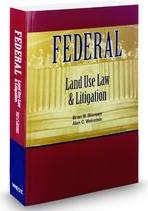
P13513986-160025L I’ve just received my copy of the 2010 revision of Federal Land Use Law & Litigation by Brian W. Blaesser and Alan C. Weinstein (West, $225).

Here’s the description of the book from West’s site:

Examines all federal, constitutional, and statutory limitations on local land use controls, discussing cases, regulations, liability, defense strategies, doctrines, and antitrust restrictions. Comprehensively reviews Supreme Court and lower federal court decisions that consider the constitutionality of land use regulations. Discusses complicated free speech issues affected by federal land use law, and municipalities exercising home rule powers. Examines issues such as: constitutional and statutory limits, First Amendment limitations on land use controls, federal remedies and attorney’s fees, liability and immunity issues, litigation guidelines, zoning, subdivision controls, growth management, model complaints, and selected constitutional and statutory decisions.

Federal Land Use Law & Litigation is an eminently useful single-volume research and reference guide. It’s well-organized, and although it

Continue Reading Book Review: Federal Land Use Law and Litigation, 2010 edition

The State of Hawaii has filed a brief responding to the amicus brief we filed in June in In re Trustees Under the Will of the Estate of James Campbell, No. 30006, an appeal now under review by the Hawaii Intermediate Court of Appeals. The issues in the case include the nature of “Torrens” title and the scope of the “public trust” in water resources.

Hawaii is one of the few remaining states retaining its Torrens system of title registration (two others are Massachusetts and Minnesota). We call it “Land Court,” a system in which the State guarantees indefeasible title to the rights and interests reflected in the title register. In Campbell, the State of Hawaii claims that title to property on Oahu’s north shore which was registered and confirmed to the Campbell Estate by the Land Court in 1938, is subject to the State’s ownership of “all

Continue Reading Final Brief In Torrens Title And Public Trust Appeal

Not much new in Numont v. State of Florida, No. 04-13610 (11th Cir., July 2, 2010) (per curiam). There, property owners sued to enjoin a Monroe County (aka the Florida Keys) ordinance that prevents “vacation rentals.” The opinion makes short work of two issues.

First, the court disposed of the claim that the ordinance was not properly adopted because it underwent “substantial or material” changes during the adoption process. The federal court certified the question to the Florida Supreme Court, which answered that the changes made conformed to the public notice, the ordinance was properly adopted.

Second, the property owners’ takings claim was not ripe since they conceded they had not sought relief in state court. The court rejected the property owners’ claim that doing so would be futile because the ordinance was “part of a larger regulatory effort to ban vacation rentals, an effort that they had challenged

Continue Reading 11th Circuit: Ixnay On The Vacay Rental Lawsuit

What we’re reading today – not all of it property or land use law related:


Continue Reading Friday Round-Up: Kagan On Property, RLUIPA, Second Amendment, CEQA, And Title VII (Yes, Title VII)

Here are items we’re reading today, in no particular order:

  • Bill Ward’s thoughts on Klumpp v. City of Avalon, the recent New Jersey Supreme Court case about inverse condemnation and beach restoration. Our take here.


Continue Reading Wednesday Potpourri: Inverse Condemnation And Beaches, Rail Takings, And More “Adult-Oriented” Land Use

Today, we bring you guest commentary on Stop the Beach Renourishment, Inc. v. Florida Dep’t of Environmental Protection, No. 08-1151 (June 17, 2010), last week’s Supreme Court decision on judicial takings and ownership of replenished beaches. 

++++++++++++++++++++++++++++++++++++++++++++++++++++++++++++++++

Beach Decision Draws No New Line in Sand

But high court launches debate about topic of judicial takings

By DWIGHT MERRIAM

On June 17, the U.S. Supreme Court handed down its decision in Stop the Beach Renourishment, its first property rights case since Kelo, Lingle and San Remo five years ago. The pundits pounced. Even the New York Times jumped on the dog pile with an editorial decrying Scalia’s promotion of judicial takings as “harebrained.”

The reaction is mostly overblown. This is a case the Court should not have taken. The Florida Supreme Court correctly decided the takings claim with a well-reasoned, rational analysis consistent with Florida precedent.

Coastal property

Continue Reading Guest Post: Beach Decision Draws No New Line In Sand

Zipler Our colleague Dwight Merriam reminds us that last year, a case related to a decision we posted about a couple of days ago was awarded a ZiPLeR.

Now in its thirteenth year, the award is presented by the Zoning and Planning Law Report for the “strangest, or at least more dramatic” land use cases each year. For an example of the awards edition of ZPLR, see here.

In 2009 it was the district court’s decision in Flava Works, Inc. v. City of Miami, that merited an award. According to Dwight’s write-up:

The We-Are-Just-Working-Girls Award, in yet another enforcement case, goes to cocodorm.com, which operates a website offering pornographic video over the internet for a fee. Thank you, Lora Lucero, for this nomination. Patricia Salkin also reported on it on her Law of the Land blog.

This isn’t the first enforcement case of this

Continue Reading We’re Going To Nominate The 11th Circuit’s “Porn Dorm” Case For A 2010 ZiPLeR Award

In Muscarello v. Ogle County Board of Commissioners, No. 08-2464 (June 24, 2010), the U.S. Court of Appeals dismissed as unripe a claim the county’s grant of a special use permit to a neighboring property owner allowing it to construct windmills on its land was a taking. 

Ogle County granted Baileyville Wind Farms a special use permit to allow the construction of 40 windmills on its property. Muscarello owns the adjoining property and brought suit in federal court for a variety of federal and state law claims. See pages 4-5 of the slip opinion for the details of the “laundry list” (in the court’s words) of allegations of harm (“We glean from all this, taking it in the light most favorable to Muscarello, that she believes that the preconstruction of windmills will have uncompensated adverse consequences for her and her fellow nonresidential property owners. Muscarello sued to stop the

Continue Reading Seventh Circuit: Claim A Wind Farm Is A Taking Is Tilting At Windmills

Most municipal zoning codes prohibit the operation of a “business” in a residential zone. Does this mean you can’t have a “home office” or take work-related calls at home? In most circumstances, doing so does not run afoul of the zoning code if the primary use of the home remains a dwelling house, and the business-like activities are incidental and subordinate to the residential purposes. Zoning codes are not meant to control every aspect of life, nor can they legally or practically.

The Miami zoning code allows “home occupations” provided they are not conducted by more than three people, and they are limited to certain occupations (architect, lawyer, real estate broker, for example). According to a new case from the U.S. Court of Appeals for the Eleventh Circuit, a “voyeur dorm” isn’t among the permitted uses of a residence. Flava Works, Inc. v. City of Miami, No. 09-11264 (June

Continue Reading 11th Circuit: Internet Porn Dorm Is “Business” In A Residential Zone

Here’s a round-up of reports and analysis of yesterday’s opinion by the New York Court of Appeals in the “Columbia U. blight” case, Kaur v. New York State Urban Development Corp., No. 125:


Continue Reading Friday’s Columbia “Blight” Case (Kaur) Links