Here’s one for all you CEQA mavens.

The California Supreme Court has determined that a denial of a conditional use permit to operate a private airport south of Sacramento is not a “project” under the California Environmental Quality Act. Sunset Sky Ranch Pilots Ass’n v. County of Sacramento, No. S165861 (Dec. 28, 2009).

Elk Grove airport has been around for a while (since 1934), when the surrounding area was most likely devoted to farming, not housing. We’re guessing that this one, like many rural airports, originally serviced crop dusting planes. By 2004, however, the nature of the area had changed, and the owner’s 5-year CUP was expiring. The owner applied for renewal.

The County denied renewal because the airport was “no longer … compatible with its surroundings.” One look at the aerial photo below should tell you this means residential development. People generally do not like airplanes buzzing overhead

Continue Reading Cal Supremes: Denial Of CUP For Private Airport Not A “Project” Requiring Environmental Review

WavesWith all that has been going on lately (SCOTUS arguments in the judicial takings case, New York’s courts issuing two big eminent domain decisions, etc.), we haven’t had the opportunity to summarize the oral argument in a very important Hawaii case.

Last month, the Hawaii Intermediate Court of Appeals heard arguments in the case about the taking of beachfront property, Maunalua Bay Beach Ohana 28 v. State of Hawaii, No. 28175.[Disclosure: we filed an amicus brief supporting the property owners, available here.]

Since there’s no official written transcript of Hawaii state courtappellate arguments, only an audio recording, we’re going toexperiment with a different approach than we’ve taken before, and embedsnippets of the recording into our written commentary, rather than attempt to transcribe the recording.

This is a rather long post, so if you’d rather just listen to our analysis along with the snippets, stop reading now


Continue Reading Taking Accretion By Legal Erosion: Summary Of The Oral Arguments In The Hawaii Beach Takings Case (Podcast)

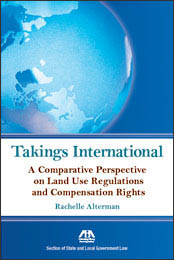
5330205_big Next month, the ABA Section of State & Local Government Law will be publishing a book by Professor Rachelle Alterman, Takings International: A Comparative Perspective on Land Use Regulations and Compensation Rights:

Everywhere in the world, land use law and regulation affect realproperty values–either increasing or decreasing them. Regulatorytakings is the potential raw nerve of land use regulation, yetpolicymakers and civic groups have tackled the issue without theperspective that a cross-national exchange of ideologies, laws, andpractices can provide.

Takings International is the firstlarge-scale effort devoted to this controversial issue, providing avast platform of comparative knowledge on direct, indirect,categorical, and partial takings. Written for legal professionals,academics, urban and regional planners, real estate developers, andcivil-society groups, the book analyzes thirteen advanced economycountries representing a variety of legal regimes, institutionalstructures, cultures, geographic sizes, and population densities.

Thecomparative prism yields some surprising and counterintuitiveobservations. In a climate of intensifying controversies about propertyand

Continue Reading New Book – Takings International: A Comparative Perspective on Land Use Regulations and Compensation Rights

This is Part II of our preview of the oral arguments in Unite Here! Local 5 v. City and County of Honolulu, the case in which the IntermediateCourt of Appeals held that unless the project changes, a supplementalEIS is not required under the Hawaii Environmental Policy Act, Haw.Rev. Stat. ch. 343.

In this post, we summarize the arguments of the parties and the amici. Part I of our preview (the summary of the issues and links to the opinion below and the briefs) is posted here.

A reminder: my colleague Mark Murakami, who blogs over at hawaiioceanlaw.com will be live blogging the arguments here (mirrored here). Tune in a few minutes before 9:00 when he goes live. I will also be commenting.

Keep the North Shore Country – Sierra Club, Hawaii Chapter

The parties seeking to overturn the ICA’s decision are Keep the North Shore Country

Continue Reading Oral Argument Preview, Part II: Hawaii Supreme Court Considers Whether A Change In “Context,” But Not The Project, Triggers A Supplemental EIS

Hawsctbldg

On Thursday, December 17, 2009, at 9:00 a.m. Hawaii time, the Hawaii Supreme Court will hear oral arguments in Unite Here! Local 5 v. City and County of Honolulu. Note: Justice Recktenwald is recused and Circuit Judge Derrick Chan will be taking his place. 

This post will review the issues in the case, and provide links to the parties’ and the amici briefs. In part II, we will summarize the arguments made by the various parties.

My colleague Mark Murakami, who blogs over at hawaiioceanlaw.com will be live blogging the arguments here (mirrored here). Tune in a few minutes before 9:00 when he goes live. I will also be commenting.

[Disclosure: although I have not participated in this case, two of my Damon Key colleagues — Mark, and Greg Kugle — have. They represented a party in the circuit court; Greg filed an amicus brief in the

Continue Reading Oral Argument Preview, Part I: Hawaii Supreme Court Considers Whether A Change In “Context,” But Not The Project, Triggers A Supplemental EIS

For better or worse, the U.S. Supreme Court’s 1954 decision in Berman v. Parker,348U.S. 26 (1954) marks the legal genesis of modern public use jurisprudence. The Court’s opinion in the case is pretty thin on facts, however, and does not provide any real clue regarding what was going on, or how the case came about.

Now, thanks to Albany Law’s Amy Lavine, you can discover the backstory. Urban Renewal and the Story of Berman v. Parker (posted on SSRN here). It’s fascinating reading. From the abstract:

TheSupreme Court’s 1954 decision in Berman v. Parker serves as thefoundation for much of our modern eminent domain jurisprudence,including the controversial 2005 Supreme Court decision in Kelo v. NewLondon. But the story behind the case starts well before 1954, and itcarries implications that are relevant today. It’s a story that playedout in many cities across the nation, just as it did in

Continue Reading Behind The Music: Berman v. Parker

I was reading this article in the San Francisco Chronicle about a dispute over whether a “concrete, flat-roofed Berkeley building [scroll down to the “Mobilized Women of Berkeley” listing] loosely linked to [architect] Bernard Maybeck” could be landmarked. According to the story:

The architect whose name is on the drawings of 1007 University Ave., however, is Phillip L. Coats, and it was built nine years after Maybeck retired.

The city’s landmark commission said Coats was a friend of Maybeck’s, and that’s close enough to merit protection. The commission voted unanimously in September to grant landmark status to the 1949 structure, citing Maybeck’s possible influence as well as the cultural history of the building.

Architectural historians say the building, with its uniqueglass-and-concrete lattice pattern, unmistakably bears Maybeck’simprint. Maybeck had worked extensively with the contractor and Coats,and would have been involved with this project because he had designedthe primary structure and

Continue Reading Landmarked For Being Loosely Linked To Famous Architect?

In WWBITV, Inc. v. Village of Rouses Point, No. 08-5112 (Dec. 9, 2009), the U.S. Court of Appeals for the Second Circuit held that a property owner whose building was demolished the day after it was badly damaged in a fire was not entitled to predeprivation notice.

After the building — an “old hotel” in up-up-upstate New York used for equipment storage — was damaged in a fire, the Village elders met the next morning and authorized demolition of the burned portion of the building. The property owners were not notified of the meeting or of the decision to demolish. That afternoon, the burned portions were demolished and the remainder followed several months later.

The only claim left standing after a motion to dismiss was the procedural due process claim that the Village owed the owners some kind of notice that their property was to be demolished.

Continue Reading Second Circuit: To Demolish Dangerous Property Without Notice, Don’t Delay

In its annual summary of the U.S. Supreme Court term, the Harvard Law Review addresses the Court’s most important decisions, and this year includes the “ceded lands” case, Hawaii v. Office of Hawaiian Affairs, 129 S. Ct. 1463 (2009). [Disclosure: we filed a brief in the case in support of the State, available here]. The case summaries are not attributed to a particular author, and are the product of the editorial board (student authors). The summary is available here (123 Harv. L. Rev. 302 (2009)).

The article argues that the Court should have given the Apology Resolution legal meaning, because doing otherwise “perpetuat[ed] an understanding of political rhetoric as meaningless and impotent.”

If Congress viewed an apology as an essentially impotent act that merely expresses goodwill, then it would be hard to explain the resistance that proposed apologies consistently face. In fact, only Japanese internment, the Hawaiian overthrow

Continue Reading Harvard Law Review On The “Ceded Lands” Case

Attacus

We promised in our earlier post on Mann v. Calumet City, No. 09-1681 (Dec. 7, 2009) that we were going to read the egg-sucking dog case, Hull v. Scruggs, 2 So.2d 543 (Miss. 1941). We have, and present it below in its full glory.

The rule of law in the case was summarized by Johnny Cash:

Dirty Old Egg-Sucking Dog

Well he’s not very handsome to look at
Oh he’s shaggy and he eats like a hog
And he’s always killin’ my chickens
That dirty old egg-suckin’ dog

Egg-suckin’ dog
I’m gonna stomp your head in the ground
If you don’t stay out of my hen house
You dirty old egg-suckin’ hound

Now if he don’t stop eatin’ my eggs up
Though I’m not a real bad guy
I’m going to get my rifle and send him
To that great chicken house in the sky

Egg-suckin’ dog

Continue Reading To Kill An Egg-Sucking Dog