Thank you to Kamuela attorney Margaret Wille for allowing us to post the commentary she published in West Hawaii Today (Mar. 7, 2009), but which is not available on line. Posting on inversecondemnation.com is not an endorsement of the views expressed or the conclusions reached, but we thought it was worthwhile to hear others’ voices on this important subject. Disclosure: we represent the property owners in the eminent domain cases instituted by the County, County of Hawaii v. C&J Coupe Family Ltd. P’ship which she discusses. Our thoughts on the topic are posted here.

Who Pays For Impacts: You Do
by Margaret Wille

Recently there have been several articles in West Hawaii Today about “fair share” versus “impact” fees.  Probably there are many readers who wonder why do these fees matter to me. In other words, does this issue affect the ordinary Big Island taxpayer?  Yes, very much so.  

These fees, regardless of name, are charged to developers to defray a portion of the cost to maintain the current level of service for one or more categories of public facilities impacted by the proposed development.

The first question to ask is whether you believe the developer who reaps the financial benefit of the new development should shoulder a portion of the financial cost to maintain the current level of service for affected public facilities that are off of the developed property, e.g. area roads or police and fire stations. Would you rather all of the resulting costs to maintain the current level of service of these affected public facilities be paid for by us existing taxpayers? By way of example, when Costco went in, who paid the 5.5 million in cost to upgrade the Queen K intersection, just to maintain the current level of service at that intersection (I believe the level of service of that intersection was level D if not worse.) We did, you, me, all of us existing taxpayers and businesses paid for the improvements needed just to continue at that same low level of service (and if bond money was used for a portion of either the County’s or the State’s cost, you could say we saddled our kids with some of this expense).  If the County had passed a development fee ordinance consistent with the State’s 1992 impact fee law, some of the County’s cost of those intersection improvements would instead have been paid by Costco’s owners.  

Continue Reading Impact Fees And “Fair Share” Guest Commentary: “Who Pays For Impacts: You Do”
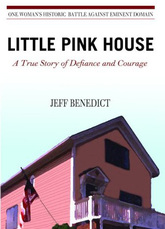
Lph Certain addresses — real and fictitious — are instantly recognizable: 1600 Pennsylvania Avenue NW, Washington, DC and 221B Baker Street, London for example.

8 East Street, New London, Connecticut, however, isn’t an address that most people recognize. 

is the former address of the “little pink house” which is the subject of Jeff Benedict’s Little Pink House – A True Story of Defiance and Courage (Grand Central Publishing 2009) (available from Amazon here)

County of Hawaii v. C&J Coupe Family Ltd. P’ship, 119 Haw. 352, 198 P.3d 615 (2008) 

Disclosure: we filed an amicus brief (posted here) supporting Susette Kelo’s arguments in the U.S. Supreme Court.Continue Reading Book Review: Little Pink House – A True Story Of Defiance And Courage

Some interesting items have crossed my desk on Friday and Saturday:

  • From the Grand Theft: Property blog, Jim Mattson posts his thoughts about Monks v. City of Rancho Palos Verdes, 67 Cal. App. 4th 263 (Cal. Ct. App. 2008), the case in which a California Court of Appeals held that a municipality’s development moratorium was a Lucas taking.
  • From the New York Zoning and Municipal Law blog comes a summary and analysis of the recent oral arguments in the latest phase of the Atlantic Yards eminent domain fight from Brooklyn. 
  • More on AmeriSource v. United States, No. 08-497 (cert. petition filed Oct. 15,


Continue Reading Weekend Round-Up

At first, it was a bit odd to see Washington, D.C. attorney Kannon Shanmugam, counsel for the Office of Hawaiian Affairs in the “ceded lands” case immediately concede in oral argument that the U.S. Supreme Court should rule against OHA — and hold the Apology Resolution was simply a symbolic statement of regret — if the Hawaii Supreme Court’s decision relied on it. Responding to a question from Justice Ruth Bader Ginsburg, he stated: 

Let me — let me be clear about this, Justice Ginsburg,if the Hawaii Supreme Court’s opinion is read to construe the ApologyResolution as creating some affirmative duty or obligation as a matterof Federal law, we agree that that would be erroneous. And if the Court–

Tr. at 31.  Later, Shanmugam again conceded the point:

Andit’s for that reason, Justice Ginsburg, that we freely concede that ifthe Hawaii Supreme Court had relied on the Apology Resolution

Continue Reading Argument To SCOTUS: “Don’t Taze Me, Bro!” — What Was Really Going On In The “Ceded Lands” Oral Arguments?

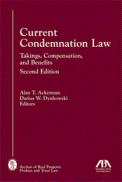
5430464_big A recent book of interest to condemnation lawyers, Current Condemnation Law: Takings, Compensation & Benefits (2d ed.).

The book is co-edited by my Owner’s Counsel of America colleague Alan T. Ackerman. (He also has a blog about eminent domain issues.)

From the blurb:

Condemnation of property is an especially topical subject after the U.S. Supreme Court’s controversial decision in Kelo v. City of New London. This completely revised edition of Current Condemnation Lawexamines the many complexities involved in the practice of eminentdomain law in order to assist lawyers in best protecting the clients’interests in these cases. The book brings together experts in thespecialty to provide analysis of both major and specialty areas ofcondemnation law, providing “how to” tips along with currentdiscussions of case law and theory.

The chapters in Current Condemnation Lawprovide a thought-provoking mix of articles covering the key topics ofbusiness valuation, contamination issues, the right

Continue Reading New Eminent Domain Book: Current Condemnation Law: Takings, Compensation & Benefits (2d ed.)

This continues our summary of today’s oral arguments in the “ceded lands” case. The summary of the state’s argument is posted here, the summary of OHA’s argument is posted here, and the transcript is posted here.

What Issues Are Presented?

Assistant to the Solicitor General William Jay argued for the Obama Administration as amicus curiae, supporting the state’s position. His initial argument — that “three federal laws” (the Newlands Resolution, the Organic Act, and the Admission Act) make it clear that the State of Hawaii has absolute fee simple title to the ceded lands — was immediately challenged by the Chief Justice as perhaps being beyond the the Question Presented (whether the Apology Resolution had any substantive legal effect).  Jay responded that the other issues have been in the case since the start, and were considered by the Hawaii Supreme Court. The Question Presented also posed

Continue Reading Federal Goverment’s Arguments In SCOTUS “Ceded Lands” Case

This continues our summary of today’s oral arguments in the “ceded lands” case. The summary of the state’s argument is posted here, and the transcript is posted here.

Washington, D.C. attorney Kannon Shanmugam argued for OHA. He began by asserting  that the issue in the case should be very narrowly drawn: whether the Hawaii Supreme Court’s decision was based on the Apology Resolution. He staked OHA’s entire argument on the factual issue of whether the Hawaii Supreme Court’s decision was based on the state’s fiduciary duties to Native Hawaiians under state law, and whether the court only relied on the Apology Resolution as a recognition that Native Hawaiians have political claims.  He conceded that if the Hawaii Supreme Court’s decision was based on the Apology Resolution, OHA should lose:

And it’s for that reason, Justice Ginsburg, that we freely concede that if the Hawaii Supreme Court had

Continue Reading OHA’s Argument In SCOTUS “Ceded Lands” Case

The transcript of today’s oral arguments in the “ceded lands” case is posted here.

Hawaii Attorney General Mark Bennett argued for the State.  He began by asserting that the Apology Resolution did not alter the state’s right to transfer the lands, and that it was, “as its sponsor said at the time, a simple apology, and no more.” He argued that the Apology Resolution did not cloud the state’s perfect title to the ceded lands, title that was derived from the United States’ title, transferred to the state in the Admissions Act.

Equitable Interest?

Justice Stevens started off the questioning, asking whether that proposition addresses OHA’s claims to an “equitable” interest in the ceded lands. Bennett responded by pointing out that “from day one in this case,” OHA argued that it has a property right in the land. Justice Kennedy asked hypothetically whether under Hawaii law, the state as

Continue Reading State’s Argument In SCOTUS “Ceded Lands” Case

The Supreme Court’s courtroom reporter has provided the raw transcript of today’s oral arguments in the “ceded lands” case, Hawaii v. Office of Hawaiian Affairs, No. 07-1372 (cert.granted Oct. 1, 2008. 

The transcript is posted here

For a primer/FAQ on appellate oral arguments and what they entail, go here.

While we haven’t reviewed it in detail yet, a quick read shows that one of the more interesting parts is the federal government’s argument as amicus curiae supporting the state. The argument, presented by Assistant to the Solicitor General William Jay, begins on page 18 of the transcript. 

Three binding Federal laws make clear that the State of Hawaii has absolute fee title to the lands in the Federal trust and also has the power to sell those lands for the purposes Congress set out in the trust instrument.

CHIEF JUSTICE ROBERTS: What do you think on

Continue Reading Oral Argument in “Ceded Lands” Case – Transcript And Summary

We will be posting the transcript — perhaps with some analysis thrown in — of tomorrow’s Supreme Court oral arguments as soon as it becomes available, but in the meantime, here is the latest:

  • David Shapiro posts “Senate sends mixed signals on ceded lands” on his Volcanic Ash blog: “Given that neither the governor nor the Legislature plan to sell cededlands anytime soon, you  wonder why OHA didn’t pursue this kind ofpolitical agreement in the first place instead of pressing the issue incourt and exposing themselves to the unintended consequences they fearfrom an adverse ruling by the Supreme Court.” The old adage of “be careful of what you wish for…” seems to apply here, since many seem to forget or overlook the fact that OHA raised the issue now before the Supreme Court.


Continue Reading The Latest On The “Ceded Lands” Case