


The California Coastal Commission has filed its Brief in Opposition to the cert petition in Charles A. Pratt Const. Co. v. California Coastal Comm’n, No. 08-668 (cert. petition filed Nov. 18, 2008) (SCOTUS docket report here).  The California Court of Appeal’s opinion, reported at 76 Cal. Rptr. 2d 466 (Cal. Ct. App. 2008) is available here). 

The issues presented involve the Penn Central ad-hoc test for regulatory takings, and the “final determination” prong of the Williamson County ripeness rule.

We filed an amicus brief in the case, available here. The cert petition and the other amici briefs supporting it are posted here.Continue Reading California Coastal Commission’s Brief In Opposition In Charles A. Pratt Construction Co. Cert Petition (Penn Central and Williamson County)
Here are links to the cases discussed on the conference call this morning:

The majority opinion by Justice Acoba, joined by Justices Nakayama and Duffy is posted here:

We hold that (1) a landowner in a condemnationaction is entitled to damages under HRS § 101-27 where the property atissue is not finally taken in the context of a particular condemnationproceeding, irrespective of whether the government attempts to take theland through subsequent condemnation proceedings; (2) abatement doesnot apply where the relief sought in two concurrent actions is not thesame; and (3) although our courts afford substantial deference to thegovernment’s asserted public purpose for a taking in a condemnationproceeding, where there is evidence that the asserted purpose ispretextual, courts should consider a landowner’s defense of pretext. Therefore, (1) automatic denial of statutory damages under HRS §101-27in Condemnation 1 is vacated and the case remanded for a determinationof damages, (2) the court’s conclusion that Condemnation 2 was notabated by Condemnation 2 is vacated and the case remanded for adetermination of whether the public purpose asserted in Condemnation 2was pretextual.

Slip op. at 5. Here’s the concurring and dissenting opinion by Chief Justice Moon joined by Justice Levinson. The briefs in the case are available here:  Opening Brief, Answering Brief of the County of Hawaii, Reply Brief. Disclosure: we represent the property owner.

      • The Ninth Circuit’s decision in West Linn Corporate Park, LLC v. City of West Linn, Nos. 05-36061, 05-46062 (9th Cir. July 28, 2008) (regulatory takings case removed to US District Court, Ninth Circuit certified questions to Oregon Supreme Court)

        Continue Reading State & Local Government Condemnation Committee Links

        Here’s the latest in the “ceded lands” case, now being briefed in the U.S. Supreme Court. 

        The Honolulu Advertiser writes that “OHA looks for some backup,” and has drafted a bill, to be considered by the Hawaii Legislature in its upcoming session, that appears to codify the Hawaii Supreme Court decision in Office of Hawaiian Affairs v. Housing and Community Dev. Corp. of Hawaii, 117 Haw. 174, 177 P.3d 884 (Jan. 31, 2008), now under review by SCOTUS:

        OHA board Chairwoman Haunani Apoliona yesterday said she and hercolleagues will lobby lawmakers to pass a bill that would impose amoratorium on the sale of ceded lands until the “unrelinquished claims”of Native Hawaiians to those lands are settled.

        Such a moratoriumwould mirror the language of a January 2008 Hawai’i Supreme Courtdecision that ordered the state not to sell or transfer ceded landsuntil claims by Hawaiians to those lands are

        Continue Reading Latest Gambit In SCOTUS Ceded Lands Case

        09.LULHI It’s not too late to register to attend the Hawaii Land Use Law Conference, taking place January 15 and 16, 2009, in Honolulu. 

        Items on the agenda include eminent domain, environmental law, transit-oriented development, subdivision requirements, and cultural impact statements. The program co-chairs are Professor David Callies and land use lawyer Ben Kudo.

        This conference takes place only once every two years, so this is your last chance for a while to learn of the latest information and updates, and what issues are on the horizon.

        I’m on the faculty, presenting a session on Emerging Water Issues: Coastal Zone Management Permits, and Hawaii’s Floodway, Floodplain and Coastal Inundation Zone Requirements.  The complete agenda and faculty listing is posted here.

        Hope you can attend, and if you do, please stop by and say hello.Continue Reading Upcoming: Hawaii Land Use Law Conference

        In a development that began in November 2007 (2005 actually, if the starting point is seen as the U.S. Supreme Court’s decision in Lingle v. Chevron, U.S.A., Inc., 544 U.S 528 (2005)), the Ninth Circuit finally ditched Armendariz v. Penman,75 F.3d 1311 (9th Cir. 1996) (en banc), and recognized that property owners are not limited to regulatory takings claims when challenging land use regulation, and the government can violate substantive due process as well.  In 2008, the Ninth Circuit issued a number of decisions in which it recognized that Armendariz‘s forced election of a regulatory takings remedy has been truly overruled. 

        Rather than plow through multiple posts, it would be easier to just download a recently published article I wrote on the subject, collecting all the cases, The Ninth Circuit Rediscovers Substantive Due Process In Land Use Cases (31 Zoning and Planning Law Report (Thomson | West

        Continue Reading 2008 Land Use In Review: The Ninth Circuit Rediscovers Substantive Due Process

        Currently at the annual conference on eminent domain law – as always, well worth attending.

        In the morning’s session, Professor Kanner mentioned the recent decision in County of Hawaii v. C & J Coupe Family Limited Partnership, No. 28882 (Dec. 24, 2008), which has not yet been published in the official reporters.  The slip opinion is posted here. Continue Reading At The ALI-ABA Conference On Eminent Domain And Land Valuation

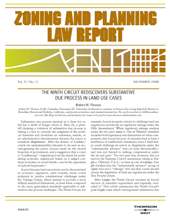
        Zplr_p1 The Zoning and Planning Law Report (Thomson | West) has published my article about the post-Lingle developments in substantive due process in the Ninth Circuit. Download a pdf of the article here.

        From the introduction:

        Substantive due process asserted as a claim for relief has a whiff of danger about it. After all, a plaintiff claiming a violation of substantive due process is asking a court to override the judgment of the political branches and invalidate an ordinance, statute, or an administrative determination because the action is somehow illegitimate. After the demise of Lochner, courts are understandably reluctant to be seen as second-guessing the policy choices made by the elected branches of government, and a suggestion that a court is “Lochnering”—legislating from the bench by invalidating economic regulations based on a judge’s contrary economic or social beliefs—can be the equivalent of judicial kryptonite.

        In

        Continue Reading New Article: The Ninth Circuit Rediscovers Substantive Due Process In Land Use Cases

        Thanks to SCOTUSblog for posting the cert petition, filed on January 5, 2008, in Navajo Nation v. United States Forest Service, No. 08A368.

        The petition seeks review of an en banc Ninth Circuit panel decision holding it was not a “substantial burden” on the religious exercises of Native American tribes for the Forest Service to allow a ski resort to make artificial snow on a mountain considered by the tribes to be sacred. The artificial snow is made from recycled sewage water. 

        The Ninth Circuit held the Religious Freedom Restoration Act, a federal statute which requires the government to justify with compelling reasons actions which substantially burden religious exercises, does not apply.  The court held that religious exercises are only burdened under the RFRA only when a person is forced to choose between adhering to their religion and accepting a government benefit, or when civil or criminal penalties

        Continue Reading Cert Petition Asks: Does Spraying Recycled Sewage Water On A Sacred Mountain “Substantially Burden” Religious Exercise?

        2008 saw no blockbuster court decisions on shoreline law, just a continuation of existing trends.

        Setbacks

        Shoreline setback are a “no build” zone on private beachfront property, measured from a “setback line.”  Hawaii state law establishes a minimum shoreline setback, and the four counties are allowed to establish their own (greater) setbackstandards. In 2008, Kauai enacted what one commentator described as the nation’s “most conservative” shoreline setback regulations (more here), continuing the trend of variable shoreline setbacks measured by historical erosion and accretion rates. For more, check out a U. Hawaii Law Review article on shoreline setbacks, published last year.

        Public Access

        Shoreline setback lines do not concern ownership, or the boundary between public beaches and private property. Theshoreline certification process under the state Coastal Zone Management Act is not supposed toaffect property rights or determine where the public may or may notaccess.  However, the two concepts continue to

        Continue Reading 2008 Land Use In Review: Shoreline Law

        The Hawaii Supreme Court clarified when an agency hearing will be deemed to be a “contested case” in E & J Lounge Operating Co. v. Liquor Comm’n of the City & County of Honolulu,No. 27940 (July 29, 2008). The issue was whether, as the caption of the caseindicates, a public hearing before the Honolulu Liquor Commission was acontested case under Haw. Rev. Stat. § 91-1(5). The court also held that under the automatic approval statute, Haw. Rev. Stat. § 91‑13.5,an agency must act to grant or deny a permit application within acertain time period, but is not required to make a “legally effective”decision, at least procedurally.  Slip op. at 64-65. More here.Continue Reading 2008 Land Use In Review: Contested Cases Refined