Syllabus

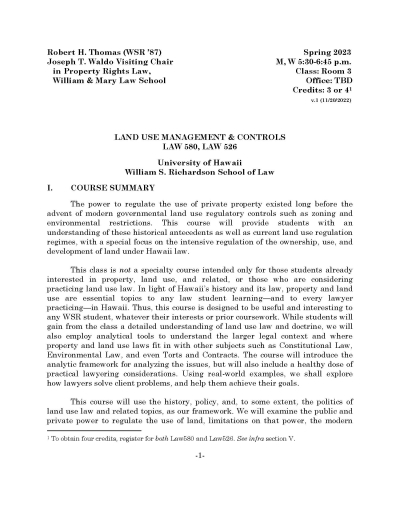
Starting in January, we’ll be teaching the venerated, and oh-so-important Land Use course (Law 580) at the University of Hawaii’s Law School.

We’re at least temporarily stepping into some mighty big slippers (this is Hawaii, so we don’t always wear shoes), as this is the course that our mentor Professor David Callies taught for decades. And is there a better venue in which to teach and study land use law and regulation, and its limits? After all, Hawaii may be the most heavily-regulated land on the planet, and is a focal point for every issue you can think of, from zoning to environmental restrictions to takings to public trust to subdivision to admin law to … well, you get the drift.

We’ll cover those topics, as well as the fundamentals. And we have a few surprises up our sleeve – some impressive guest lecturers, explorations of dirt law careers

Continue Reading Hawaii 5-80: Land Use Law At The University Of Hawaii

Here it is, the official agenda and program for the 40th ALI-CLE Eminent Domain & Land Valuation Litigation Conference, February 2-4, 2023 (with a special event the evening of Wednesday, February 1, 2023 to entice you to arrive early).

Screenshot 2022-11-18 at 13-35-13 ALI CLE PA NY VA TX FL Continuing Legal Education

Here’s the brochure with the complete agenda, schedule, and faculty listing. But to tempt you, here are some of the highlights of the program:

  • Everything Old is New Again: Why Today’s Practitioners Need to Understand the Original Meaning of the Takings and Just Compensation Clauses
  • Private Utility Takeovers – Lessons From a 67 Day Trial

  • Valuation Issues When Billboards and Signs are Condemned

  • Setting Client Expectations and Identifying Red Flags

  • Developing Property Right Issues in Texas – Questions and Answers from the Bench: A View From the Bench (with Texas Supreme Court Justice Jimmy Blacklock)

  • Eminent Domain and Regulatory Takings Updates: Important Decisions You Need to Know

  • Ethics:


Continue Reading Here’s The Program For The 40th ALI-CLE Eminent Domain & Land Valuation Litigation Conference, Feb 1-4, 2023, Austin

Well, that was quick. As we noted here, we recently argued a case in the Ninth Circuit (October 20, 2022) about whether a regulatory takings claim is ripe

Not long after we posted the argument recording, the Ninth Circuit panel issued a short memorandum opinion rejecting our arguments wholesale (November 1, 2022).

So earlier this week, we asked the entire Ninth Circuit to take a look. Here’s our en banc petition.

We’ll leave it to you to read it and see why we think this one is ripe.

Appellants’ Petition for Rehearing En Banc, Ralston v. San Mateo Cnty., No 21-16489 (9th Cir. Nov. 15, 2022…

Continue Reading Let’s Take A Deeper Look At Takings Ripeness, Ninth Circuit

Check it out: our Pacific Legal Foundation colleagues Jim Burling, Jon Houghton, and Jeff McCoy, along with Jeremy Hopkins (Cranfill & Sumner, North Carolina), share with us the latest on property rights, Sackett, takings, the future of Penn Central, and the upcoming SCOTUS arguments in Wilkins v. United States (is the Federal Quiet Title’s statute of limitations jurisdictional?).

Don’t miss it.Continue Reading Video: “The Future of Private Property Regulation in America”

The County of El Dorado requires everyone seeking a building permit for new development to pay a fee to mitigate the additional traffic that the proposed development is predicted to cause. But the County doesn’t calculate the fee by actually looking at a proposed development and predicting what traffic impacts in may be responsible for. Rather, it has a generic fee schedule that applies to all proposed developments broken down by location and type (residential, commercial, etc.). We don’t care whether your development actually causes more traffic (or if it does, the extent of the increase), we’re hitting you all up.

Or as the California Court of Appeal put it in Sheetz v. County of El Dorado, No. C093682 (Oct. 19, 2022), “[i]n assessing the fee, the County does not make any ‘individualized determinations’ as to the nature and extent of the traffic impacts caused by a particular project

Continue Reading Whether $23K Traffic Fee Is Proportional To One Single-Family Home Is Beyond The Ken Of Judges

Takingspanel

For the last week, the blog has been a bit idle. That hasn’t been because we’re slowing down, but was mostly the result of our blog platform being worked on behind-the-scenes, which knocked a lot of the hosted blogs offline, this one included. But things look good now, so here we are.

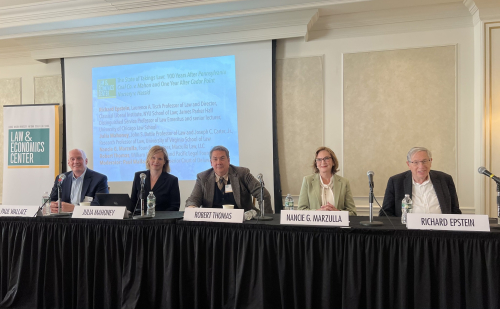
We were also on the road, traveling to New York for the Seventeenth Meeting of the American College of Business Court Judges, where we were able to join an august panel of takings mavens (pictured above, L-to-R: Judge Paul Wallace, Professor Julia Mahoney, some guy, Nancie Marzulla, and Professor Richard Epstein) to talk about the state of takings law.

The title of our program was “The State of Takings Law: 100 Years After Pennsylvania Coal Co. v. Mahon and One Year After Cedar Point Nursery v. Hassid,” and we spent our time discussing and debating

Continue Reading What’s “The State of Takings Law: 100 Years After Pennsylvania Coal Co. v. Mahon and One Year After Cedar Point Nursery v. Hassid”? Incoherent (But Getting Better)

Earlier this month, the U.S. District Court invalidated Honolulu’s stretching of the minimum term for a residential rental from 30 days to three months, concluding that the ordinance likely violates the state Zoning Enabling Act, and also would be a taking if implemented. The court issued a preliminary injunction.

The lawyers repping the plaintiffs in that case — our former law partner Greg Kugle — appeared on Kelii Akina’s Hawaii Together (Think Tech) program to talk about it more. Check it out.Continue Reading More On Federal Court Invalidating Honolulu’s 3-Month Minimum Rental Term

October 20, 2022 was what one advocate noted was “land use day at the Ninth Circuit,” because three out of the four cases being argued in Courtroom 3 of the San Francisco courthouse were indeed land use — or perhaps more accurately, regulatory takings — cases.

Ours was one of those cases, Ralston v. San Mateo County.

Without going into too much detail, this is an appeal from the district court’s 12(b)(6) dismissal of our regulatory takings complaint. The crux of the claim is that Ralston’s R-1 zoned property is subject to an “overlay” district called the Montecito Riparian Corridor, a highly-restricted zone that allows only 5 environmental uses of land within the zone (none of which are consistent with the R-1 zoning). (Ralston’s property is labeled “076-19” on the County’s MRC map.)

Montecito Riparian Corridor

Absent some kind of special dispensation — what the County calls an “override” —

Continue Reading CA9 Takings Ripeness Oral Arguments: Must Property Owners Secure Govt’s Agreement That Property Is Subject To Challenged Regulations Before A Court Can Review?

IMG_20170323_142842

Here’s one we’ve been waiting to drop, in a case we’ve been following.

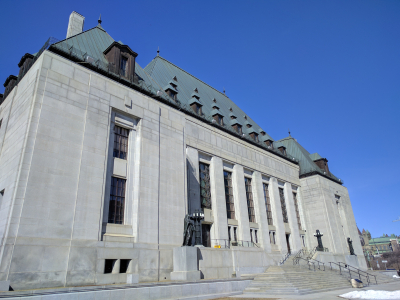
Today, in Annapolis Group Inc. v. Halifax Regional Municipality, No. 39594 (Oct. 21, 2022), the Supreme Court of Canada held (and we’re translating into United States here), that to state a claim for a regulatory taking based on the government’s refusal to approve a development application consistent with the residential zoning, requires only that the plaintiff allege a taking of a beneficial interest, and does not require that the government have seized land.

Our northern friends do not label this claim a “taking” or “regulatory taking,” but use different terms: de facto expropriation or constructive appropriation, or constructive taking, or even “disguised expropriation.” You get the drift. (For the record, we really like “disguised expropriation.”)

One major difference between Canadian takings law and the U.S. approach is that Canada does not consider property rights to

Continue Reading Oh, Canada! SCOCAN: Constructive Appropriation (Regulatory Takings) Claim Need Not Be Based On Land Acquisition; Taking Of Beneficial Interest Suffices

Many Honolulu residents don’t like short-term (less than 30 day) rentals. Whether fueled by NIMBY-ism, a genuine belief that tourists should stay out of residents’ neighborhoods and be limited to accommodations built for transients, or the belief that long-term rentals to locals somehow promote more affordable housing, the anti-transient renter vibe is most definitely there.

The no-less-than-thirty-days restriction wasn’t enough, however, and recently the City and County of Honolulu made it illegal to rent for less than three months (90 days). The ordinance stated the reasons:

Short-term rentals are disruptive to the character and fabric of our residential neighborhoods; they are inconsistent with the land uses that are intended for our residential zoned areas and increase the price of housing for O‘ahu’s resident population by removing housing stock from the for-sale and long-term rental markets. The City Council finds that any economic benefits of opening up our residential areas

Continue Reading Federal Court: Honolulu’s 3-Month Minimum Rental Term Preempted By State Law (And Would Be A Taking Of Vested Rights)