A short one from the Florida District Court of Appeal (Second District) on exactions.

More precisely, what is an “exaction.”

In Murphy Auto Group, Inc. v. Fla. Dep’t of Transportation, No. 2d19-1236 (Nov. 20, 2020), the court held that the requirements of Nollan/Dolan (nexus and rough proportionality) apply when the DOT demanded the owner spend money to improve government-owned land as a condition of granting a permit to develop the owner’s own land.

Initially, the DOT demanded that the owner dedicate a strip of land as a condition of the DOT’s grant of a drainage and driveway connection permits the owner needed to develop its commercially-zoned property (DOT controlled access to the adjacent highway). The owner declined to make the dedication, and in a counter-proposal, the DOT “required that Murphy, at its sole expense, reconstruct the drainage collection system as a condition for approval of the drainage

Continue Reading It’s An “Exaction” When Govt Requires Landowner To Spend Money To Improve Govt Land
Charlie Brown got a bag of rocks for Halloween.

But you aren’t so cruel, and want to give better gifts this holiday season to the dirt lawyer in your life, no? Here are our 2020 suggestions for stocking stuffers that will make property mavens celebrate the season. 

Start with this one, Professor Bart Wilson’s newly-published “The Property Species – Mine, Yours, and Human Mind.” As describe in the book blurb: “Arguing that neither the sciences nor the humanities synthesizes a full account of property, the book offers a cross-disciplinary compromise that is sure to be controversial: Property is a universal and uniquely human custom. Integrating cognitive linguistics with philosophy of property and a fresh look at property disputes in the common law, the book makes the case that symbolic-thinking humans locate the meaning of property within a thing.”

Property book cover image

We are so confident that the book is sure


Continue Reading Holiday Suggestions For The Dirt Lawyer On Your List (2020 Edition)

Often, the dispositive question in many takings cases tuns on whether the plaintiff owns “property,” and if so, what rights does that recognize. If you define the property in such a way that ipse dixit excludes the “stick” the owner claims was taken, then the answer is always going to be no property, no taking. To us, this is largely a question of definitions and policy: is this interest, in a judge’s view, worthy of constitutional protection?

And that’s the wrong approach, because this analysis often seems more like a semantic exercise, undertaken by the wrong party. Instead of concluding, for example, that the property in a case is a lease (a recognized property interest) and then going on to ask whether there’s been a sufficient interference with an owner’s distinct investment-backed expectations, the question shifts from what we think is the proper focus (a fact question of the impact

Continue Reading Surf And Turf (Our Beef With The Virginia Oyster Takings Case): Although Leases Are “Property,” They Don’t Confer A Right To Exclude Government Sewage

Here’s the Reply in Support of what we think is a very worthy cert petition, and which responds to the recently-filed BIO.

For the background of the case, check out this post (“What Constitutes a Loss“). The property owner has also summarized the situation thusly in its petition:

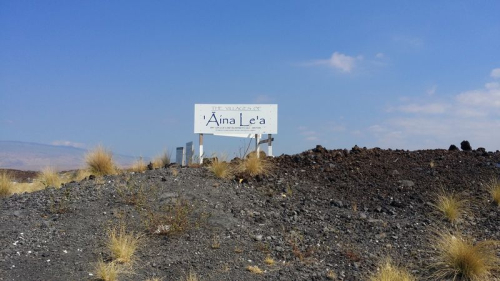
The State of Hawaii zoned for agricultural use land that it knew was not viable or appropriate for such use. At the property owner’s request, it rezoned it for urban use but, after Plaintiff Bridge Aina Le‘a began developing it, the State illegally (as the Hawaii Supreme Court later held) “reverted” the land to agricultural use. A jury found this to be a 5th Amendment taking under this Court’s standards in both Lucas v. South Carolina Coastal Council, 505 U.S. 1003 (1992) and Penn Central Transp. Co. v. City of New York, 438 U.S. 104 (1978).

Continue Reading Reply In Penn Central And Lucas Takings Case

PXL_20201118_163528916 (1)

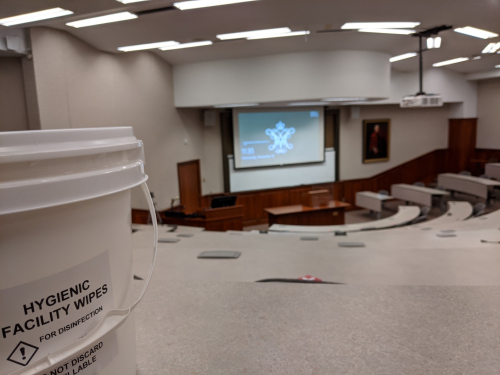
We have now wrapped up the coursework portion of the Fall semester at William and Mary Law School, so here’s an after-action report from the two full courses which I taught in a “hybrid” style (some students live, in the classroom; others attending via Zoom live; and still others with the option to attend via the Zoom recording). The two courses: (1) Land UseEminent Domain & Property Rights

Overall, it went much better than I think nearly everyone else expected. When I say “everyone else,” that is because when I posted photos of the “distanced” classroom that the law school set up in the adjacent indoor Tennis Center, the reactions were mostly dubious, or even scornful. I had much less doubt about teaching and learning in a non-typical environment. The in-person option, I believed, was essential, and anything less would likely be … less.

So off

Continue Reading Wrapping Up A Semester In A “Hybrid” Law Classroom (Never Go “Full Remote”)

Ainalea

Here’s the State of Hawaii’s Brief in Opposition in a case we’ve been following for what seems like forever.

Check it out. The State waived response, but after a whole bunch of amici filed briefs in support of a cert grant (ours included), at least one of the Justices wanted to hear its arguments in opposition. 

Instead of the State’s “Solicitor General” filing the brief, it hired a SCOTUS player to argue that this case isn’t worth the Court’s time. The need to hire the D.C. big guns with name-recognition instead of relying on the in-house lawyers who are the State’s appellate experts somewhat belies any assertion that the State isn’t concerned about this case. 

Here are the Questions Presented as (re)framed by the BIO:

1. Whether the Ninth Circuit correctly held that Petitioner did not suffer a taking where the State rezoned Petitioner’s property because

Continue Reading BIO In Penn Central And Lucas Takings Case

Screenshot_2020-11-05 Legal challenges regarding COVID-19 emergency orders

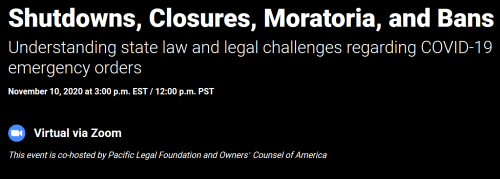
Join us next Tuesday, November 10, 2020 at 3pm ET (12 noon Pacific) for the free webinar “Shutdowns, Closures, Moratoria, and Bans,” produced by Pacific Legal Foundation and Owners’ Counsel of America.

Along with my colleagues Leslie Fields (Executive Director, OCA), and Jim Burling (PLF), I’ll be talking about the legal foundations for objections, some of the cases that have made their way to decision, and what the future might look like. To register (did I mention it was free?) go here.

Here’s the program description:

Governors and state legislatures across the country have implemented an array of policies in an attempt to contain the virus and its socioeconomic impacts. Many of these policies broadened the scope of government power while placing a heavy burden on property owners and businesses already struggling with the pandemic.

Join representatives from Pacific Legal Foundation and Owners’ Counsel of America as

Continue Reading Join Us: Tuesday, Nov. 10, 2020 (3pm ET, 12n PT) For Free (!) Webinar: “Shutdowns, Closures, Moratoria, and Bans”

This semester, we’re teaching two courses at the William and Mary Law School: the usual Eminent Domain & Property Rights (our regularly-scheduled fall semester course), and Land Use. If we were to try and create a hypothetical for the final exam in either class, we couldn’t do better than the actual fact pattern and arguments presented to the Texas Court of Appeals in City of Dickinson v. Stefan, No. 14-18-00778-CV (Oct. 27, 2020). That case involved a use of property alleged to have been started before the city adopted a zoning code, and claims of vested rights, “grandfathering,” and related.

We won’t recount the entire fact pattern here (we suggest reviewing the entire opinion yourself; it is a decent read), and only note that it covers a range of land use and takings topics, including the aforementioned nonconforming use arguments, exhaustion of admin remedies, and the like. In all

Continue Reading Your Land Use/Takings Exam Hypo: Tex App Considers Nonconforming Uses, Vested Rights, Zoning, Admin Appeals, And Takings

Callies Book Launch Invitation Announcement_Page_1

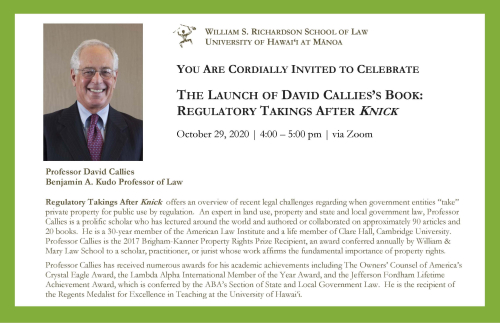
Come join us for the book party for Professor David Callies’ recently published (by the ABA State and Local Government Law Section) book, “Regulatory Takings After Knick.”

We’re online (of course), so you don’t have to come to Honolulu – we’re on Zoom:

Date: Thursday, October 29, 2020

Time: 4-5pm Hawaii Time

RSVP: No need to RSVP, just follow the Zoom link on the flyer below.

Is joining at 4pm Hawaii Time too late in the day in your time zone? We will be scheduling a “pre-event” on Zoom where you can record your video congratulations for Professor Callies. Details to be posted here shortly, or email us.

And yes, buy this book. As the back cover blurb notes:

The problem with so much regulatory takings scholarship — like the Supreme Court’s takings doctrine itself — is that it is muddled and murky, and casts shadow

Continue Reading You’re Invited: Book Launch For “Regulatory Takings After Knick” (David Callies), Oct. 29, 2020