ELHy3bhUYAAdM4B

If there’s one downside to the law school experience from the teacher’s side of the lectern, it’s grading. Especially at a law school like William and Mary that has a pretty strict mandatory curve.

In an upper-division course like “Eminent Domain and Property Rights Law,” where we’re dealing with some very high-level stuff and the quality of the students is uniformly excellent, that makes for some hard choices at this time of year. But we’ve wrapped up grading, and have submitted the official scores.

Although I cannot share with you all the papers themselves, I don’t think my students would mind if I give you a sampling of the topics and titles, just so you can see how the next generation of lawyers is thinking about this area of law: 

  • One Man’s Castle is Another Man’s Parking Lot: A Homeowner’s Theory of Eminent Domain
  • Native Title: Concept and


Continue Reading The Circle Is Now Complete: A Sampling Of Final Paper Topics From William and Mary Law’s Eminent Domain & Property Rights Course

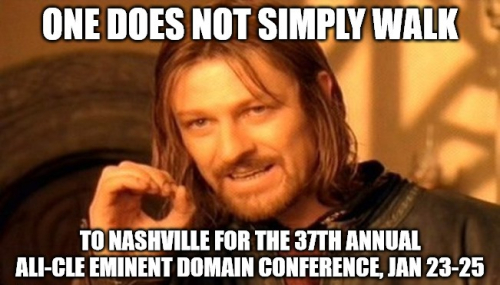
One does not simply walk to nashville

You can also fly, drive, or bike to the upcoming 37th Annual ALI-CLE Eminent Domain & Land Valuation Litigation Conference. in Nashville. Limited space still available, so don’t delay further and register now. We’re on track to record attendance, so you don’t want to miss the best nationally-focused three-day program on our area of law.

Takings, Knick, compensation, appraisals … and a bit of fun thrown in. We have many new attendees, and many new speakers, too.  Continue Reading (Nearly) Last Chance To Join Us In Nashville For ALI-CLE’s Eminent Domain Conference

Check out Marianist Province of the United States v. City of Kirkwood, No. 18-3076 (Dec. 13, 2019), for the U.S. Court of Appeals’ handling of RLUIPA and (state law) takings claims stemming from the city not allowing a religious school to light up its baseball field. 

Today’s a busy day, so we won’t delve in detail into the opinion. But nicely, the Eighth Circuit’s website has a summary:

In school’s challenge to city’s zoning regulations in connection with the school’s lighting of its outdoor baseball diamond, the district court did not err in determining that the regulations concerning lighting and sound systems did not substantially burden the school’s religious exercise in violation of RLUIPA; the school’s inability to use its baseball field at night is a mere inconvenience and not a substantial burden because there are alternative times and locations available to it; school’s “as-applied” claim that the school

Continue Reading If You Build It, It Might Be A Zoning Violation: No Taking, No RLUIPA Violation When Zoning Limited Lights On Religious School’s Baseball Field

Here’s the latest opinion about land use from the Hawaii Supreme Court. Unite Here! Local 5 v. Dep’t of Planning & Permitting, No. SCAP-17-823 (Haw. Dec. 13, 2019).  Because our Damon Key partner Greg Kugle was the prevailing lawyer in the case, we won’t go into detail about the opinion, but leave it to you to delve into it.

It is about procedural due process and the opportunity to object in the administrative appeals process, permit conditions, and the like. Land users, check it out. 

Unite Here! Local 5 v. Dep’t of Planning & Permitting, No. SCAP-17-0000823 (Haw. Dec. 13, 2019) 

Continue Reading HAWSCT: When Agency Includes Conditions In Phase 1 Land Use Permit, But Later Removes The Conditions In Phase 2 Permit, Party Who Asked For Conditions Is Entitled To Notification

We were not as creative as our colleague Paul Henry (see below), but our Planning Co-Chair Joe Waldo and I wanted to personally invite you to join the “big guns” in our area of law at the 37th Annual ALI-CLE Eminent Domain and Land Valuation Litigation Conference, January 23-25, 2020, in Nashville, Tennessee.

We’ve assembled an excellent faculty, and an agenda that covers the hot topics of the day. Go here to view the complete faculty list and agenda. Water rights, Knick, appraisal, ethics, civil rights, and a whole lot more in three days of the longest (and we think best) conference in our area of law. Also, for those new to the field, Andy Brigham and Jack Sperber are again leading their “Eminent Domain 101” program. A great way to learn the topic, or for experienced lawyers to get a quick refresher on the basics. Your registration

Continue Reading Don’t Miss Out: Join The “Big Guns” And Secure Your Space At ALI-CLE’s Upcoming Eminent Domain & Land Valuation Litigation Conference (Jan 23-25, 2020, Nashville)

20170918_185734_Richtone(HDR)

Here’s the latest in a case we’ve been following for a while, Smyth v. Conservation Comm’n of Falmouth, No. 19-223 (cert. petition filed Aug. 16, 2019). 

The petition seeks review of a Massachusetts decision which held that a judge, not a jury, determines Penn Central takings questions, and also that the owner lost anyhow because, you know, Penn Central. The petition asks the Supreme Court to review these Questions Presented:

  1. Whether the loss of all developmental use of property and a 91.5% decline in its value is a sufficient “economic impact” to support a regulatory takings claim under Penn Central.
  2. Whether a person who acquires land in a developed area, prior to regulation, has a legitimate “expectation” of building and, if so, whether that interest can be defeated by a lack of investment in construction?
  3. Whether the Court should excise the “character” factor from Penn Central regulatory


Continue Reading Latest In SCOTUS Penn Central Cert Petition

We think the Connecticut Supreme Court’s opinion in Mayer-Whitman v. Zoning Board of Appeals, No. SC 19972 (Nov. 5, 2019) is worth a read, even if it does not break new ground, because it does a good job of explaining some basic principles. 

Quick story: Breunich had a house. It didn’t conform to height, setback, and flood area requirements. That’s because it was build prior to the regulations were adopted. Dirt lawyers call this a “nonconforming use.” Civilians call it being “grandfathered.” Hurricane Sandy damaged the house, but the cost of repairs was more than 50% of the home’s value. And you know what that meant: Breunich could not rebuild without a variance.

He applied for a variance to rebuild the home in pretty much the same configuration it was before, asserting hardship because it would be impossible for the building to conform to both the height above-flood requirements

Continue Reading Connecticut: “Hardship” For Variances Means Inverse Condemnation

With the ongoing wildfire dramas ongoing across California, several of you have asked us to collect the posts we have done about inverse condemnation liability in one place. So here you go:

As you can see from the above video, this one isn’t over. Stay tuned.Continue Reading All Of Our Past California Wildfires And Inverse Condemnation Posts