Cover

Two items from land use guru Lawprof Daniel Mandelker:

  • A link to his resource web site, appropriately titled “Land Use Law.” It’s where we go to keep up with all of the land use and related (including takings) stuff.  Includes photos of the sites in key casess (like our “takings piligrimages“), the newest decisions and articles related to land use law, and links to other resources. Frequently updated. We’re adding it to our “Links” sidebar (scroll about halfway down our page on the right). Our suggestion: visit frequently. We’ve done so for a number of years, and you should also.
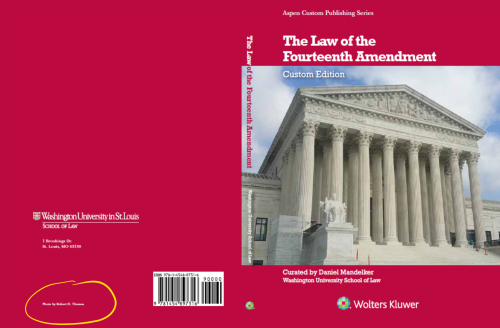
  • Also, Professor Mandelker just published the above book, “The Law of the Fourteenth Amendment.” And we must say that the cover has has the best photo of the U.S. Supreme Court building that we’ve ever seen. Absolutely the best! (All kidding aside, thanks


Continue Reading New Resource, New Book (The Law of the Fourteenth Amendment)

35th Annual Advanced Course

Logo_150pxEminent Domain and
Land Valuation Litigation

Live Program | Video Webcast | Video Webcast Segments

Thursday – Saturday, January 25 – 27, 2018
Francis Marion Hotel | Charleston, SC

Do not miss this popular conference! Intended for all eminent domain and land use practitioners, both experienced and those new to the practice. You can even customize the unique curriculum to work for you: freely go between the Advanced and 101 tracks, with additional tracks for Practice and Substantive law.

With a faculty of national experts who offer both condemnor and property owner perspectives, this is the big program, and the one you don’t want to miss.

Recognized and experienced professionals representing the diverse stakeholders in these cases will discuss the issues hitting your desk today or in the future, including:

  • Overlap of condemnation and regulatory takings: Murr and other blurred lines
  • Takings and damaging by flood


Continue Reading ALI-CLE Eminent Domain & Land Valuation Conference – There’s Still Time To Join Us In Charleston

Back in October, the William and Mary Law School awarded U. Hawaii lawprof David Callies the Brigham-Kanner Prize at a two-day conference in Williamsburg. Our summary of the conference is posted here.

We spoke at the conference, at the first panel entitled “The Future of Land Regulation and a Tribute to David Callies,” along with Professors Shelly Saxer and Jim Ely, and past B-K Prize winner Michael Berger. Of course, Professor Callies also delivered his opening remarks.

The law school has posted the audio from that session, which you can listen to here, or stream it above (via Soundcloud). 

We’re in the process of transforming our remarks into a short essay, to be submitted to the Brigham-Kanner Property Conference Journal if you want to wait for the expanded version. (Feb. 13, 2018 update: here’s the draft article.)Continue Reading Brigham-Kanner Podcast: “The Future Of Land Regulations And A Tribute To David Callies”

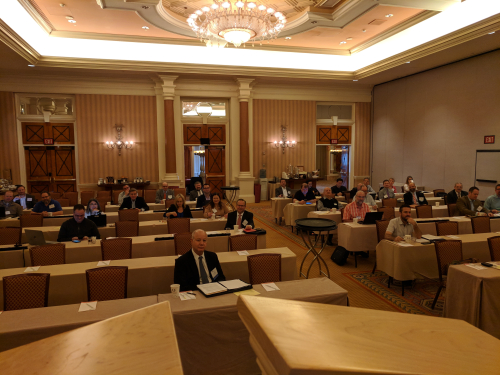
IMG_20171211_090714This photo of the view from the lectern at the start of the day
proves we really
were in the room and not distracted by all the distractions
possible in Las Vegas

Here are the materials and cases which I spoke about earlier today at the CLE International Eminent Domain Conference in Las Vegas. I had the lead off session on updates, and my talk focused on cases that I didn’t cover in the written materials:


Continue Reading Links And Materials From Today’s Las Vegas Eminent Domain Conference

Here’s a case about the denominator in a regulatory takings case from July 2017, just after the U.S. Supreme Court issued its opinion in Murr v. Wisconsin. We somehow missed the opinion when it was issued, but since we think it must be the first case which attempted to apply the Murr majority’s multi-factor test, figured we better post it.

In Quinn v. Board of County Commissioners, Queen Anne’s County, No. 16-1890 (July 7, 2017), a panel of the U.S. Court of Appeals for the Fourth Circuit upheld the district court’s dismissal of a regulatory takings claim that the County’s regulations, “designed to limit overdevelopment of the area” on South Kent Island. Slip op. at 3. But not as you might expect (on Williamson County ripeness grounds), but on the merits.

Practice note: when you are the property owner’s lawyer and an opinion starts by characterizing your

Continue Reading The First Post-Murr Case? Fourth Circuit: No Taking Because Anti-Development Merger Regulations Actually Make Property Developable

…this is might be it: Lampkins Crossing, LLC v. Williamson County, No. 3:17-cv-00906 (Nov. 14, 2017), in which the District Court dismissed substantive due process, procedural due process, and equal protection claims for not being ripe under Williamson County‘s “final decision” prong. The Williamson County case decided on Williamson County grounds.

Now, we’re just being cheeky with our title, of course, and this case may not present a good vehicle for addressing the most troubling prong of Williamson County (the “available state remedies” requirement in takings cases), but with the real County being the defendant here (and not the Williamson County Planning Commission), who could resist? Just think of the law review article titles, and the confusion in oral arguments about “Williamson County.”

Short story here is that the plaintiff’s claims against the County were not ripe in the court’s view, because the County still might

Continue Reading If There Ever Was A Perfect Case To Address Williamson County …

According to this story (“Scott Walker signs bill inspired by western Wisconsin cabin-owners’ court fight“), Wisconsin’s governor has signed into law a new bill which remedies the problem the Murr family faced after the U.S. Supreme Court ruling in Murr v. Wisconsin, 137 S. Ct. 1933 (2017).

In that case, as you recall, the Court’s majority concluded that the Murrs’ two adjacent parcels had — for the purposes of evaluating their regulatory takings claim — been effectively merged into a single parcel. Thus, both parcels together were the “denominator” against which the regulation’s economic impact was measured. The parcels were not actually or formally merged, and the Court’s ruling only meant that Wisconsin’s regulations which prohibited the Murrs from separately developing their second lot, or selling it to an unrelated party, was not a taking.

The new law would allow the Murrs to sell their undeveloped, “substandard”

Continue Reading Murrs Offered Succor; Owners In Other 49 States … Not So Much

The latest in the “Map Act” inverse cases out of North Carolina. This is a longer post, but you really will want to read the summary, or just pick up the opinion and read it.

These are the cases in which the N.C. Department of Transportation, under the power of the state’s Map Act, for decades has designated private property for future acquisition for highway corridors, which prevented present use and development, but hasn’t bothered to actually take the properties.

Hundreds of property owners sued in inverse condemnation (the North Carolina Supreme Court denied class action status). More on the issue and the N.C. Supreme Court’s landmark opinion in Kirby v. N.C. DOT, which concluded the properties’ designation was a taking, here. The cases were remanded for trials for what should have been compensation and damages calculations, but the DOT instead sought to reboot the cases, and

Continue Reading NC App: State Does Not Have Sovereign Immunity From Takings: “sovereign immunity must be juxtaposed with the contrary sovereignty of the individual, whose natural rights preceded government and were enumerated in the federal Bill of Rights”

The Georgia Supreme Court’s analysis in Diversified Holdings, LLP v. City of Suwanee, No. S17A1140 (Nov. 2, 2017) reminded us of that old trope from logic, “no true Scotsman.” 

According to a completely reliable source (Wikipedia):

No true Scotsman is a kind of informal fallacy in which one attempts to protect a universal generalization from counterexamples by changing the definition in an ad hoc fashion to exclude the counterexample. Rather than denying the counterexample or rejecting the original claim, this fallacy modifies the subject of the assertion to exclude the specific case or others like it by rhetoric, without reference to any specific objective rule (“no true Scotsman would do such a thing”; i.e., those who perform that action are not part of our group and thus criticism of that action is not criticism of the group).

(And, in case you were wondering, “For the practice of

Continue Reading Georgia: No True Taking – Challenge To City’s Refusal To Rezone Isn’t Really Inverse Condemnation

Border walls, pipelines, and state takings law. All topics we dig. So for today’s reading, we recommend “When the Government Grabs — the Border Wall, Pipelines and New Challenges to Eminent Domain,” an interview with U. Va. lawprof Molly Brady on these topics. Check it out. 

PS – Professor Brady will be speaking on another one of her areas of expertise (land use and regulatory takings) at our upcoming ALI-CLE Eminent Domain and Land Valuation Litigation Conference in Charleston, SC, January 25-27, 2018. Her session, “Overlap of Condemnation and Regulatory Takings: Murr and Other Blurred Lines” is one of our featured presentations on the first day of the Conference. Sign up now (space is filling quickly)Continue Reading Monday Reading: “When the Government Grabs — the Border Wall, Pipelines and New Challenges to Eminent Domain”