PXL_20240821_114525464.MP
How it started.

Once again, our fall duties included teaching two property law courses at the William and Mary Law School: Eminent Domain & Property Rights, and Land Use Controls. We started in mid-August, and just wrapped the classroom portion of the courses earlier this week. I say “classroom portions” because although we are done with classwork, the courses are not done, and the students are presently deep into writing their final papers (we don’t do an exam in either course). Then comes grading, and a welcoming of the students as full-fledged colleagues in the Dirt Law Bar.

Many law schools feature Land Use Law courses, but only a few are so bold as to include a course on Eminent Domain and Property Rights in their offerings (and a substantial three-credit course, at that). William and Mary Law School is an excellent and very appropriate place to study these topics.
Continue Reading Another Semester Of Dirt Law In The Books

Euclid_front98 years old, and still going (for better or worse)

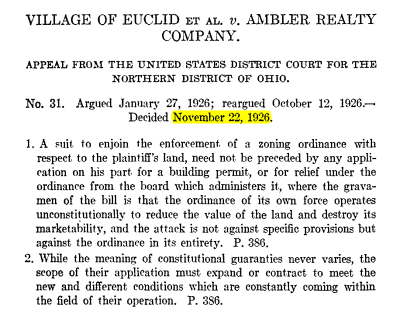
On this day in 1926, the United States Supreme Court issued its landmark opinion in Village of Euclid v. Ambler Realty Co., 272 U.S. 365 (Nov. 22, 1926).

You know this one (and can you call yourself a dirt lawyer if you don’t?). It’s the one in which the Supreme Court first upheld — against a facial due process challenge — the validity of this thing we call “zoning.” While in the intervening century, zoning has become a catch-all term for all sorts of regulatory restrictions on the uses of real property, land users know that “zoning” — ackshually — refers only to the regulation and separation of uses, and restrictions on density, and height regulation. At least that’s how it began.

While “Euclid” and “Euclidean zoning” have become part of the land use

Continue Reading (Un?)Happy Euclid Day!

Screenshot 2024-11-20 at 09-16-50 Lake Worth Lagoon - Google Maps
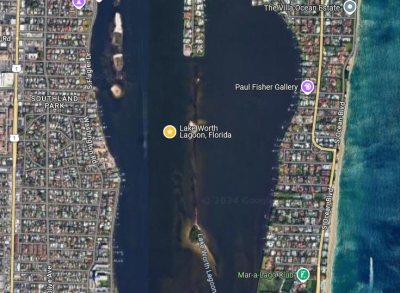
Lake Worth: the “lago” in Mar-a-Lago

You know his name. He’s taken on the City of Riviera Beach twice at the U.S. Supreme Court. And won both times. The houseboat that isn’t a boat. The government can’t shut you out from speaking your mind simply because you irritate them.

That’s right, it’s Fane Lozman. A “Florida Man” that you can like and admire. And he’s back for Round 3.

He owns property that’s mostly in (in, not near) Lake Worth. Two-tenths of an acre is uplands, and the rest (7.75 acres) is submerged. As the Eleventh Circuit noted, “[o]nly a sliver of Lozman’s property is above water.” 

The city, in accordance with the usual approach to land use regulation has a comprehensive plan. That plan designates submerged lands as “Special Preservation Future Land Use,” a label which should set off your Lucas

Continue Reading CA11: Takings Claim Not Ready Despite Govt’s Enforcement Actions

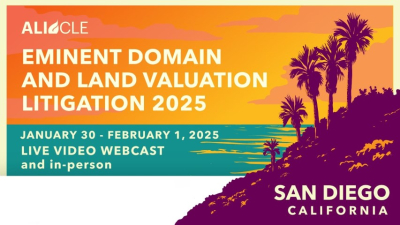
2025 San Diego

Get ready to join your colleagues and friends in San Diego for the 42d ALI-CLE Eminent Domain & Land Valuation Litigation Conference.

The 41st Conference was in New Orleans. Here’s a report of that event, and here are our reports from prior conferences in Austin and Scottsdale.

Here are some of the highlights of the upcoming Conference:

  • Property Rights at the Supreme Court: DeVillier and Sheetz and What’s Next
  • Slow Take: Possession, Rent, Relocation, and Offset
  • The Jury’s View: How Jurors See Your Case
  • From Penn Coal to Penn Central: How to Prove “Too Far”
  • Leveraging Expertise in Eminent Domain Litigation: Working with Land Planners, Engineers, and Other Predicate Experts
  • Kelo at Twenty: What Changed, What Didn’t, and What’s on the Horizon
  • Viva Las Vegas: How the Nevada Judiciary Upheld Property Rights in 180 Land’s Inverse Condemnation Taking
  • Ethics: Guiding the Trolley: Perspectives on Professional Ethics in


Continue Reading Registration For The 42d ALI-CLE Eminent Domain & Land Valuation Litigation Conference Is Underway (Don’t Miss Out!)

Here are the cases and other materials we discussed in today’s Section of State & Local Government Law Land Use group meeting on takings:


Continue Reading Links From Today’s ABA Land Use Session

Untitled Extract Pages

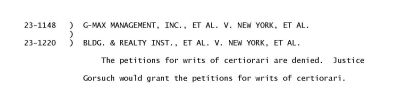
Here’s the latest in a case we’ve been following. This morning, in this Order, the Supreme Court denied cert in two cases which seemed to have a good chance at a grant, on two pressing issues which have divided lower courts, the physical occupation in tenancies (aka Yee), and the nature of the Penn Central takings test. Only Justice Gorsuch would have granted.

Here are the Questions Presented:

New York’s Housing Stability and Tenant Protection Act of 2019 transforms a temporary rent- regulation system into a permanent expropriation of vast swaths of private real estate, without just compensation, in the name of “affordable housing.” Among other things, the Act prohibits owners—even of small and midsized apartment buildings like Petitioners—from reclaiming rental units for their own personal use, and grants tenants a collective veto right over condo/co-op conversions. As Justice Thomas has observed, the constitutionality of regimes like New York’s

Continue Reading SCOTUS Declines To Review NYC Rent Control Challenge

Sutherland_5
Justice Sutherland asks:
whadda mean, you don’t like apartments?

Check out this uncharacteristically-lengthy opinion from New York’s Appellate Division (and entire 6 pages!).

In Bennett v. Troy City Council, No. CV023-0709 (Oct. 24, 2024), the court invalidated a municipal upzoning (from single-family residential to Planned Development — which would permit apartments) because the city’s conclusion that the zone change would have no significant environmental impact under New York’s study-and-disclose statute.

Not content with apartments coming to the neighborhood, an adjoining owner, the “coufounder of The Friends of the Mahicantuck,” sued to challenge the negative environmental declaration. Under New York’s environmental study-and-disclose statute, the “environment” may include such things like historic or archaeological resources, and similar. 

Zoning and rezoning is generally subject to deferential judicial review under Euclid, with the courts applying rational basis review and generally taking a hands-off approach. But this was not a Euclid-like challenge

Continue Reading The Old “Neighborhood Character” Trope Dressed In Environmental Clothing

Screenshot 2024-10-25 at 13-19-32 Housing and Exactions The Next Frontiers After Sheetz Pacific Legal Foundation

Our outfit (Pacific Legal Foundation) has put out a call for papers. on the topic of land use exactions and housing law. Honorarium included for accepted papers, and there will be a workshop to follow.

Here’s the description:

This workshop seeks to build on the result of Sheetz v. County of El Dorado and chart the course of the next steps in exactions/unconstitutional-conditions law. From Nollan v. California Coastal Commission, through Dolan v. City of Tigard and Koontz v. St. John’s River Water Management District, and now including Sheetz, the Supreme Court has looked to the doctrine of exactions and unconstitutional conditions to ensure property rights are protected. In doing so, it has created a constitutional bulwark protecting the right to build housing on private property, an important stick in the property rights bundle.

The Supreme Court’s unanimous decision in Sheetz held that legislatively-imposed development-fee schedules are

Continue Reading Call For Papers: “Housing and Exactions: The Next Frontiers After Sheetz“

Screenshot 2024-10-24 at 12-28-24 Vacancy Taxes A Possible Taking The University of Chicago Law Review

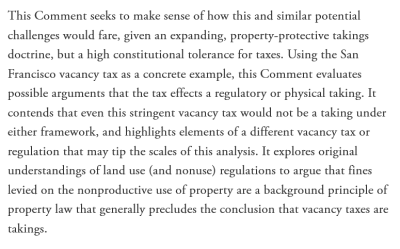
A new student-authored journal article worth reading, Christine Dong, “Vacancy Taxes: A Possible Taking?,” 91 U. Chi. L. Rev. 1725 (2024).

Here’s the Abstract:

Vacancy taxes are an increasingly popular solution to the paradoxical problem of high housing demand coupled with high vacancy. Cities across the country facing housing shortages have either implemented or are considering adopting vacancy taxes to encourage property owners to rent or sell their property. Soon after San Francisco adopted a vacancy tax with one of the broadest definitions of vacancy, property owners lobbed a constitutional challenge under the Takings Clause, taking advantage of a moment of doctrinal instability.

This Comment seeks to make sense of how this and similar potential challenges would fare, given an expanding, property-protective takings doctrine, but a high constitutional tolerance for taxes. Using the San Francisco vacancy tax as a concrete example, this Comment evaluates possible arguments that the

Continue Reading New Article (Comment): “Vacancy Taxes: A Possible Taking?” (U. Chi. L. Rev.)

PXL_20241004_152452877.MP
Lawprof Ilya Somin (GMU Law), Mercatus Center’s Charles Gardner,
and lawyer Emily Cruikshank Bayonne (Tubman Realty, LLC)
speaking on “
How Policy Changes Can Address Incursions on
Property Rights Where Courts Have Failed to do So.”
Jim Burling (PLF) moderating.

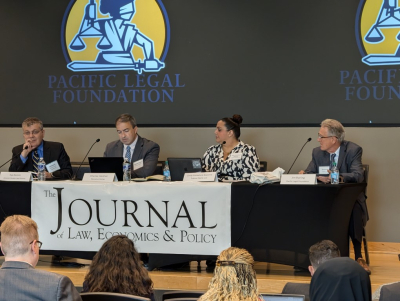
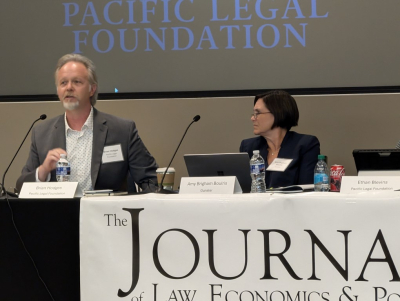
Recently, we attended a wonderful symposium co-sponsored by George Mason Law School’s Journal of Law, Economics & Policy (congratulations to the student editors who ran the show that day), and our outfit Pacific Legal Foundation. Of course, with the subject being “Imagining the Future of Regulatory Takings,” how could we resist attending?

If you missed it, it was not recorded unfortunately. But stay tuned for the full published symposium issue which shall include all of the articles and other pieces the speakers presented that day.

PXL_20241004_130701595.MP
PLF’s Ethan Blevins kicked off the day by
urging the speakers and the audience to
“make property rights cool again.”

PXL_20241004_182439511.MP
Brian Hodges

Continue Reading Imagining The Future Of Regulatory Takings: “Making Property Rights Cool Again”