A couple of noteworthy conferences upcoming, one in-person, the other a “webinar” format:

  • The first is “Kelo: A Decade Later” at the U. Connecticut Law School, Friday, March 20, 2015, from 8:30 am – 4:30 pm. The conference promises to “look back at the decision and its repercussions,” and includes the lawyers for Ms. Kelo and the City of New London. “The conference will then explore the role of eminent domain in government planning generally. What role does and should eminent domain play in economic development?  What is the impact of post-Kelo changes to state law?  Does eminent domain have distinctive impacts on low income communities?  Leading scholars and practitioners in law, planning, sociology, and economics will explore these questions.” We note that our Connecticut Owners’ Counsel colleague Dwight Merriam is one of those “leading practitioners,” and will be moderating a panel entitled “Eminent Domain and Economic Development”


Continue Reading Upcoming Conferences – Kelo In Connecticut, APA And The ESA
We can’t hear or read the word “plethora” without thinking of the “¡Three Amigos!” scene with Jefe and El Guapo, so when the California Court of Appeal “apologize[d] for the plethora of statutory citations and footnotes” (in a footnote!) in the latest opinion about the fallout and intragovernmental battle over the money in the wake of the “Great Dissolution” of California’s redevelopment agencies, we naturally had to post the video.

Bottom line: the agreements which the County entered into as the successor to the county redevelopment agency “are ‘enforceable obligations’ of a former redevelopment agency that continue to be payable out of property taxes before distribution of the remainder to the taxing entities.” Slip op. at 2. 

County of Sonoma v. Cohen, No. C075120 (Cal. App. Mar. 12, 2015)


Continue Reading Cal App: “A Plethora of Statutory Citations And Footnotes” In The Latest Redevelopment Chapter

Check out State ex rel. Sunset Estate Properties, LLC v. Village of Lodi, No. 2013-1856 (Mar. 10, 2015),  a case in which the Ohio Supreme Court held that a local zoning ordinance was unconstitutional on its face.

The Village’s zoning code, adopted in 1987, banned manufactured home (trailer) parks. Of course, the ordinance could not ban those parks already in existence, which were allowed as nonconforming uses. Sunset Estates was one such park.

The ordinance also provided that if a nonconforming use was discontinued for six months, that was evidence of the owner’s intent to abandon the nonconforming use:

Whenever a nonconforming use has been discontinued for a period of six months or more, such discontinuance shall be considered conclusive evidence of an intention to legally abandon the nonconforming use. At the end of the six-month period of abandonment, the nonconforming use shall not be re-established, and any further

Continue Reading A Zoning Due Process Violation From The Land Of Euclid: Owner Can’t Lose Nonconforming Use By Actions Of Tenant

Here’s the amici brief of the National Association of Home Builders, the National Association of Realtors, the National Association of Independent Business Small Business Legal Center, and others in the case we’ve been following out of the federal courts in Florida about a county’s “right of way preservation” ordinance (which is somewhat similar, but perhaps worse in some ways than North Carolina’s Map Act).

As you might recall, the federal district court held that the ordinance — which allows the county to land bank for future road corridors by means of an exaction is “both coercive and confiscatory in nature and constitutionally offensive in both content and operation” — violated Hillcrest’s due process rights. Yes, the Takings Clause was part of the mix in that it was Hillcrest’s right to just compensation that the county wrongfully interfered with (see Nollan, Dolan, and Koontz), but this was

Continue Reading Amici Brief: Didn’t Lingle Tell Us That Due Process And Takings Are Distinct Claims?

Weird headline from KITV. No, owners whose property is taken for the rail aren’t “profiting” if they are able to get more for their land than what the condemning agency offered; “just compensation and damages” are required by the constitution, and if they are able to obtain more, in many cases that still leaves them undercompensated and simply means the condemnor’s offer was inadequate.

But besides the headline, KITV does a good report on last night’s community forum on property owners’ rights in eminent domain which we sponsored

Continue Reading Video: Report On Community Meeting On Property Rights And The Honolulu Rail

Worth reading: “Legislative Exactions after Koontz v. St. Johns River Management District,” an article by colleagues Luke Wake and Jarod Bona, recently posted to SSRN. Here’s the abstract:

Decided in June, 2013, Koontz v. St. Johns River Management District settled a long-running debate among scholars as to whether the nexus test — first pronounced in Nollan v. California Coastal Commission — applies in review of monetary exactions. In the preceding years, the lower courts had largely resolved this question in the government’s favor — limiting Nollan to its facts, and holding the nexus test inapplicable if a challenged permit requires the applicant to pay or expend money as a condition of permit approval. Further, the trend among the lower courts held the nexus test inapplicable in review of legislatively imposed exactions, regardless of whether the contested condition requires a dedication of real property or money.

Without question

Continue Reading New Article: “Legislative Exactions after Koontz v. St. Johns River Management District”

Here’s the latest in an issue we’ve been following out of North Carolina.

In Kirby v North Carolina Dep’t of Transportation, No. COA14-184 (Feb. 17, 2015), the N.C. Court of Appeals not only held that the property owners’ claims were ripe, but that the Map Act — which gives the DOT the ability to designate property for future highway use and prevent its development in the meantime — effected a taking. The court reversed the trial court’s dismissal and sent the case back down for a calculation of the compensation owed to each property owner. A big win for the property owners.  

We’ve set out the background here and here, but the short story is that the N.C. legislature adopted a statute which allows the DOT to designate future highway corridors, but doesn’t require it to actually acquire the property. Once the DOT files a map showing

Continue Reading NC App: “Map Act,” Which Land Banks Property For Future Highways, Is A Taking

20150205_072910

Here are the links from our opening sessions this morning:

It seems clear that the city and

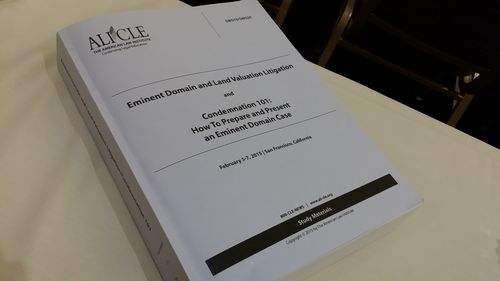
Continue Reading Links From Day Two, ALI-CLE Eminent Domain Conference

Sodarock

Beach cases from Hawaii. The South gets gator law opinions. Vermont, snow law.

To this list of “local flavor” cases, add Belle Terre Ranch, Inc. v. Wilson, No. A137217 (Jan. 13, 2015), an opinion by a California Court of Appeal resolving a boundary dispute between a Northern California winery and the owner a neighboring vineyard.

There’s a lot of discussion about old boundary descriptions, hundred year old surveys, and other stuff, but in the end the court of appeal concluded the trial court got it right when it determined that the winery did indeed encroach on the vineyard and enjoined it from future trespass. The court of appeal had no quarrel with the trial court’s assignment of $1 as nominal damages.

The interesting part of the opinion, however, is the court’s reversal of the attorneys’ fee award of $117,000. The court held that the statute which the plaintiff

Continue Reading Cal App: Award Of $1 Not Enough To Support Attorney Fee In Vineyard Boundary Dispute

No, it’s not about the weird dude down at the Planning Department, but a new (draft) article by two familiar property lawprofs, Lee Fennell and Eduardo Penalver. Here’s the abstract:

How can the Constitution protect landowners from government exploitation without disabling the machinery that protects landowners from each other? The Supreme Court left this central question unanswered — and indeed unasked — in Koontz v St. Johns River Water Management District. The Court’s exactions jurisprudence, set forth in Nollan v. California Coastal Commission, Dolan v. City of Tigard, and now Koontz, requires the government to satisfy demanding criteria for certain bargains — or proposed bargains — implicating the use of land. Yet because virtually every restriction, fee, or tax associated with the ownership or use of land can be cast as a bargain, the Court must find some way to hive off the domain of exactions

Continue Reading New Article: “Exactions Creep”