You mght read the headline of this post and naturally say to yourself, “well, that’s obvious.” But to the Eleventh Circuit in Kentner v. City of Sanibel, 750 F.3d 1274 (11th Cir. 2014), it wasn’t.

In that case, the court concluded that riparian rights are not “fundamental rights” protected by the Due Process Clause from arbitrary and capricious government action, in this case, a ban on the construction of docks and piers (except, apparently, city-owned docks and piers). The court concluded that riparian rights are not “fundamental” rights because they are merely “state-created” rights.

After we read it, the court’s rationale was so inexplicable we asked aloud, “[i]f you can figure out the court’s logic about why riparian rights are not fundamental, and what is a ‘state-created’ right (in contrast to a state-created right created by legislative act, or why the legislature’s hand triggers greater scrutiny than mere

Continue Reading New Cert Petition: Isn’t Property A Fundamental Right?
We’re tied up in court today, so don’t have time to post up the latest cases which have crossed our desk in the past few days.

We will get to them soon, but in the meantime, check out this story (“The Stubborn ‘Nail Houses’ That Refuse to Get Demolished“) from Gizmodo (a blog about tech gear) about eminent domain holdouts, including one particularly endearing woman who refused to go gentle into that good night.  

We”ll return to our regularly scheduled programming shortly. Continue Reading “Nail Houses” And Eminent Domain

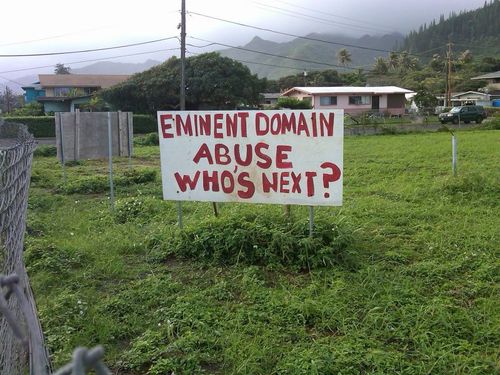
EM Hauulaeminent_domain_abuse

Remember that case which we posted about earlier, in which the City and County of Honolulu condemned an undeveloped lot in rural Oahu for a fire station, but has been met with staunch resistance by the property owners? Not only did we post on the case, but it made national waves, also.

The City filed an eminent domain action in state court, and obtained a writ of immediate possession. After that, the City removed the eminent domain protest signs the owners had maintained on the property. The owners objected, filing a complaint in U.S. District Court alleging that the City went on the property and posted a “removal notice” under the City’s newly-adopted “Bill 54,” an ordinance allowing the City to seize property “stored” on public property provided it “tags” it 24 hours in advance, and that the removal was retaliation for the signs’ content.

The complaint alleges that the

Continue Reading Hawaii Federal Court: “Quick-Take” In Eminent Domain May Not Give Condemnor Exclusive Possession

2010-03-24 15.24.40
Tennessee Supreme Court, Nashville

In Phillips v. Montgomery County, No. M2012-00737-SC-R11-CV (Aug. 18, 2014), the Tennessee Supreme Court held that a property owner could recover under the state’s inverse condemnation statute, Tenn. Code Ann. § 29-16-123, for a regulatory taking:

We hold that, like the Takings Clause of the United States Constitution, article I, section 21 of the Tennessee Constitution encompasses regulatory takings and that the Property Owners’ complaint is sufficient to allege a state constitutional regulatory taking claim, for which they may seek compensation under Tennessee’s inverse condemnation statute, Tennessee Code Annotated section 29-16-123.

Slip op. at 12.

That’s all well and good, and we applaud the court for doing so. But wait a minute, you say, that statute and this issue sure sound familiar.

Indeed they do. This is the same statute which the U.S. Supreme Court, in Williamson County Regional Planning Comm’n v. Hamilton Bank

Continue Reading Tennessee Finally Recognizes Regulatory Takings Cause Of Action – A Quarter Century After The US Supreme Court Wrongly Assumed It Did

Ducks

Here’s what we’re reading on this blustery Friday:


Continue Reading Friday Links: Duck Gets Eminent Domain Power, A Small Piece Of New York City … And More

A couple of years ago, we posted the complaint (actually, a petition for mandate) alleging a big regulatory takings claim against the County of San Luis Obispo based on the County’s denial of a permit to drill for oil. A very big claim. $6.24 billion big. SeeWow, That’s A Lot of Just Compensation.”

We always wondered what happened to that lawsuit. Now, thanks to our colleagues at the California Eminent Domain Report, we know

In “How Untimely Service Can Be Deadly To Your Takings Claim,” Ben Rubin reports that in an unpublished decision, the California Court of Appeal affirmed the dismissal of the complaint for failure to timely serve it on the County. The plaintiffs filed the complaint on time, they just didn’t serve it. Read Mr. Rubin’s write up for the details, but here are the highlights:

  • The County’s denial of the


Continue Reading Cal App: OK For County To Mislead By Omission In Due Process Notice

Civil Beat has a piece by Ian Lind (“Hawaii Monitor: Why Has Florida Company Picked a Fight Over Aerial Advertising?“) that has more on that story we first posted about here (“Hawaii Under Attack From The Air!“). He writes:

Local attorney and blogger, Robert Thomas (InverseCondemnation.com), has commented that the prior court cases have “pretty definitively” determined that Honolulu’s ban on airborne advertising is neither preempted by federal law, nor a violation of Free Speech rights. I certainly hope he’s right.

In our original post, we linked to the two Ninth Circuit decisions Ian mentions.

All we have so far is questions. Is there room for the aerial bannerist to navigate over Honolulu? Does the ban survive strict scrutiny (which is usually fatal scrutiny) as the Ninth Circuit twice concluded? Have Honolulu residents really called 911 to report the plane as the mayor

Continue Reading More On That Pesky Banner-Towing Airplane

We usually don’t pay a whole lot of attention to unpublished opinions. Not that they are not interesting mind you, but if the court itself, for whatever reason doesn’t believe the case is worthy of publication, then who are we to say otherwise? But occasionally, we read one that has something worth sharing. Like this case, for example.

In Dagres v. County of Hawaii Planning Dep’t, No. CAAP-11- 0000071 (June 30, 2014), the Hawaii Intermediate Court of Appeals gave us one of those blogworthy tidbits, a short (one page) discussion of the appellant’s judicial takings claim. We don’t see many of those, so we had to follow up. 

The case involved three buildings near the shoreline on the Big Island. The owner wanted to fix them up, and the Planning Department concluded that two of the buildings were exempt from the requirement to obtain a Special Management Area use

Continue Reading A Hint Of Judicial Takings From The HAWICA

When the one side or the other in the public debate complains about “judicial activism,” they’re usually talking about judges legislating from the bench — finding new rights, reading words into statutes that aren’t there, and the like. But that species of judicial activism doesn’t bother us all that much since we rarely see it, and even when we do, we understand that when accomplished incrementally, it is an integral and generally accepted feature of the common law process. Professor Steven Eagle has compared the common law’s gradual evolution to a big ship making a slow turn, and we think that’s an evocative and apt description. Judges in such a system sometimes do things like that, so that kind of judicial activism doesn’t truly get under our skin. 

No, the “judicial activsm” that bothers us is what the Second Circuit did in the the latest chapter in an issue we’ve been following

Continue Reading Circuit Split Alert: Second Circuit Says Williamson County Ripeness Applies To Due Process

To those of you who joined us at the ABA’s Land Use, Planning, and Development Forum, thank you. Here are links to some of the topics I mentioned: 

Those of you who couldn’t make it can get the recording on CD or mp3 here in a couple of weeks, once it is produced.  


Continue Reading Links From Today’s Land Use, Planning, And Development Forum