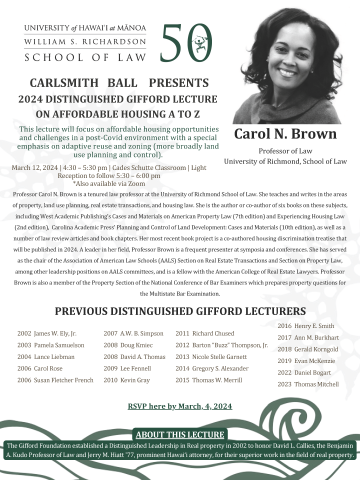
2024 Gifford Lecture Carol N. Brown Professor of Law flyer

Join us and our Land Use class, in-person on the campus of the University of Hawaii Law School (or online via Zoom, where it will be livestreamed), as Richmond Law lawprof Carol Brown delivers the 2024 Distinguished Gifford Lecture in Real Property, on March 24, 2024, at 4:40 p.m. Hawaii Time in the Cades Schutte classroom.

Her talk is titled “Affordable Housing A to Z” and is very timely. More details on this flyer.

Made possible by the generosity of one of Hawaii’s premiere dirt law firms, Carlsmith Ball, LLP.

Space is limited, so please RSVP here.
2024 Distinguished Gifford Property Lecture – Professor Carol N. Brown (Richmond Law) (March 12, 2024, U. H…

Continue Reading 2024 Distinguished Gifford Property Lecture – Professor Carol N. Brown (Richmond Law) (March 12, 2024, U. Hawaii Law School)

Yesterday, the other shoe dropped. In this order the U.S. Supreme Court denied review to a case that we’ve long been following, which challenged aspects of New York’s draconian rent control laws as a taking, 74 Pinehurst v. New York.

We say the “other shoe” because ever since the Court denied review months ago to other challenges to rent control (yet kept relisting Pinehurst, which was always among the two strongest of the multiple challenges), it appeared this round of petitions was doomed, and the Court was holding off denying review, to allow one or more Justices to write something. To us, it was unlikely that the Court would deny some of the petitions outright, while at the same time agreeing to take up the issue in another case. Grant-and-hold seemed the most likely scenario there. Absent that, we didn’t expect these last two to be granted. 

So

Continue Reading SCOTUS Denies Review To Remaining Rent Control Takings Petitions: “Important and pressing question” (Just Not In This Case)

PXL_20230509_183011703

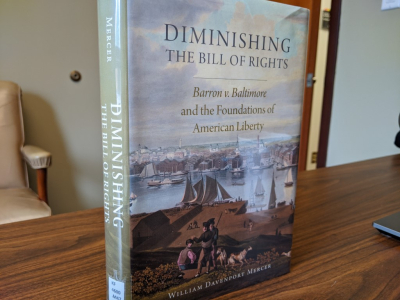
Today’s the day, 191 years ago, when — a mere 5 days after oral arguments — the U.S. Supreme Court issued its (in)famous opinion in Barron ex rel. Tiernan v. Mayor and City Council of Baltimore, 32 U.S. 243 (1833).

Generations of law students study this one in their Con Law classes, and it is mostly known as the case which held that the Bill of Rights limits only the federal government and does not limit the power of states. For the latter, one must look to state constitutions. Barron, of course, was overruled or otherwise neutralized by the Fourteenth Amendment (privileges or immunities clause or the due process clause, take your pick).

But the reason we’re posting our sad birthday wishes today isn’t for that reason, but more because in our estimation, Barron was the first “takings” case considered by the U.S. Supreme Court.

The case was instituted

Continue Reading Sad 191st Birthday To You, Barron v. Baltimore (Feb. 16, 1833) – The First SCOTUS Takings Case?

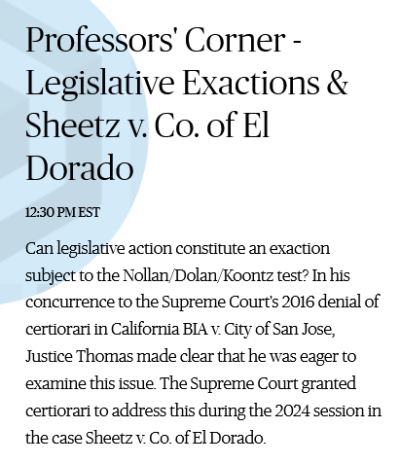
Screenshot 2024-02-13 at 06-58-13 Professors' Corner - Legislative Exactions & Sheetz v. Co. of El Dorado

Join us at 12:30pm ET today, Tuesday, February 13, 2024, for the ABA’s Section of Real Property, Trust and Estates’ monthly Professor’s Corner, where we will join exactions experts Prof Tim Mulvaney, Andrew Gowder, and Prof Elizabeth Elia to discuss the Supreme Court arguments, the issues in the case, and what may be down the road.

Here’s the description:

Can legislative action constitute an exaction subject to the Nollan/Dolan/Koontz test? In his concurrence to the Supreme Court’s 2016 denial of certiorari in California BIA v. City of San Jose, Justice Thomas made clear that he was eager to examine this issue. Justice Thomas’s wait is over; the Supreme Court granted certiorari to address this very question during the 2024 session in the case Sheetz v. Co. of El Dorado. Our expert panel will discuss all sides of this extremely interesting case and its implication for takings jurisprudence.Continue Reading Today, 12:30pm ET: Professor’s Corner – Legislative Exactions & Sheetz v. County of El Dorado (ABA RPTE)

NCSCT
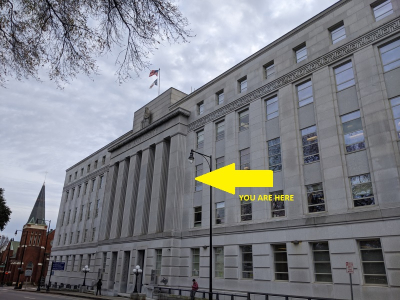
The historic Supreme Court of North Carolina.

Here’s the latest in a somewhat strange case we’ve been following about what happens after a court determines that a taking lacks a public use — but the condemnor goes ahead and just seizes the property anyway.

The Town of Apex, North Carolina, sought to take an easement across Rubin’s land. She objected, asserting the taking was not for a public use or purpose, but rather to benefit a private party: a developer who needed the easement to connect two of his non-contiguous parcels to the municipal sewer system, a precondition of the Town’s development approvals for his proposed residential subdivisions.

While Rubin’s public use objection was pending, the Town went ahead at installed the sewer line, purportedly under its quick-take power. That was not the best of moves, however, because the courts eventually agreed with Rubin that the taking violated the public

Continue Reading The Public Use Requirement Is Self-Executing: “In a free society, we should not expect that when a court tells the government that a taking is illegal and unconstitutional, that it would just go ahead and seize the property anyway.”

A quick per curiam from the Ohio Supreme Court.

In State ex rel. AWMS Water Solutions, LLC v. Mertz, No. 2023-0125 (Ohio Jan. 24, 2024), the court issued a gentle (or maybe not-so-gentle) “benchslap” to the court of appeals. Here’s the scenario.

First of all, recall that Ohio does not recognize a claim for “inverse condemnation” or “regulatory taking.” Instead, if a property owner believes that the government has de facto taken property but has not provided just compensation, the owner seeks a writ of mandamus asking the court to compel the government to institute an eminent domain action (what CJ Roberts calls “an upfront taking”).

AWMS thought this was the case and sought a writ to compel Mertz, an official with the state Department of Natural Resources, to take and pay. The court of appeals entered summary judgment for Mertz, but the Ohio Supreme Court held

Continue Reading Ohio: We Really Meant It When We Remanded For Weighing Of Evidence – Appeals Court Had No Business Dismissing

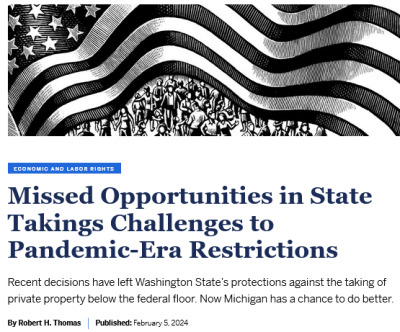
Screenshot 2024-02-05 at 12-23-56 Missed Opportunities in State Takings Challenges to Pandemic-Era Restrictions

Thank you to the Brennan Center for Justice at NYU Law School’s State Court Report (#statecourtreport) for publishing our piece “Missed Opportunities in State Takings Challenges to Pandemic-Era Restrictions.” The title gives a hint about what this is about: how state and local government’s reaction to Co-19 spurred challenges not only under the U.S. Constitution, but under state constitutions. We give examples of — and comment on — missed opportunities and out-and-out errors in several approaches.

Here are the opening paragraphs:

Responding to the Covid-19 pandemic, the federal government and many state and local governments imposed a variety of restrictions on individuals and businesses. The Centers for Disease Control and Prevention, for example, purported to suspend the ability of property owners to evict nonpaying tenants — a move the U.S. Supreme Court rejected as beyond the agency’s power. State and local governments adopted similar eviction moratoria, and many directed

Continue Reading New Article: Missed Opportunities in State Takings Challenges to Pandemic-Era Restrictions (Brennan Center’s State Court Report)

Don’t miss out!

We promise: this is the last time we’re going to try to entice you to the upcoming ALI-CLE Eminent Domain & Land Valuation Litigation Conference in New Orleans. We are getting close to capacity, but there is still room. In recent years, we have standing room only in the Conference halls, and have sold out the hotel block. After all, this is a pretty niche area of law. So what gives?

When we were in Austin last year, we thought it might be nice to try and answer that question. We asked Conference participants why they come, year-after-year (and in Austin, despite massive travel disruptions). Yes, it is the various venues (Nashville, Austin, Scottsdale, Palm Springs, to name a few recent locations), and yes, it is the excellent and useful programming.

But as we suspected it is more than that.

Continue Reading No FOMO: There’s Still Room For You To Join Us In New Orleans Feb 1-3, 2024 For The 41st ALI-CLE Eminent Domain & Land Valuation Litigation Conference

This season of the Institute for Justice‘s podcast series “Bound by Oath” is devoted to property rights. It’s a fascinating series — produced by John Ross, it is more like an audio documentary than a typical podcast — focusing on constitutional issues. And we say this not just because we’ve been a guest a couple of times — see “Groping in a Fog“, this season’s immediate prior episode about regulatory takings, and Season 1, where we guested on the episode about the origins of the “incorporation” doctrine).

In the latest episode, “A Lost World,” John covers the world before zoning and the use (and abuse) of the plain-old police power to regulate the use of land and property.

Here’s the description:

On Episode 3, we journey back to a lost world: the world before zoning. And we take a look at a

Continue Reading “The Lost World – Land Use Before Zoning” – Bound by Oath Podcast, S3 E3: Hadacheck, Buchanan

“No need to ask, he’s a smooth operator…”

On Tuesday, January 16, 2024, the Supreme Court will hear arguments in a case we’ve  been following closely because it involves the fundamental limitation on the sovereign power to take private property. In our system, the sovereign indeed has the power to take private property against the will of the owner, but only if the taking is accompanied by just compensation.

Before we go on, a disclosure: we filed an amicus brief supporting Devillier’s arguments, so we’ve have an obvious bias. Special kudos to our law firm colleagues — and self-executing Just Compensation mavens — Deb La Fetra and Kady Valois for this brief.

Texas Flooded Devillier’s Property

Here are the facts in Devillier v. Texas. As part of a road project, the Texas Department of Transportation caused Devillier’s property to flood. The state flooding someone’s property is one of those

Continue Reading Devillier v. Texas Argument Preview: Do Courts Need Congress’ Permission To Enforce The Right To Just Compensation?