Here’s what we are reading this Thursday:

  • Appeals Court Declines Invitation To Destroy Land Use Law As We Know It – from the Massachusetts Land Use Monitor blog: “Now that the Appeals Court has reminded us of the permanence of permit conditions, anyone who receives a permit with a restrictive condition should think twice about whether that condition is a proper exercise of municipal authority, or whether an appeal should be taken in an effort to modify or strike a condition that will otherwise burden the land for time immemorial.”
  • The ‘Public Uses’ of Eminent Domain: History and Policy – (hat tip to PropertyProf blog for the heads-up) – “This paper examines the effects and implications of the ‘public use’ requirement for the exercise of eminent domain in the United States. It is part of an ongoing inquiry the consequences of eminent domain in the United States. The first part examines the history


Continue Reading Thursday Links: Public Use, Mass Court Saves Land Use, Judicial Takings

Save the date: on Thursday, December 1, 2011 (1:00pm-2:30pm EST, 10:00am-11:30am PST) we’ll be presenting the on-line seminar “Eminent Domain: Redevelopment Challenges for Local Governnment – Navigating Federal Funding Requirements, Challenges for Public Utilities in Right-of-Way Projects, and Objections to Taking for Public Use.

Joining me are colleagues Anthony Della Pelle (McKirdy & Riskin – New Jersey), J. Casey Pipes (Helmsing, Leach, Herlong, Newman & Rose – Alabama), Rick E. Rayl and Bradford Kuhn (Nossaman – California), and Mark M. Murakami (Damon Key Leong Kupchak Hastert – Hawaii).

Each member of the faculty should be well-known to our readers: Tony publishes the New Jersey Condemnation Law blog and is a frequent speaker at the annual ALI-ABA eminent domain program. Casey is with the Owners’ Counsel member firm from Alabama and Co-Chair of the ABA Litigation Section’s Condemnation, Land Use, and Zoning Law Committee. Rick and Brad produce

Continue Reading Upcoming National Webinar – Eminent Domain: Redevelopment Challenges for Local Government

On behalf of the Star-Advertiser, today we filed a motion for summary judgment in the case which seeks disclosure of the JSC list from the Governor. More here from the Star-Advertiser. The hearing is set for November 9, 2011.

The Complaint is posted here, and the Governor’s Answer is posted here.

Motion for Summary Judgment, Star-Advertiser v Abercrombie, No. 11-1-1871-08 (filed 10-18-2011)Continue Reading Motion For Summary Judgment In JSC List Case

Last week, after the welcome reception at the U.S. Embassy celebrating the Brigham-Kanner Conference’s visit to Beijing and the awarding of the B-K prize to Justice Sandra Day O’Connor, I had a chance to meet up with an old law school classmate and friend, Laurence Brahm.

Since our graduation nearly a quarter-century ago, Laurence has led a life that can best be described as “interesting” (as in “may you live in interesting times”), and he has not followed the usual lawyer career path. Lawyer, filmmaker, hotelier, economic advisor, philanthropist, author, futurist, and restaurateur, among many others. Over drinks and dinner at his retro-kitschy Red Capital restaurant (now that is the PRC I remember!), we caught up and Continue Reading Brigham-Kanner Conference: An Evening With An Old Friend

Here is the Petitioner’s Reply Brief in Colony Cove Properties, LLC v. City of Carson, No. 11-189 (cert. petition filed Aug. 11, 2011). We posted the cert petition and the amici and BIO here

The cert petition is asking the Supreme Court to revist and discard the ripeness rules of Williamson County Regional Planning Comm’n v. Hamilton Bank of Johnson City, 473 U.S. 172 (1985). It poses two Questions Presented:

1. Should Williamson County be overruled, to the extent that it arbitrarily denies a federal forum to regulatory takings claimants seeking just compensation for the violation of their rights under the Fifth Amendment, contrary to the intention of Congress in enacting Section 1983?

2. Should this Court recognize an exception to Williamson County’s “state procedures” requirement for takings claimants like Petitioner, whose Fifth Amendment claims will otherwise be relegated to a California state court system that

Continue Reading Final Cert Brief In Williamson County Challenge

12.WATHIWe’ve just finalized the agenda and faculty for the Hawaii Water Law conference, to be held in Honolulu on January 11, 2012. I am the planning co-chair along with Jesse Souki, Director of the State of Hawaii Office of Planning.

In addition to Jesse and me, we’ve assembled a diverse and talented faculty: UH lawprof David Callies will speak with Elijah Yip (Cades) on the latest developments in water law and public trust litigation. State Water Commissioner Lawrence Miike will update us on the latest goings-on at the Commission. My Damon Key partner Greg Kugle is speaking with Leo Asuncion, the Manager of the Coastal Zone Management Program at the State Office of Planning on coastal issues.

After lunch, we have a special guest, Ed Thomas (a lawyer and President of the National Hazard Mitigation Association, and a nationaly known expert in floodplain management and disaster

Continue Reading Mark Your Calendars: Hawaii Water Law Conference (Jan. 11, 2012)

Last week, the petitioners filed their merits brief in Sackett v. EPA, No. 10-1062, the case in which Idaho property owners are asserting their right to challenge the EPA’s assertion that a portion of their land are “wetlands.”

A multitude of amicus briefs have been filed to support the Sackett’s arguments. We haven’t had the time to review each brief yet, but here they are for your review:


Continue Reading Amicus Briefs In Sackett v. EPA: Judicial Review Of A Claim Of Regulatory Jurisdiction

Here are the latest briefs in a case we’ve been following. In Colony Cove Properties, LLC v. City of Carson, 640 F.3d 948 (9th Cir. 2011), the Ninth Circuit affirmed the dismissal of a property owner’s claim that the city’s mobilehome rent control ordinance is a taking. The district court dismissed the facial takings claim because it was filed outside the statute of limitations, and the as-applied takings challenge as unripe.

The cert petition is asking the Suprme Court to revist and discard the ripeness rules of Williamson County Regional Planning Comm’n v. Hamilton Bank of Johnson City, 473 U.S. 172 (1985). It poses two Questions Presented:

1. Should Williamson County be overruled, to the extent that it arbitrarily denies a federal forum to regulatory takings claimants seeking just compensation for the violation of their rights under the Fifth Amendment, contrary to the intention of Congress in

Continue Reading More Cert Briefs In Williamson County Challenge (Colony Cove)

Update: cert denied.

This might be academic at this point, since this case was up for consideration by the Court at the September 26, 2011 conference and it didn’t make the grant list (yet). But the amicus brief filed by the local chapter of the American Planning Association in City of San Leandro v. International Church of the Foursquare Gospel, No. 11-106 (cert. petition filed July 11, 2011), is worth reviewing for its walk-through of the land use process in one East Bay city.

The brief’s bottom line: it’s all about planning:

Land use planning and related zoning laws and decison-making enable local governments to preserve their distinct characters. Indeed, a general plan translated long-term values into comprehensive, complicated documents that describe how, why, when, and where to build or rebuild while challenging and inspiring members of the community with a vision of what might be — and

Continue Reading Amicus Brief In RLUIPA Case: Planning Is A “Compelling Interest” Justifying Denial Of Church’s Request For Rezoning

IMG_3352

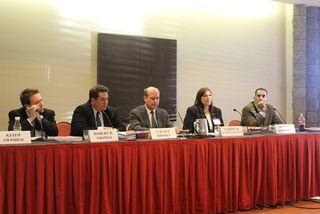
As part of the Fall Meeting of the ABA’s Section of State & Local Government Law in Tucson, on Thursday, September 22, I was on a panel discussing the Supreme Court’s recent decision in Nevada Commission on Ethics v. Carrigan, “Ethical Considerations for Municipal Attorneys: Caught in the Crosshairs Reconciling the Rules of Professional Conduct with Government Ethics Laws.”

Joining me in the discussion were Yvonne M. Nevarez-Goodson (Commission Counsel and one of the lawyers for the Nevada Commission on Ethics in the Supreme Court), J. Scott Rhodes (an expert in ethics and professional responsibility issues), and Professor Keith Swisher (Phoenix School of Law – his scholarship includes ethics and he produces the Judicial Ethics Forum blog). Michael Donaldson moderated.

I started us off by providing a short summary of the Carrigan case, touching on the Nevada Supreme Court’s conclusion that vote by a legislator is a

Continue Reading CLE Report: Government Ethics, Free Speech, And Voting Rights