Check this out, a recently-filed cert petition in a case we’ve been following, filed by our friends and colleagues at the Institute for Justice. This one involves an issue we’ve been on top of also, most recently in these two cases (see here and here).

That is, what does the Supreme Court’s description of the Takings Clause as “self-executing” actually mean? Do you need statutory authorization in order to bring a takings or just compensation claim, or can you sue directly under the Constitution?

In Devillier v. Texas, No. 21-40750 (Nov. 12, 2022), the Fifth Circuit’s cryptic opinion concluded that “the Fifth Amendment Takings Clause as applied to the states through the Fourteenth Amendment does not provide a right to action for takings against a state[.]” Slip op. at 1-2. Here’s the entirety of the decision (minus footnotes):

The State of Texas appeals the district court’s decision

Continue Reading New Cert Petition: Do You Need Statutory Authorization To Sue For A Taking?
If a zoning statute or ordinance sets out the uses permitted in a zone, and the uses not permitted in the zone, and a property owner wants to make a use not permitted in the zone, all she needs to do is apply for a variance, or a Conditional Use Permit, or a nonconforming use permit, or a Special Use Permit, right? After all, isn’t the point of these exceptions to bright-line use prohibitions to build in a large degree of flexibility and afford front-line regulators in the right circumstances the discretion to grant a use the legislature prohibited? One size does not fit all, does it? 

That was the issue that closely divided the Hawaii Supreme Court in Hoomoana Foundation v. Land Use Comm’n, No. SCWC-17-181 (Mar. 10, 2023). In a 3-2 opinion, the court concluded that when a use is expressly barred by a zoning statute (and

Continue Reading Denying Uses (But Allowing Discretionary Ad Hoc Exceptions) Isn’t A Recipe For Rational Land Use

Screenshot 2023-03-03 at 08-06-54 Robert Thomas inversecondemnation.com on Twitter

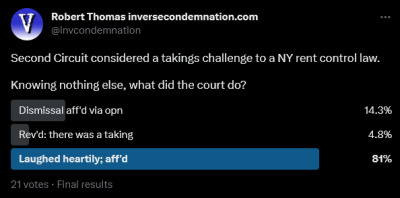
Let’s say you know nothing else about an appeal except it is being decided by the U.S. Court of Appeals for the Second Circuit, and the case is a constitutional challenge to rent control. What’s your best guess about the outcome (the district court dismissed for failure to state a claim)?

When the Second Circuit issued its summary order in just such a case last week — a challenge to the “Housing Stability and Tenant Protection Act of 2019” — we decided to undertake a little unscientific poll to see whether others out in the Twitterverse predicted as we did.

Looks like so. Yes, the sampling size was small, and the respondents were only those who voluntarily offered their thoughts. But 95% accurately predicted that the property owners would lose, as the Second Circuit indeed held in an appellate court’s version of “laughing heartily” at an appellant’s arguments:

Continue Reading One Guess What The Second Circuit Did With A Takings Challenge To Rent Control

20151208_064159

Here’s the merits brief, filed yesterday in the above-depicted Court by our law firm colleagues, headed by Counsel of Record Christina Martin in Tyler v. Hennepin County, No. 22-166, a case and an issue we’ve been following closely. This is the one, where, as recounted in the petition:

Hennepin County confiscated 93-year-old Geraldine Tyler’s former home as payment for approximately $15,000 in property taxes, penalties, interest, and costs. The County sold the home for $40,000, and, consistent with a Minnesota forfeiture statute, kept all proceeds, including the $25,000 that exceeded Tyler’s debt as a windfall for the public. In all states, municipalities may take real property and sell it to collect payment for property tax debts. Most states allow the government to keep only as much as it is owed; any surplus proceeds after collecting the debt belong to the former owner. But in Minnesota

Continue Reading Property Owner’s SCOTUS Merits Brief: “Under no circumstances can government have an unbounded ability to confiscate entire properties of any size for even the most minimal tax debts.”

Screenshot 2023-02-23 at 11-13-54 Toward Principled Background Principles in Takings Law

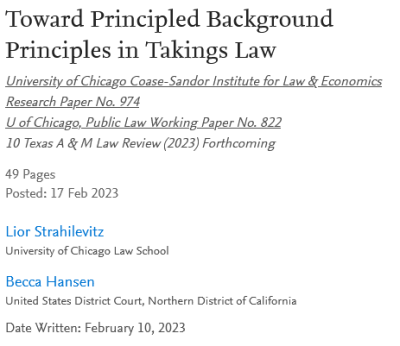
Check this out, a new article co-authored by a federal judge’s law clerk and lawprof Lior Strahilevitz (Chicago). With the title, “Toward Principled Background Principles in Takings Law” are we going to read it? You bet. (Unlike a lot of new scholarship that we post here, we read this one immediately.)

Here’s the Abstract:

Blunders made by lawyers, judges, and scholars have caused the Supreme Court’s recent opinion in Cedar Point Nursery v. Hassid to be deeply misunderstood. In Cedar Point, the Court re-wrote takings law by treating temporary and part-time entries onto private property as per se takings. Prior to Cedar Point these sorts of government-authorized physical entries would have been evaluated under a balancing framework that almost invariably enabled the government to prevail. As it happens, there were two well-established rules of black letter law that California’s lawyers and amici mistakenly failed to invoke in defending

Continue Reading New Article: “Toward Principled Background Principles in Takings Law” (Strahilevitz & Hansen)

ThomasMitchell

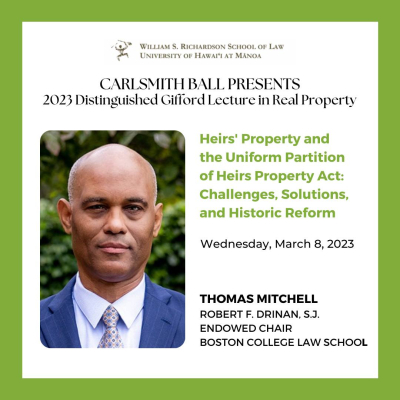
If you are in Honolulu, please join us on Wednesday, March 8, 2023, 4:30-5:30 p.m. at the University of Hawaii Law School for Professor Thomas Mitchell on “Heirs’ Property and the Uniform Partition of Heirs Property Act: Challenges, Solutions, and Historic Reform.”

Our U.H. Land Use class is attending to learn more about “heirs’ property” (described as “the biggest problem you’ve never heard of“), and so should you. Yes, Hawaii has adopted the Uniform Partition of Heirs’ Property Act and we have followed this issue for some time, but if you didn’t know about this, now is your chance to catch up.

Here are the details from the U.H. newsletter:

Carlsmith Ball presents the 2023 Distinguished Gifford Lecturer in Real Property, Thomas W. Mitchell. Mitchell is a professor at Boston College Law School, where he holds the Robert F. Drinan, S.J. Endowed Chair and serves as the Director of the Initiative on Land, Housing & Property Rights. He is a national expert on property issues facing disadvantaged families and communities and has published leading scholarly works addressing these matters.

In 2020, Professor Mitchell was named one of 21 recipients of the MacArthur Fellowship in recognition of the substantial impact his professional work has had in assisting disadvantaged farmers and property owners, people who are disproportionately but not exclusively African American and other people of color. He is the only lawyer in his MacArthur Fellowship class. Please join us for this Distinguished Gifford Lecture; a light reception is to follow from 5:30 – 6:30 p.m.

Come, join us for this compelling session.
Continue Reading Join Us On Wed March 8 at 4:30pm For 2023 Distinguished Gifford Lecture In Real Property – Prof Thomas Mitchell On “Heirs’ Property & the Uniform Partition of Heirs’ Property Act: Challenges, Solutions, & Historic Reform”

IRWA header

The International Right of Way Association‘s Real Estate Law Committee produces twice-a-year reports “which contain summaries of eminent domain decisions and legislation within the United States.”

And what is really nice is that they make the report available.

Here’s the latest.

We’re posting it here because we’re one of the co-authors. Hat tip to our co-authors Brad Kuhn, Jillian Friess Leivas, and Ajay Gajaria.

The report is short, and doesn’t contain a lot of fluff. Just what you wanted.Continue Reading IRWA’s Summary Of Major Eminent Domain Cases & Legislation (June-Dec 2022)

As we wrote up here, national zoning and planning expert Nolan Gray joined our U. Hawaii Land Use class (and the public) last week for a talk about whether zoning is an impediment to affordable housing in Hawaii.

Thank you to Grassroot Institute of Hawaii for recording the talk, as well as making Mr. Gray’s appearance in our classroom possible. See Grassroot’s summary of his presentation here.

If you’d prefer to just listen, try this.

Continue Reading Video: “Are Zoning Laws the Cause of Hawaii’s Housing Crisis?” With Nolan Gray

PXL_20230216_040131899.PANO
The session was recorded.
Here’s the video and audio
.

Earlier this week, planner M. Nolan Gray, author of the new book, “Arbitrary Lines: How Zoning Broke the American City and How to Fix It” (Island Press 2022) joined our Land Use class at the University of Hawaii Law School to talk about zoning and housing.

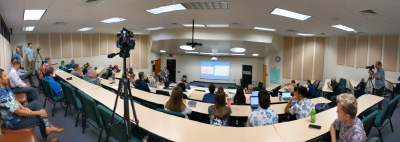
The title of his talk was “Are zoning laws the cause of Hawaii’s housing crisis?” The subject matter is important, and the public was invited to join us. As you can see, there was a lot of interest in this critical topic and turnout was excellent. 

Thank you to the Grassroot Institute of Hawaii for their sponsorship of the event, and for generously getting Mr. Gray to Honolulu for his in-person appearance. It was also nice to have refreshments following class, and a chance to “talk story” (as we

Continue Reading A National Zoning Expert Pays A Visit To The L580 Land Use Class At U. Hawaii

LUI

Here are the opinions that we spoke about this afternoon at the Land Use Institute on “The Use of Eminent Domain for Redevelopment & Economic Development Projects.”

Thanks for joining in.Continue Reading Cases And Links From Today’s Land Use Institute Session: “The Use of Eminent Domain for Redevelopment & Economic Development Projects”