104481738_2170057539806372_2938554143515873721_nphoto: Patricia Salkin

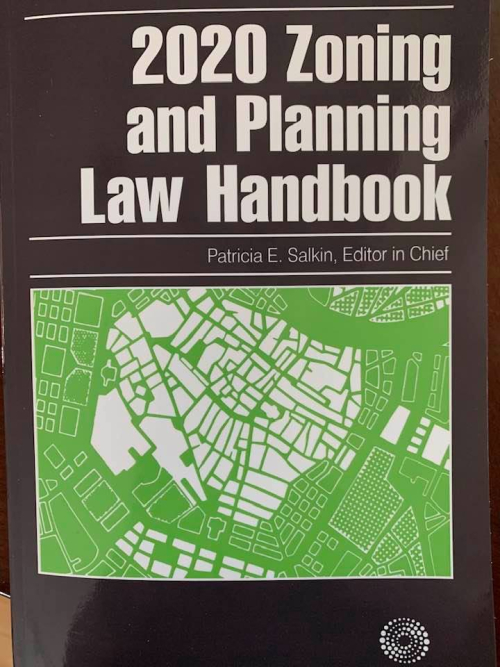
Just published: the 2020 Zoning and Planning Law Handbook (Green Book). The first section of the Summary of Contents is about Takings, and includes as the lead piece Professor Gideon Kanner and Michael Berger’s tour-de-force article, “The Nasty, Brutish, and Short Life of Agins v. City of Tiburon.” It also includes my articles on Murr, “Restatement (SCOTUS) of Property: What Happened to Use in Murr v. Wisconsin?”

Check it out. The Green Book is a one-stop shop for the best articles on land use in a given year, and this edition includes chapters on housing, agriculture, cell tower placement, RLUIPA, and (of course) zoning.

Our thanks to Dean Patty Salkin who edited the volume for including us.

Summary of Contents, 2020 Zoning and Planing Law Handbook (Green Book)

Continue Reading Available Now: 2020 Zoning and Planning Law Handbook (Green Book)

One more to add to your reading queue. The latest complaint alleges, among other claims, that the Illinois governor’s coronavirus shut down orders for businesses deemed “non-essential” result in takings. 

The list of similar challenges keeps growing. See here, here, here, here, here, here, here, here, here, here, here, here and here, for example. The longer this thing goes on, the more like this we’re going to see.

join us later today, Wednesday, June 16, 2020 at 5:30pm Hawaii Time, when we’ll be speaking about this question in a program for the King Kamehameha V Judiciary History Center (open to the public, more details here). Our thoughts on the takings aspects of the shutdowns orders: Evaluating Emergency Takings: Flattening The Economic Curve.

Complaint at Law, Nowlin v. Pritzker, No. 1:20-cv-01229-MMM-JEH (C.D. Continue Reading The Hits Keep Coming: New Complaint Alleges Illinois’ Lockdown Order Is A Taking

Sorry

Update: our thoughts on the Hawaii-law claims in this article, “Hoist the Yellow Flag and Spam® Up: The Separation of Powers Limitation on Hawaii’s Emergency Authority,” 43 U. Haw. L. Rev. ___ (forthcoming 2020).

+++++++++++++

Here’s the second complaint filed in the U.S. District Court for the District of Hawaii challenging the governor’s coronnavirus shut down orders. Back in March, the governor issued a proclamation declaring an emergency, and since then has issued nine “supplemental” declarations, re-upping the end date which is now the end of July). Here’s the first complaint (in that case, the plaintiffs dropped their request for a TRO, and the court has scheduled a hearing on a motion for preliminary injunction for June 26, 2020).

There’s a Fifth Amendment claim (sorry, not a takings claim, but a right to travel), as well as a host of federal constitutional claims (due process, equal protection, section

Continue Reading New (Hawaii) Complaint: Coronavirus Orders Violate Right To Travel, Equal Protection, Due Process (And More)

MVIMG_20191108_125325

Here’s the latest in a case we’ve been following (we visited the site last November with our William and Mary class), the property owners’ Opening Brief in  a case being considered by the Virginia Supreme Court.

This is a case at the intersection of property and takings law, and environmental protection. Several Nansemond River oystermen own a lease from the state for the riverbed, which among other things, allows them to harvest some of the oysters that Virginia is so well known for. But they were forced to bring an inverse condemnation claim in state court, asserting that the City’s dumping of wastewater in the river — and prohibiting the harvesting of oysters during those times — was a taking under the Virginia Constitution’s taking or damaging clause (article I, § 11).

The trial court sustained the City’s demurrer, accepting the City’s argument that it has the right to

Continue Reading Property Owners’ Brief In Virginia Supreme Court “Oyster Takings” Case

Here’s the latest complaint challenging coronavirus-related orders (in this case, the City of Los Angeles’ rent payment and eviction moratoria) as a taking.

More here from the LA Times: “Landlord group sues city of L.A. over coronavirus anti-eviction protections.”

You should probably read the entire document, as it is drafted well. But it is long (48 pages – it even has a Table of Contents and a Table of Authorities), so here are the key parts of the Introduction in case you don’t have time to digest the whole complaint:

1. In the wake of the novel coronavirus, Defendants City of Los Angeles, City Council of the City of Los Angeles, and Mayor Eric Garcetti (collectively “City” or “Defendants”) hastily instituted a series of ordinances which prohibit lessors and landlords, such as Plaintiff’s members, from exercising their contractual remedies where tenants refuse to pay rent on the

Continue Reading New Fed Ct Complaint: Coronavirus Rent Freeze And Eviction Moratorium Is A Taking

0fcc0c09-ff44-4f8c-bb01-c2455719ae6d

Next Wednesday, June 17, 2020, at 5:30pm Hawaii Time, we’ll be speaking for the King Kamehameha V Judiciary History Center about “Constitutional Law and States of Emergency: Lessons from the COVID-19 Pandemic.”

This is a one-hour program, open to the public, where we will take a dive into Hawaii’s emergency preparedness and response laws, how Hawaii’s courts have treated emergencies, plagues, pandemics, and quarantines in the past (we have a long history there), and respond to (moderated) audience questions.

Space limited to 100 attendees, although it will be recorded and posted on the Center’s YouTube channel. Here’s the program description:

The King Kamehameha V Judiciary History Center invites you to join our live webinar with attorney Robert H. Thomas as he shares his expertise about constitutional rights and civil liberties during the COVID-19 pandemic. He will share lessons from Hawaiʻi’s history of public health laws during

Continue Reading Upcoming Judiciary History Center Program: “Constitutional Law and States of Emergency: Lessons from the COVID-19 Pandemic” – Wed., June 17, 2020, 5:30pm HST

Here’s the latest court order telling business and property owners that they have little chance of success on the claims asserted in various mostly-constitutional challenges to shut-down orders.

This time the businesses are in North Carolina, and appear to be — ahem — so-called “gentlemen’s clubs” (and by that, we’re not referencing those in St. James’s), which asserted a host of constitutional claims (including takings), and sought immediate relief.

Today, in this order, the district court denied a preliminary injunction (having denied a TRO last week). The main relief sought is an injunction. The entire order is worth reading, even though it doesn’t focus on the takings question. Applying rational basis review, the court concluded that cases like Jacobson show that the governor’s orders “pass[] this deferential test, where it imposes temporary restrictions on businesses to prevent the spread of COVID-19[.]” Slip op. at 19. Allowing some businesses to

Continue Reading Federal Court: Talleywhacker Not Likely To Win Coronavirus Shut-Down Takings Claim

On one hand, the Colorado Supreme Court’s opinion in Forest View Co. v. Town of Monument, No.18SC793 (June 8, 2020), concluding that a restrictive covenant is not a property interest that the government needs to pay for conflicts with the decisions on similar facts from other jurisdictions (Kansas, for example). On the other, the ruling is nothing new under Colorado law, because the court didn’t announce a new rule, but simply refused to overrule a prior case holding the same thing, Smith v. Clifton Sanitation Dist., 300 P.2d 548 (Colo. 1956).

Town wants to build a water tower. Seems like a reasonable goal. It purchased property, another reasonable thing. The property it bought, however, was subject to a covenant, running in favor of the neighboring property owners, that the owner couldn’t use the property for anything other than single-family homes. Last time we checked, single-family homes

Continue Reading Negative Easements Such As Restrictive Covenants Still Are Not Property In Colorado. tl;dr: We Can’t Afford To Consider These Things Property

Way back when (you know, less than 2 months ago, a lifetime in coronavirus time) when the plaintiffs filed the complaint, we noted that, win or lose, it laid out the takings argument in a comprehensive and understandable way.

It still may be that the arguments are worthwhile pursuing. Our more comprehensive thoughts on that subject here (“Evaluating Emergency Takings: Flattening The Economic Curve“). We don’t know yet, because the district court dismissed the suit because the defendants (Michigan’s governor) enjoys 11th Amendment immunity. Yes, even against claims for just compensation. Opinion and Order Granting Defendant’s Motion to Dismiss, Martinko v. Whitmer, No. 2:20-cv-10931 (E.D. Mich. June 5, 2020).

A suit against the Governor in her official capacity is a suit against the State, and there’s no takings exception to 11th Amendment immunity (according to the court). As is often the case, the harder stuff is

Continue Reading Federal Court: Not Going To Deal With Takings Argument Because 11th Amendment

Short answer: yes, with a caveat. For why there’s an asterisk on this one, take a look at the Supreme Court’s electronic docket for PennEast Pipeline Co., LLC v. New Jersey, No. 19-1039 (cert. petition Feb. 20, 2020) (a case we’ve been following), and tell me whether you think there’s anything unusual about the list of parties, amici, and their counsel.

SCOTUS Überlawyers? Check. Big well-funded parties? Check. Heavy-hitter amici? Check.

But the one thing missing, we noticed, was the property owners’ bar. No Mike Berger, neither of the Ilyas (Somin or Shapiro), no PLF, no IJ, no Carolyn Elefant, no Chris Johns, no NFIB, none of the other individuals or groups who often weigh in on property questions on either side (and yes, no Owners’ Counsel). This might strike you as odd, in a case where the Question Presented is about eminent domain:

Whether the NGA delegates

Continue Reading Should Takings Mavens Follow The Latest Eminent Domain Case At SCOTUS?