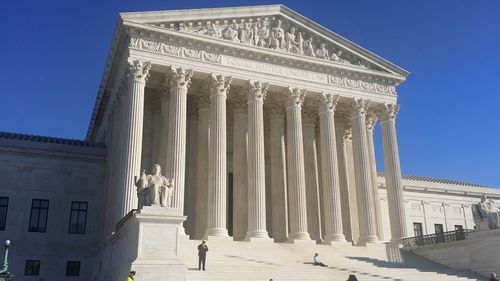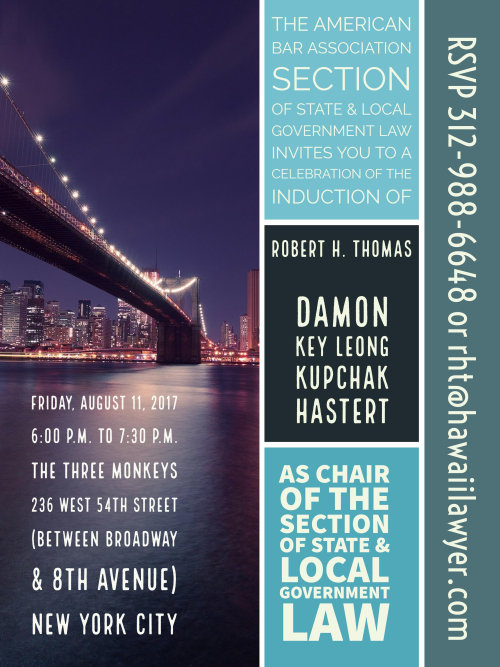
Chair Reception SLG 8-11-2017 invitation

If you are scheduled to be in or near New York City on Friday, August 11, 2017, please consider attending one or both of the following events:

  • 10-11:30am, Midtown Hilton, Concourse E, Concourse level:Murr and Beyond: Implications for Regulatory Takings.” Yes, Murr is the case that keeps on giving, and has already given CLE providers numerous opportunities to add to their coffers. The ABA is sponsoring this program, which includes the lawyers for the two main parties, and two (me included) lawyers who do this kind of thing. Come,  join your colleagues for a roundtable discussion of the case, and more importantly, what comes next. With John M. Groen, Principal Attorney, Pacific Legal Foundation, Sacramento,CA; Robert Thomas, Damon Key Leong Kupchak Hastert, Honolulu, HI; Hon. Misha Tseytlin, Solictor General , WI Dept. of Justice, Madison,WI; and Nancy Stroud, Land Use Attorney, Lewis Stroud & Deutsch, Boca Raton, FL. Our


Continue Reading ABA CLE, NYC: “Murr and Beyond: Implications for Regulatory Takings” – Aug 11, 2017
The Connecticut Appeals Court’s opinion in Stones Trail, LLC v. Town of Weston, No. AC 38078 (July 18, 2017), does not offer a lot in terms of substance — it holds that a property owner’s regulatory takings claim based on the Town’s approval of what the owner thought was a subdivision was not ripe because the owner had not actually filed a subdivision request — but the facts are interesting nonetheless:

The plaintiff had purchased the property with the purpose of dividing it into six buildable lots. Before the closing of the purchase, the plaintiff submitted three maps of the property to the town. The town’s attorney determined that the property depicted on one of the maps was not a subdivision, and that map was stamped accordingly and filed in the town land records. Thereafter, the other two maps, which altered the lot lines of the property to depict

Continue Reading After A Plaintiff Jury Verdict (And Rejection Of Town’s Four Previous Motions Over Nine Years), Takings Claim Held Not Ripe

Load this one up for your morning drive, or workout: the Federalist Society’s podcast on “Lucas v. South Carolina Coastal Council at 25.” Featuring Professor Eric Claeys, Professor Michael Wolf, and Pacific Legal Foundation’s James Burling. Well worth your time.

Here’s the description:

This spring marks the 25th anniversary of the U.S. Supreme Court’s decision in Lucas v. South Carolina Coastal Council. In Lucas, a 5-4 Court majority held that a state law can effect a “regulatory taking” and trigger inverse condemnation requirements if it deprives an owner of all viable uses of his land. Join our panel to hear a discussion of questions such as: Did Lucas mark a major change in Supreme Court regulatory takings doctrine? Was the decision about right, or did it go too far or not far enough? Is Lucas still relevant to regulatory takings law today, and what are the

Continue Reading A Quarter-Century Of Lucas: What’s Next?

SSRN

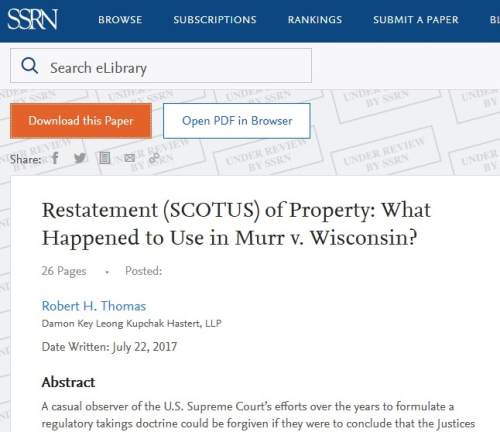
 A couple of weeks ago, we noted that the Supreme Court’s recent decision in Murr v. Wisconsin would no doubt be a boon for law review editors. To avoid shirking our duty, we’ve spent the interim doing some writing, adding a drop to the flood. First draft done, posted on SSRN here

Emphasis on “draft,” so send your comments. Continue Reading Restatement (SCOTUS) of Property: What Happened to Use in Murr v. Wisconsin?

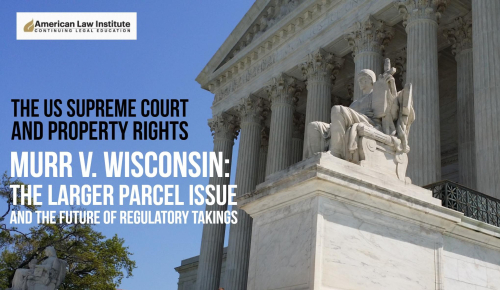
ALI Murr Title Card

One last reminder: next Tuesday, July 25, 2017 at 2:00 pm Eastern, is “The U.S. Supreme Court and Property Rights: The ‘Larger Parcel” Issue and the Future of Regulatory Takings,” ALI-CLE’s first look at the U.S. Supreme Court’s recent decision on the “larger parcel” or denominator issue in regulatory takings cases where the plaintiff owns more than a single parcel, Murr v. Wisconsin.

Please come and join Sara BeachyMichael BergerSteven Eagle, and John Groen for lively and informative analysis and discussion. I will be introducing and moderating the panel. 

Details, including registration and CLE credit information here. Registration is $199, or, if you have attended one of our in-person Eminent Domain and Land Valuation Conferences in the past (the 2018 Conference in set for Charleston, SC, January 25-27, 2018, at the Francis Marion Hotel, stay tuned here for details shortly)

Continue Reading ALI-CLE: The Larger Parcel Issue and the Future of Regulatory Takings (July 25, 2017)

A very short one from the Connecticut Appellate Court, Santos v. Zoning Board of Appeals, No. AC37281 (July 11, 2017) in a Penn Central-style takings challenge to local land use regulations. We’re going to set out the facts, then let you guess who prevailed.

The plaintiff purchased an unimproved parcel of land in Stratford at a tax sale conducted by the town in May, 2002. The prior owner had owned the property for approximately seventeen years, but had never attempted to develop the property. The town had never formally approved the property as a building lot. In noticing the sale of the property, the town included a warning that the property had not been guaranteed to be buildable under the town’s current zoning regulations. The property was sold to the plaintiff for approximately one half of its assessed value, and the prior owner made no attempt to exercise his

Continue Reading Conn App: Because Owner Can Easily Correct The Problem With Confiscatory Regulation, His Reasonable Expectations Have Not Been Thwarted

20151204_140514

Now that the dust has settled somewhat, for your weekend reading, here are your links to some of the vast amount of commentary which the Murr v. Wisconsin decision has thus far generated:


Continue Reading Murr Round-Up

The Township of Scott, Pennsylvania, apparently has a problem of unregulated cemeteries. Who knew?

So it did what local government do when they think they have a problem, it passed a law. That law, Ordinance 12-12-20-001, required owners of all cemeteries, public or private, to maintain them. The ordinance also contained two troublesome provisions. First, it requires the owners of the cemeteries to keep them open to the public during the day. Second, it allows the Township’s code inspectors to enter “any property” to inspect and see if it is in compliance with the ordinance.  

Under the authority of the ordinance, a code inspector came on Knick’s property without a warrant, and told her “guess what, these stones are actually grave markers, and you better clean up this cemetery.” Knick’s response was “what cemetery? My land doesn’t have a cemetery on it.” Not buying it, the inspector wrote

Continue Reading Night of the Living Zombie Zoning Inspectors – Ordinance Allowing Searches For Unauthorized Cemeteries “Constitutionally Suspect,” But Not Yet Justiciable

Winter storms damaged a seawall which protected a blufftop, oceanfront home. The owners, not surprisingly, wanted to rebuild the wall to protect their home. The Coastal Commission, as is its wont, saw this as an opportunity to extract some goodies from the owners. So it granted a limited-term permit to rebuild the wall, conditioned on the owners not repairing a stairway leading from the top of the bluff to the private beach:

Ultimately, the Commission approved a coastal development permit allowing seawall demolition and reconstruction, with the addition of midbluff geogrid protection below Lynch‟s home. The permit was subject to several conditions, three of which are at issue here. Special condition No. 1(a) prohibits reconstruction of the lower stairway. Special condition No. 2 provides that the seawall permit will expire in 20 years and prohibits future blufftop redevelopment from relying on the seawall as a source of geologic stability or

Continue Reading California Supreme Court: Accept The Exaction, Or Let Your Home Fall Into The Sea – Your Choice

Here are links to the cases and materials we spoke about today during our portions of the APA’s 2017 Planning Law Review webinar:


Continue Reading Cases And Links From Today’s American Planning Association’s 2017 Planning Law Review