ABA State and Local 2017-2017 conferences image

Mark your calendars for this Friday, June 16, 2017, at 2:00 p.m. Eastern Time for a free talk we’ll be giving, “Regulatory Takings: Emerging Issues.” 

Yes, it’s free, but there’s a catch: this talk is sponsored by the ABA Section of State and Local Government Law’s Land Use Committee, and you have to be a Section member (or be willing to join us). One of the benefits of being a member is that you can sign on to these bi-monthly calls and learn about the latest developments in the broad range of topics the Committee covers. Ping me if you want to sign up.  

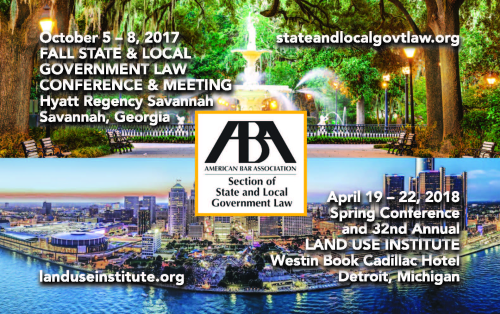
And what’s the deal with the graphic above? Well, starting in August 2017, I’ll be taking over as Chair of the Section (assuming my ABA colleagues do not come to their senses before then), and the big focus of the Chair is to

Continue Reading Upcoming Free Takings Talk (Friday, June 16, 2017). But There’s A Catch…
You heard that right. After the Michigan Court of Appeals’ recent ruling in Lanzi v. Township of St. Clair, No. 329795 (May 23, 2017), you should consider skipping the usual Williamson County step of filing your federal takings claims in state court.

In that case, property owners sued the township after the township’s sewage system broke down and backed up grey water into the plaintiffs’ basement. They brought a complaint in Michigan state court alleging both negligence and a physical invasion taking. The township alleged it was immune by statute from such suits. The trial court rejected the argument and the township appealed. 

The court of appeals reversed on the negligence claim, agreeing with the township that it was immune because it had taken reasonable steps to repair any defects in the sewer system. We’ll let you read that part of the opinion if you’re interested.

What got us

Continue Reading Michiganders: Go Ahead, File Your Federal Regulatory Taking And Inverse Condemnation Claims In Federal Court

Here’s the unanimous Supreme Court opinion, issued this morning in a case we’ve been following, Town of Chester v. Laroe Estates, No. 16-605 (June 5, 2017), a takings case, although the issue resolved by the Court is one of civil procedure. 

The Court’s holding is remarkably unremarkable: a plaintiff — including a plaintiff who intervenes in a lawsuit as of right under Fed. R. Civ. P. 24(a)(2) — must have Article III standing. We say “unremarkable” because we never could quite figure out why that proposition was apparently so controversial that it ended up with a lower court split: doesn’t every federal court plaintiff need to show that there’s a live case and controversy on every claim and form of relief that is alleged? Yes, the parties didn’t dispute it, and the Court, in the opinion authored by Justice Alito, reached that conclusion in the second sentence:

Continue Reading SCOTUS: To Intervene As A Plaintiff (In A Takings Case), You Need Article III Standing (Duh)

Here’s the latest in a case we’ve been tracking, the City of Missoula, Montana’s takeover of a privately-owned water system. Last year, the Montana Supreme Court held that the city could exercise its power of eminent domain to take the property for a “more necessary” public use. The court allowed the city to take the company, and on remand, the lower court determined compensation. But the case is not yet final, and the final order of condemnation has not issue. Which means that title and possession still remain with the water company and not the city.

The follow up, Mountain Water Co. v. Montana, No. 16-0469 (May 16, 2017), involves the question of who is responsible for paying property taxes. After the city instituted the taking, the water company asked the Montana Department of Taxation agree that the company was not liable for the payment of property taxes. The

Continue Reading Who Owes And Who Pays Taxes On Property Being Condemned?

We don’t normally post trial court decisions, particularly ones which simply dismiss a case. But the U.S. District Court for the Eastern District of Pennsylvania’s recent memorandum order in The Property Management Group, Ltd. v. City of Philadelphia, No. 17-1260 (May 23, 2017), which deals in part with a somewhat unusual takings claim, is posted here for two reasons. First, Williamson County. Second, the opening paragraph.  

The case involves Philadelphia’s notorious parking situation, something that — if you have ever parked a car on the street in that city — can be a real exercise in frustration and even fear. Predatory towing, ransoming cars, private spaces, and the like. The city council, apparently responding to towing abuses (see page 2 of the slip opinion, for example), adopted an ordinance which added a “ticket-to-tow requirement” which required that a law enforcement officer first certify that a vehicle

Continue Reading Federal Court Dismisses Removed Takings Claim Under Williamson County … And That’s OK

Seattle

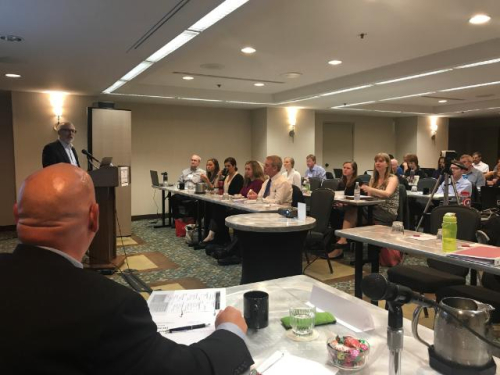
My thanks to Bart Freedman (K&L Gates) and Kinnon Williams (Inslee Best Doezie & Ryder) for asking me to speak on national takings and inverse condemnation issues at yesterday’s Eminent Domain conference in Seattle.

As you can see, the room was packed and standing room only. Here are the cases and issues I mentioned during my talk, “National Takings Trends, Hot Practice Areas, and Property Rights in the Age of Trump:”


Continue Reading Cases And Links From Washington Eminent Domain Conference

Kauaipark

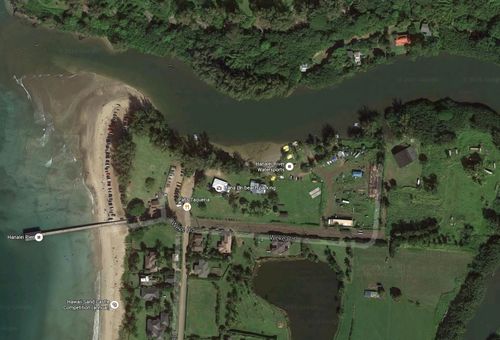
Yesterday, the Hawaii Supreme Court issued a unanimous opinion opinion authored by Justice Nakayama in an eminent domain case we’ve been following. We filed an amicus brief in the case supporting the property owner on one of the three issues presented, too. More on that below. 

The case involves three parcels on Kauai — one of which is owned by a fellow who has been a thorn in the County’s side — which were condemned by the County for the expansion of a public beach park. The County was taking Parcels 49, 33, and 34. Sheehan owned 49, and HRH, an entity incorporated in the Cook Islands, owned 33 and 34. Sheehan asserted his use of Parcel 49 stretched across 33, 34, and Area 51 — a portion of another Parcel but not a separate record lot. He claimed to use Area 51 pursuant to an easement. 

The owner sought

Continue Reading Hawaii Supreme Court – Major Eminent Domain Opinion: Larger Parcel, Deposit

We’re back in meme territory today, with the Georgia Supreme Court’s opinion in Abramyan v. Georgia, No. No. S17A0004 (May 15, 2017), a case about takings, taxi medallions, and (you guessed it), ridesharing and the “sharing economy.”

After the Georgia legislature adopted a statute that made it easier for ridesharing services to operate by limiting the power of local governments to regulate ridesharing and taxi services, owners of taxi medallions sue, alleging this was a taking of their property, the taxi medallions.

This claim fared as well as similar claims in other courts (see here and here, for example), meaning the trial court dismissed and the Georgia Supreme Court affirmed. No property interest, no taking. 

The court’s opinion, which is short (9 pages of large font type) is a quick read, and the bottom line rationale is that the taxi medallions didn’t give them an “unalterable monopoly” on

Continue Reading Georgia SCT: “You keep using ‘taxi medallion.’ I do not think it means what you think it means!”

Facepalm

We all have had those moments, haven’t we?

Today’s linked story is more land-usey than eminent domain-ey, but still interesting for you condemnation lawyers on the line (besides, condemnation lawyers really do have to know land use law, don’t they?).

Honolulu can is a tough place to be, with our status as one of the most expensive places in the world to live, and the high cost of housing is one of the prime reasons for that. In Honolulu Civil Beat, Stewart Yerton has a story on the legal risks triggered when a City Council member suggested that the council might deny development permits if the permitted condos were sold to Chinese nationals instead of local residents. 

In “Opposition To Foreign Condo Sales Raises Legal Questions,” In addition to national experts on such things like Professor Eugene Volokh, the article quotes us about those times we have

Continue Reading Land Use Facepalm

61RcOQLR1DL._SX355_

Here’s one that — although unpublished — is still worth a quick read. Because it’s a case where the Sixth Circuit held that a federal court takings claim against the City of Franklin, Tennessee, which is the seat of Williamson County, Tennessee, should be dismissed under Williamson County because it wasn’t ripe.

In Beech v. City of Franklin, No. 16-6326 (Apr. 19, 2017), Beech sued the City claiming it was a taking for the City to allow Beech’s neighbor to operate a barbershop next door. That’s a tough claim to begin with, but Beech pressed a mandamus claim in Tennessee state court, seeking to enjoin the neighboring barber shop. Included within the petition were claims for damages for violations of Beech’s federal constitutional due process and equal protection rights because (allegedly) the City was not enforcing its zoning code. Beech did not assert a takings claim. The state court

Continue Reading A Williamson County Ripeness Case From Williamson County, Tennessee