You can really breathe in San Jose
They’ve got a lot of space
There’ll be a place where I can stay.
I was born and raised in San Jose
I’m going back to find some peace of mind in San Jose

Today, in this order after a series of rescheduled considerations that had seen the U.S. Supreme Court repeatedly delay the conference, the Court declined to review the California Supreme Court’s decision in California Building Industry Association v. City of San Jose.

That’s the case in which the California Supreme Court upheld the city’s “affordable housing” requirement against a challenge which asserted that it was an exaction and thus should have been subject to the heightened scrutiny of the unconstitutional conditions doctrine of Nollan, Dolan, and Koontz. The California court disagreed, holding that because the ordinance did not require a developer to give up land, or

Continue Reading Cert Denied In Cal Affordable Housing “Exaction” Case
Colorado’s Constitution prohibits the use of proceeds from the state lottery, which are used to fund the “Great Outdoor Colorado Program” Trust Fund from being “used to acquire real property by condemnation through the power of eminent domain.” Colo. Const. art. XXVII, § 9. 

The Town of Silverthorne used trust fund money on a recreational trail project, a part of which required the condemnation of Lutz’s land. Lutz objected to the taking, arguing that the Town lacked the power to take because the constitution “barred the Town’s exercise of eminent domain power to acquire the easement rights over the landowners’ property.” 

In Town of Silverthorne v. Lutz, No. 2015COA17 (Feb. 11, 2016), the Colorado Court of Appeals disagreed, concluding that the constitutional prohibition only extended to using trust fund money to “acquire” land by eminent domain, and since the Town was not using the money to actually pay compensation, but was

Continue Reading Colo App: Town Can Use Lottery Money For Trail Project, Despite Constitutional Prohibition On Using Funds To “Acquire” Property By Eminent Domain

Let’s say that you didn’t know much about regulatory takings, or municipal employment and Fair Labor Standards law (in our case, the latter would most certainly be correct). And let’s say you were asked to predict how the plaintiff would fare with a claim that the city’s regulatory regime for taxicabs was so oppressive that it resulted in taxi drivers effectively working for less than minimum wage, and thus the city must make up the difference, on either of two theories: (1) the regulatory scheme is a taking, or (2) taxi drivers are city employees and the city must pay the difference between minimum wage and the amounts actually earned.Any guesses whether she succeeds?

We don’t think it would be too hard to predict that the plaintiff got nowhere, on either theory.

In Callahan v. City of Chicago, No. 15-1318 (Feb. 17, 2016), the U.S. Court of Appeals for the

Continue Reading 7th Circuit: Bring Your Regulatory Takings Claims In Federal Court (At Least Those That Come Out Of Illinois)

Kirbyncsctarguments2-2016

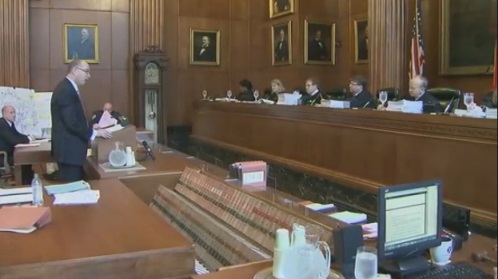
All of the drama playing out in the North Carolina Supreme Court yesterday as the court heard oral arguments in its review of Kirby v North Carolina Dep’t of Transportation, No. COA14-184 (Feb. 17, 2015) came down — as they often do in these things — to a single question from the bench, and an advocate’s response. At about the 8:40 mark on the the video, this colloquy took place:

Q [Justice Newby]: How would you characterize the benefit, or the purpose of the Map Act. Isn’t it to set in place the value of the property … by restricting improvements or subdivision to keep the ultimate cost of the project at a particular level?

A [NCDOT counsel]: Well that is certainly one aspect or element of the rationale behind the Map Act. The public purpose and benefit can be broadly described as coordinating future road projects with current

Continue Reading NC Supreme Court Hears Arguments In Important Takings Case

Here’s what we’re reading today:


Continue Reading Tuesday Round-Up: Inversely Condemning Flint, “Well Nigh Conclusive?,” Parcel-As-A-Whole

20160114_125445

Here’s the latest on a takings case that is winding its way through the U.S. District Court in Honolulu. Yes, you read that right: a takings case being litigated in federal court.

Intrigued? Read on. 

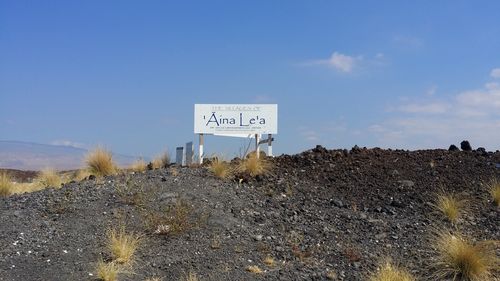
We’ve covered this case and the related state court litigation several times here before, so this isn’t entirely unfamiliar ground. This is a case in which a property owner (the developer of the Aina Lea project on the Big Island, just north of the Waikoloa beach area) filed a case in Hawaii state court seeking, among other things, just compensation for the temporary taking of its right to develop its property. The case ended up in federal court because the State of Hawaii Land Use Commission waived the State’s 11th Amendment immunity and removed the case from state court under federal question jurisdiction. 

The litigation began as two lawsuits originating in state court in the

Continue Reading Latest On The Latest Hawaii Takings Case: Unconstitutional Conditions, Statutes Of Limitations, And Vested Rights

We’ve posted a lot lately reporting on the 2016 ALI-CLE Eminent Domain and Land Valuation Litigation Conference, recently held in Austin. We have a couple of more posts for you before we turn to other things. Here is the first, a run-down of the blogs of faculty members, and others we were in the audience. If your blog is missing from this list, email me the link and I will update the post to include it.


Continue Reading The Blog Lineup From The 2016 ALI-CLE Eminent Domain Conference

Norfolk_sign

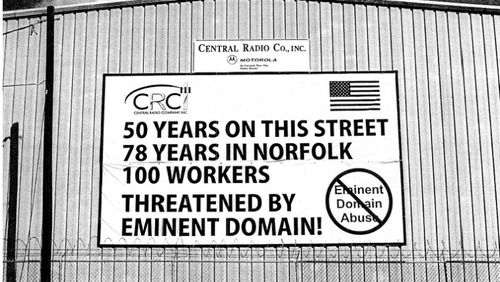
Talk about timing: Dana Berliner, Andy Gowder, and I were talking about the Central Radio case during a session on free speech and other First Amendment issues at the recent ALI-CLE Eminent Domain Conference, when we learned that at the same time we were speaking about the case, the U.S. Court of Appeals for the Fourth Circuit was issuing its opinion on remand from the Supreme Court. 

Bottom line: Norfolk, Virginia’s sign ordinance is an unconstitutional restriction on free speech. See slip op. at 1 (“Applying the principles of content neutrality articulated in Reed, we hold that the sign ordinance challenged in the plaintiffs’ complaint is a content-based regulation that does not survive strict scrutiny. Accordingly, we reverse the district court’s judgment with respect to the plaintiffs’ First Amendment challenge and remand that claim to the district court to award nominal damages to the plaintiffs and for consideration of other

Continue Reading Fourth Circuit: City Violated First Amendment By Banning Anti-Eminent Domain Sign

20160126_164326

Austin, Texas, is where we’re at for the next few days, for the 2016 edition of the American Law Institute-CLE Eminent Domain and Land Valuation conference, now in its 33d year. First time we’re in Austin, however, and our registration numbers are looking very good, and we haven’t had this big a turnout in years.

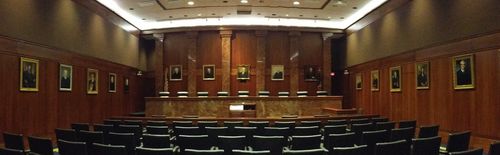
We haven’t been back to Austin in a few years ourselves, so we did what law nerds sometimes do when we go to new towns: visit the local courtroom to check out the scene. So we dropped by the Supreme Court of Texas to take a look. Turns out it was an off-day for the court and it was not in session and the courtroom was locked. But Security suggested that if we asked the Clerk nicely, she might retrieve the key and let us take a look around. And you know what? She did.

Continue Reading ALI-CLE 2016 Eminent Domain Conference: Austin Scouting Report

We know inverse condemnation liability can be triggered by intentional government action. But what about when government doesn’t act?

That was the issue before the Court of Appeals of Maryland in Litz v. Maryland Dep’t of the Environment, No. 23 (Jan. 22, 2016). And when the opinion starts this way, you just know where this is going to end up:

“The nine most terrifying words in the English language are, ‘I’m from the government and I’m here to help.’”

-Ronald Reagan, 40th President of the United States, News Conference (12 August 1986).

Petitioner, Gail B. Litz, might have welcomed hearing those nine words spoken to her, but, according to her Third Amended Complaint, they were not forthcoming.

Slip op. at 1.

The case involved “human sewage” flooding onto Ms. Litz’s once-popular campground from nearby septic fields, which, quite naturally resulted in a dearth of people who wanted to camp

Continue Reading “We’re Here From The Government, And We’re Here To … Do Nothing” – Gov’t Inaction Gives Rise To Inverse Condemnation