


Barista’s note: last week, the Hawaii Supreme Court issued a 4-1 ruling in Friends of Makakilo v. D.R. Horton-Schuler Homes, LLC, No. SCAP-13-0002266, holding that the State Land Use Commission was not prohibited from adopting a boundary amendment (akin to a rezoning under Hawaii’s state-heavy land classification scheme) while the process for designating Important Agricultural Lands plays out. 

Earlier this year, on June 25, 2015, court heard oral arguments, and our colleague Paul Schwind, who has guest posted before on this and other important cases, kindly attended the arguments, and had the the following report, which we’re posting while we digest the majority and dissenting opinions.

According to the Judiciary web site summary of the case, here are the issues:

In this case, Appellants Sierra Club and Clayton Hee appeal from the Decision and Order of the Circuit Court of the First Circuit, which dismissed their appeal
Continue Reading Guest Post: HAWSCT Oral Arguments In Hoopili – Is The State Prohibited From Rezoning “Potential” Important Ag Land?

Here’s one in a land use case we’ve been following, both because it is a huge issue and because our partners Greg Kugle and Matt Evans represent the prevailing land owner.  

All Hawaii land users need to read this, a 4-1 decision (Justice McKenna writing for the majority, with Justice Pollack in in dissent) that involves the LUC, the “Important Agricultural Lands” process, and reclassification. We haven’t yet read it in detail, but here’s the holding:

This appeal involves a long-standing issue in this state: balancing agricultural and urban land uses.

Pursuant to Save Sunset Beach Coalition v. City & County of Honolulu, 102 Hawaii 465, 476, 78 P.3d 1, 12 (2003), Article XI, Section 3, standing alone, is not self-executing; rather, its mandate is carried out through the provisions of Part III. Therefore, the plain language of Article XI, Section 3 does not require the LUC

Continue Reading HAWSCT: Land Use Comm’n Need Not Impose Moratorium Until After “Important Ag Lands” Process Is Complete

We are on the road today, so were not going to post. But when the case title is Perfect Puppy, Inc. v. City of East Providence, No.15-1553 (Dec. 8, 2015), who could resist?  

Reading through the court of appeals’ passive-aggressive sniping at the plaintiff — a pet shop challenging the City’s ban on pet shops — it boils down to this: plaintiffs did the right thing and filed their due process and equal protection claims in state court, after which the complaint was removed to federal court by the City. In federal court, Perfect Puppy amended its complaint to allege a facial and as-applied regulatory takings claim. After which the District Court dismissed the facial takings claim and all of the other constitutional claims, except the as-applied takings challenge, which it remanded to state court under — you guessed it — Williamson County

The First Circuit affirmed

Continue Reading Happiness Is Not A Perfect Puppy In The First Circuit: Removed Takings Claim Remanded As Unripe

A shorter one today. In Catalina Foothills Unified School Dist. No. 16 v. La Paloma Prop. Owners Ass’n, Inc. No. 1 CA-CV 14-0838 (Nov. 24, 2015), the Arizona Court of Appeals held that a statutory grant of power to school districts to take property for “buildings and grounds” also implied the power to take property to access those buildings and grounds.

The School District acquired La Paloma’s vacant land in a stipulated eminent domain judgment, promising that the only access to the new campus from an adjacent private road also owned by La Paloma would be on foot. The road was used by residents of the La Paloma subdivision for vehicular access.

Well, you know how these things go when you make agreements with entities with the power of eminent domain, and sure enough, after the District built a new campus, it decided that it also needed vehicular access

Continue Reading Ariz App: Statute Giving School District Power To Take “Buildings And Grounds” Implies Power To Take Roads

Here’s a fascinating decision from the Ninth Circuit on our other area of interest, election law. 

Public Integrity Alliance, Inc. v. City of Tucson, No. 15-16142 (9th Cir. Nov. 10, 2015) was a challenge to Tucson’s unusual hybrid system of electing the city council. The primary election is a partisan primary, limited to residents of each of the city’s wards. Once elected in these ward-by-ward primaries, the candidates go on to an at-large general election, where everyone in the city is eligible to vote. This system was challenged as violative of equal protection, because it deprives city voters of the ability to vote in the ward-by-ward primaries.

In a 2-1 decision authored by Judge Konzinski, the Ninth Circuit agreed.   

Public Integrity Alliance, Inc. v. City of Tucson, No. 15-16142 (9th Cir. Nov. 10, 2015)

Continue Reading Election Law Detour: All Voters Must Be Allowed To Vote In Primary If It’s “Unitary” With General Election

“Waikiki” means a lot of things to a lot of people. With its wall-to-wall high rises, it could be Las Vegas-by-the-Sea. Or the site of the most famous beach in Hawaii, if not the world. A place where impossibly tony shops and kitsch exist side-by-side. Where the “Hawaiian” bric-a-brac is imported from the Phillipines and China, and the beach sand is reputed to be Australian. A place to go, and a place to escape from

But whatever Waikiki might be, one thing is certain: it no longer has just two hotels as it once did, nor is it a sleepy agricultural backwater. It is the economic engine that drives Hawaii’s tourist economy, and the visitor destination, where one-third of our tourists end up. Even with these contradictions — or perhaps because of them — the ordinance which controls development within the Waikiki Special District requires consideration

Continue Reading What Does “Waikiki” Mean? – Variances, Safety Valves, And A “Hawaiian Sense Of Place”

Here’s the amici brief we filed today in California Building Industry Ass’n v. City of San Jose, No. 15-330 (Oct. 16, 2015).

That’s the case in which the California Supreme Court upheld the city’s “affordable housing” requirement against a challenge which asserted that it was an exaction and thus should have been subject to the heightened scrutiny of the unconstitutional conditions doctrine of Nollan, Dolan, and Koontz. The California court disagreed, holding that because the ordinance did not require a developer to give up land, or money in lieu of land, it was a mere zoning restriction and subject to the “rational basis” test. 

CBIA filed a cert petition, and our brief (filed on behalf of the National Federation of Independent Business Small Business Legal Center and the Owners’ Counsel of America) agrees that the Court should review this case. We argue that even though

Continue Reading Amici Brief In SCOTUS Affordable Housing Case: Prohibiting Homebuilders From Selling At Fair Market Value For 55 Years Is A Taking

Here are some upcoming events in which you may be interested, in chronological order:


Continue Reading Upcoming Events And CLE’s – Appellate, RLUIPA, Sharing Economy, And More

ALI-CLE-2016-masthead

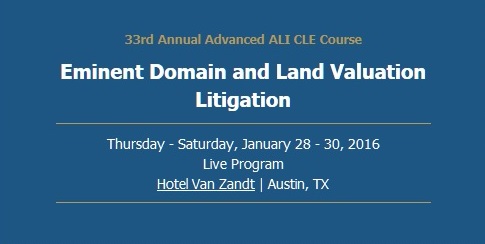
Here’s the full agenda for the 2016 Eminent Domain and Land Valuation Litigation / Condemnation 101 Conference, January 28-30, 2016, in Austin, Texas. 

Together with our friend and colleague Joe Waldo, we think we’re put together a pretty good program that covers a lot of ground. This is the first time the conference has been to Austin, and we’re starting off with a talk by Austin Mayor Steve Adler, who in his former life was an eminent domain lawyer. Other highlights:

  • Professor Ilya Somin will speak about his recently-published book in a segment entitled “The Impact of Kelo and the Limits of Eminent Domain.”
  • Pipelines and Energy Corridors: Valuation Perspectives of Condemnors and Condemnees” with the lawyers on the front lines of one of the hottest topics in eminent domain law nationwide.
  • Retired Minnesota Supreme Court Justice Paul H. Anderson will give us his tips


Continue Reading It’s Here – 2016 ALI-CLE Eminent Domain Conference: Complete Agenda, Faculty, Registration Information

Earlier today, I moderated a panel of expert speakers on the topic of “Civil Forfeiture of Property” at the 12th Annual Brigham-Kanner Property Rights Conference at William and Mary Law School in Williamsburg, Virginia. 

Sara Sun Beale of Duke Law, Scott Bullock of the Institute for Justice, and Sandra Guerra Thompson of the University of Houston Law School were our speakers. Here are my introductory remarks:

Is the right of private property a “poor relation” to other civil rights, as the Supreme Court once warned? Or is the Takings Clause like the Pirate Code in Pirates of the Caribbean — more like what you’d call ‘guidelines’ than actual rules? 

If you were to look only at civil forfeiture laws — what one of our speakers has eloquently referred to as “policing for profit” — you might think so.

These laws allow government to seize private property without first convicting or even charging

Continue Reading Introduction To The Civil Forfeiture Panel At The 2015 Brigham-Kanner Property Rights Conference