Bk_2020_02_475

In case you missed any part of it: the recordings of the recent 2020 Brigham-Kanner Property Rights Conference are now available.

Go here for the descriptions of the panels, speakers, and links to the recorded sessions.

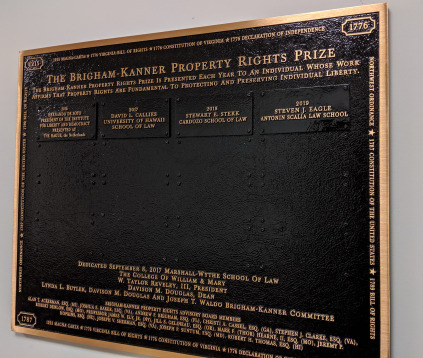
This year’s conference, held on October 1-2, opened with the Brigham-Kanner Property Rights Prize being awarded to Professor Henry E. Smith of Harvard Law School. The prize is named in honor of the lifetime contributions of Toby Prince Brigham, founding partner of Brigham Moore, LLP, and Gideon Kanner, professor of law emeritus at Loyola Law School in Los Angeles, and is presented annually to a scholar, practitioner or jurist whose work affirms the fundamental importance of property rights.

Topics covered: “Where Theory Meets Practice: A Tribute to Henry E. Smith,” “The Housing Crisis,” “Emerging Issues in Takings and Eminent Domain Law,” “The Reach of Government’s Confiscatory Powers over Exigencies and Emergencies,” and “The

Continue Reading Brigham-Kanner Property Rights Conference Videos Now Available
You know those times you go to the store and try to get a refund on something you’ve purchased, and instead of cash back, you get a gift card, only useable at the same store? Or when, instead of refunding your plane ticket, the airline gives you some limited-time credit for a future flight? Anyone like those?

Well, a fascinating case from the New Mexico Court of Appeals, Premier Trust of Nevada, Inc. v. City of Albuquerque, No. A-1-CA-34784 (Oct. 1, 2020) reminds us of the risks associated with these things.

Albuquerque has an impact fee ordinance which developers must pay to offset the costs of needed infrastructure such as roads, drainage, parks, and public safety facilities. To satisfy the exaction requirement, the property owner could either pay money, build the improvements, or give the city property. If the value of these exactions was more than the impact

Continue Reading NM App: No Property In Impact Fee Gift Card

IMG_20190925_175845

Although it is set to launch this Friday, October 2, 2020, there’s still more than enough time to register (and room at the inn) for you to join us for the 17th Annual Brigham-Kanner Property Rights Conference at the William and Mary Law School.

Like everything else this season, the Conference is online (register here), and although we would have preferred to gather in-person of course, the online format has some advantages: the number of attendees isn’t limited by the classroom size (this year’s registrations are at record levels), you don’t need to travel to Williamsburg, and the Conference is free if you don’t want Virginia CLE credit for attending. What a deal.

In our opinion, this is the best legal academy/practicing bar conference on property law. This year, the Conference honors the Brigham-Kanner Prizewinner, Harvard Law School Professor Henry Smith.

Here are the panel topics

Continue Reading There’s Still Room: Join Us For The 17th Annual Brigham-Kanner Property Rights Conference (Online, Free!)

News just in: we’ve just received confirmation that the Conference will not be in-person in Scottsdale in January 2021, and we’re going online.

Not a big surprise, but still a bit disappointing, and it’s a shame that the circumstances won’t allow us to meet in-person to talk shop and to renew our friendships like we do every year. 

But rest assured we’re making lemonade out of these lemons, and we’d appreciate everyone holding the dates on your calendars to join your colleagues from across the nation for the online Conference. And no, we’re not going to do two-and-a-half-days remotely, we’re paring down the agenda and will be focusing on hot topics, and great presenters. The remote format has some advantages, and we’re taking advantage of the circumstances to plan a conference more interactive and a bit different than usual.

This will also be a great program for first-time Conference participants.

Continue Reading Breaking: News About The 2021 ALI-CLE Eminent Domain & Land Valuation Litigation Conference (Jan. 28-29, 2021)

Reading through the Federal Circuit’s opinion in Christy, Inc. v. United States, No. 19-1738 (Aug. 24, 2020) (a case we’ve been following since its inception; see here for the complaint), doesn’t hold out a lot of hope for something new, because the Federal Circuit already ruled in Golden v. United States, 955 F.3d 981 (Fed. Cir. 2020), that cancellation of a patent via inter partes review is not a taking. That precedent took care of the Christy plaintiffs’ main beef.

But they also alleged that the fees they paid to the PTO for issuance and maintenance of the patent were exactions. They wanted the fees they had paid refunded. Why should we have to pay for what the government eventually held was an invalid patent? No dice, held the court. An “exaction” is for money paid “in contravention of the Constitution, a statute, or a regulation.”

Continue Reading Fed Cir: No Taking For Invalidating Patent By Inter Partes Review (But You Knew That Already)

Here’s the latest in a case we posted about last year. There, the North Dakota Supreme Court noted an open issue, but declined to resolve it. Now, in Fargo v. Wieland, No. 20200100 (July 22, 2020), the court addressed it head-on. 

Here’s how the noted the issue:

whether a landowner who appeals an award in eminent domain proceedings, without accepting or withdrawing deposited funds, is entitled to the payment of post-judgment interest subsequent to the deposit of the full amount of the judgment

Slip op. at 2.

After a just comp judgment, the city deposited the funds to cover the verdict, plus money for the court’s award of attorneys’ fees. The property owner appealed. Even though she could have, she didn’t withdraw the money because doing so would have waived her right to appeal on all issues except a claim for more compensation. Her appeal asserted the taking

Continue Reading Time Isn’t Money: Landowner Not Entitled To Interest On Deposited Funds Satisfying Just Comp Verdict, Even If That Forces Property Owners Into A Bad Choice

We don’t often post trial court orders, but this one, Chiquita Canyon, LLC v. Cnty of Los Angeles, No. BS 171262 (Cal. Super. July 2, 2020), from the California Superior Court, is worth reading for you land use and exactions mavens.

It’s a long order, so we won’t go into great detail, but the short story is that the petitioner (a landfill) administratively challenged 22 of the 130 conditions and fees the County imposed on a Conditional Use Permit. Some of the conditions violated the trash law (California’s Integrated Waste Management Act) because they discriminated against out-of-area trash.And the condition requiring the landfill to support the state’s waste management goals? Compelled speech (no trash talk required!).

But you Nollan/Dolan mavens will really like the part about California’s Mitigation Fee Act, which essentially is a codification of the same exaction standards which the U.S. Supreme Court adopted in

Continue Reading Trash Talking: Permit Condition Not Backed By Proof Of Nexus And Proportionality Is Illegal Exaction

KingStreet

Breaking! In H.C. Cornuelle, Inc. v. City and Cnty of Honolulu, No. 14068 (Haw. July 17, 1990), the Hawaii Supreme Court held that the City and County of Honolulu inversely condemned a strip of private property in downtown when it prohibited development and use of that land because the City intended to acquire it in the future for a road-widening project.

Wait, what? “Breaking,” you say? This memorandum opinion was issued nearly 30 years ago. What gives? Well, we remember this case from back in the day when we were just starting out, but had long forgotten about it. Plus, the same case resulted in one of the first post-Williamson County Ninth Circuit opinions, because the landowners originally sued for the taking in federal court, but were bounced out for ripeness. So they tried the takings case in a Hawaii state court. The Hawaii Supreme Court’s opinion

Continue Reading HAWSCT: City’s Prohibiting Use Of Property Pending City Acquisition Is Land Banking Taking

Screenshot_2020-05-12 William Mary Law Review

Looking for some property and takings scholarly reading while you cool your heels at home? Well, the William and Mary Law Review has recently published no less than three worthy pieces, all available for download.


Continue Reading Three New Property And Takings Articles From William & Mary Law Review