


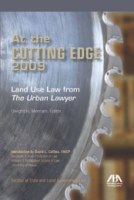
Cutting_edge_2009 One of the benefits of doing your own blog is that every now and then you are allowed to engage in a little shameless self-promotion (what’s this “every now and then?”).

Well, here goes.

The ABA has announced the forthcoming publication of a new book by the State and Local Government Law Section: At the Cutting Edge 2009: Land Use Law from The Urban Lawyer, edited by my colleague Dwight H. Merriam, and which features “[a] compilation of the most recent Section of State and Local Government Law committee reports from The Urban Lawyer.”

What this means is that it contains topical and timely articles about the hottest topics in land use law, including exactions and impact fees, green building laws, ethics in land use, regulatory takings, citizen participation in public hearings, and public use and pretext in eminent domain (the piece I authored).

Here’s the Table

Continue Reading New Book: At the Cutting Edge 2009: Land Use Law from The Urban Lawyer
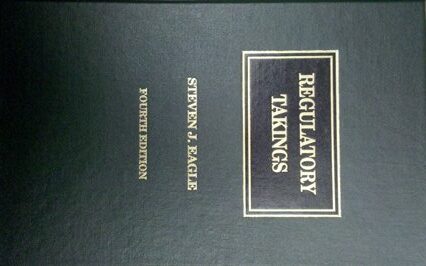
Eagle_reg_takings_cover I just received my copy of the latest edition of Professor Steven J. Eagle‘s definitive treatise Regulatory Takings (Lexis/Nexis, 4th ed. Dec. 2009).

Like the earlier editions, this is a must-have for every land use and property law attorney’s back bookshelf.

Chapters include “Property Rights and Their Sources,” “The Ascendancyof Land Use Regulation,” “Analytical Issues in Regulatory TakingsLitigation,” and “Regulatory Takings Remedies.”

The book is available here (oddly, the Lexis-Nexis web site only has the 3d edition for purchase, but I expect that to be remedied shortly).

From the preface to the fourth edition:

Thisbook is about “regulatory takings,” which is a relatively new term, but not an entirely new idea. The underlying concept is stated simply — government may “regulate” private property, but not to the extent that it constitutes a “taking,” under the United States Constitution, or a state constitution. Owners need not be compensated for losses

Continue Reading Eagle On Regulatory Takings (4th ed. 2009)

The property owners and the County of Maui have filed their opposition and reply briefs regarding the cross motions for summary judgment in the Maui affordable housing case now being litigated in the U.S. District Court, Kamaole Pointe Development LP v. County of Maui, No. 07-00447 DAE (D. Haw.).

The case is a challenge to the County of Maui’s “workforce housing”ordinance, enacted in in 2006, which imposes a40% to 50% affordable requirement on new housing developments of fiveor more units, and on an application to subdivide a lot into five ormore parcels. In lieu of providing actual units, a developer may eitherpay a fee equivalent to 30% of the total project sales, donate improvedland of the same value, or donate raw land valued at 200% of thein-lieu fee. Ordinance 3418 is posted here.

The complaint asserts claims for “unconstitutional conditions,”regulatory takings, substantive and procedural due process, equal protection

Continue Reading Final Briefs On Due Process Motions In Maui Affordable Housing Exaction Case

Here’s the latest in the Maui affordable housing case now being litigated in the U.S. District Court, Kamaole Pointe Development LP v. County of Maui, No. 07-00447 DAE (D. Haw.). The case is a challenge to the County of Maui’s “workforce housing”ordinance, enacted in in 2006, which imposes a40% to 50% affordable requirement on new housing developments of fiveor more units, and on an application to subdivide a lot into five ormore parcels. In lieu of providing actual units, a developer may eitherpay a fee equivalent to 30% of the total project sales, donate improvedland of the same value, or donate raw land valued at 200% of thein-lieu fee. Ordinance 3418 is posted here.  We posted on the case earlier here and here.

The complaint asserts claims for “unconstitutional conditions,”regulatory takings, substantive due process, equal protection, andclaims under Hawaii law. The Complaint for Declaratory and InjunctiveRelief (filed

Continue Reading Latest In Maui Affordable Housing Exaction Case: Cross-Motions On Due Process

Earlier this week, the Supreme Court declined review of the Ninth Circuit’s decision in McClung v. City of Sumner, 548 F.3d 1219 (9th Cir. 2008). In that case, the Ninth Circuit held:

This casepresents an issue of first impression in this Circuit — whether alegislative, generally applicable development condition that does notrequire the owner to relinquish rights in the real property, as opposedto an adjudicative land-use exaction, should be reviewed pursuant tothe ad hoc standards of Penn Central Transportation Co. v. City of New York, 438 U.S. 104 (1978), or the nexus and proportionality standards of Nollan v. California Coastal Commission, 483 U.S. 825 (1987), and Dolan v. City of Tigard, 512 U.S. 374 (1994). We affirm, holding that the Penn Central analysis applies to the 12-inch pipe requirement. 

The Ninth Circuit’s opinion is available here. The Cato Institute which along with others filed an

Continue Reading Cert Denied In Ninth Circuit Legislative Exactions Case

The Washington Examiner has published an op-ed about McClung v. City of Sumner, 548 F.3d 1219 (9th Cir. 2008), petition for cert. filed May 2, 2009, “When the Government Takes Your Money, It Takes Your Property,” by Cato Institute’s Ilya Shapiro and Pacific Legal Foundation’s Lauren Wiggins (who filed an amicus brief urging the Court to review the case).

McClung involves an exaction of money, and not land, as a condition of a development permit. The Ninth Circuit held that legislative exactions are not subject to Nollan/Dolan:

Courts are deeply divided over whether the Fifth Amendment applies tothe taking of property by means of fees such as the ones the McClungswere assessed.  They are also split as to whether legislatively imposedconditions allow a local government to avoid making individualizeddeterminations of a development’s impact.  Courts like the NinthCircuit rely on the fact that the Supreme

Continue Reading Op-Ed: Money Is Property – Monetary Exactions And Nollan/Dolan

Several items of interest:

  • California Coastal Commission: “You must farm” – As a condition of allowing a Northern California family to build a home, the California Coastal Commission demanded that they dedicate an “agricultural easement” on their 143-acre parcel.  In other words, as a condition of use, the Commission requires a family that has never farmed its land to use its land for farming.  More about the case from the Half Moon Bay Review here. The complaint is posted here.

    “What the Coastal Commission is asking us to do in return for a building permit is to put the remaining acreage into agriculture easement,” Dan Sterling said. “But it doesn’t stop there. They want control of what and how we farm. And even then, they can come in here whenever they want.” That’s Sterling’s biggest issue. He says he’d lose control over all but 10,000 square feet of


Continue Reading Tuesday Round-Up: Forced Farming, Tax Or Taking, RLUIPA Loophole

A cert petition has been filed seeking review of the Ninth Circuit’s decision in McClung v. City of Sumner, 548 F.3d 1219 (9th Cir. 2008), the case in which the court held:

This case presents an issue of first impression in this Circuit — whether a legislative, generally applicable development condition that does not require the owner to relinquish rights in the real property, as opposed to an adjudicative land-use exaction, should be reviewed pursuant to the ad hoc standards of Penn Central Transportation Co. v. City of New York, 438 U.S. 104 (1978), or the nexus and proportionality standards of Nollan v. California Coastal Commission, 483 U.S. 825 (1987), and Dolan v. City of Tigard, 512 U.S. 374 (1994). We affirm, holding that the Penn Central analysis applies to the 12-inch pipe requirement. 

The Ninth Circuit’s opinion is available here.  The petition presents three

Continue Reading New Cert Petition And Amicus Brief On Nollan/Dolan Applicability To Legislative Exactions, In-Lieu Fees