In Cappel v. Nebraska Dep’t of Natural Resources, No. S-16-1037 (Dec. 22, 2017), the Nebraska Supreme Court concluded the Department’s notices to Cappel pursuant to an interstate water compact which closed off his land’s ability to draw surface water from the Republican River for irrigating his crops was neither a physical nor regulatory taking. 

As you might expect, the central takings question which the court addressed was whether Cappel’s water allocations were “property.” The court held that because the closing notice was made pursuant to the Department’s obligations under the compact, “the water rights at issue were not a compensable property interest and the Cappels’ physical taking argument must fail.” Slip op. at 454. The court also dispensed with the regulatory takings claim by applying the Penn Central test. And you know what that means. 

Here’s the money quote, which reveals the court’s essential problem with the takings claims:

Continue Reading Nebraska: No “Property” In Water Rights Subject To Interstate Compact
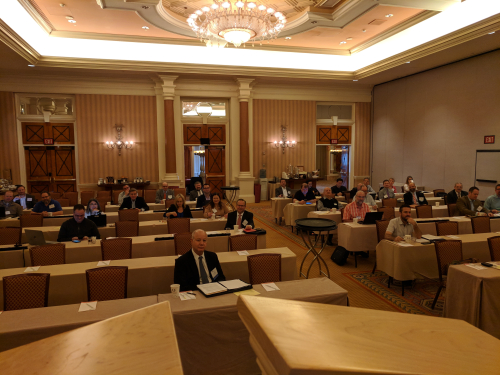
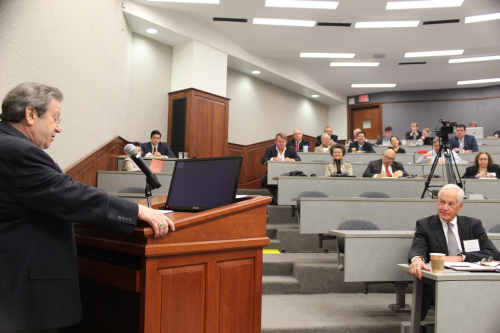
IMG_20171211_090714This photo of the view from the lectern at the start of the day
proves we really
were in the room and not distracted by all the distractions
possible in Las Vegas

Here are the materials and cases which I spoke about earlier today at the CLE International Eminent Domain Conference in Las Vegas. I had the lead off session on updates, and my talk focused on cases that I didn’t cover in the written materials:


Continue Reading Links And Materials From Today’s Las Vegas Eminent Domain Conference

Here’s a case about the denominator in a regulatory takings case from July 2017, just after the U.S. Supreme Court issued its opinion in Murr v. Wisconsin. We somehow missed the opinion when it was issued, but since we think it must be the first case which attempted to apply the Murr majority’s multi-factor test, figured we better post it.

In Quinn v. Board of County Commissioners, Queen Anne’s County, No. 16-1890 (July 7, 2017), a panel of the U.S. Court of Appeals for the Fourth Circuit upheld the district court’s dismissal of a regulatory takings claim that the County’s regulations, “designed to limit overdevelopment of the area” on South Kent Island. Slip op. at 3. But not as you might expect (on Williamson County ripeness grounds), but on the merits.

Practice note: when you are the property owner’s lawyer and an opinion starts by characterizing your

Continue Reading The First Post-Murr Case? Fourth Circuit: No Taking Because Anti-Development Merger Regulations Actually Make Property Developable

We’re in court today (so blogging about lawyering must yield to the actual practice of lawyering) so we’re going to just post this here, and let you consider it. And maybe wait for our New York City colleagues (who just happen to represent the property owner), to weigh in via their eminent domain blog

The New York Appellate Division’s opinion in City of New York v. Baycrest Manor, Inc., No. D59668 (Nov. 15, 2017) is an eminent domain case which involves the valuation of wetlands on Staten Island, and Palazzolo‘s holding that long-existing restrictive regulations are not baked into a parcel’s value.

The City claimed that the condemned property was not worth a whole lot because the wetlands regulations predated the condemnee’s purchase. The owner, by contrast, argued that it had a pretty good shot at prevailing on a regulatory takings claim, because the Supreme Court in 

Continue Reading Staten Island Wetlands Regulations Are A Penn Central Taking. A Penn Central Taking!

The Georgia Supreme Court’s analysis in Diversified Holdings, LLP v. City of Suwanee, No. S17A1140 (Nov. 2, 2017) reminded us of that old trope from logic, “no true Scotsman.” 

According to a completely reliable source (Wikipedia):

No true Scotsman is a kind of informal fallacy in which one attempts to protect a universal generalization from counterexamples by changing the definition in an ad hoc fashion to exclude the counterexample. Rather than denying the counterexample or rejecting the original claim, this fallacy modifies the subject of the assertion to exclude the specific case or others like it by rhetoric, without reference to any specific objective rule (“no true Scotsman would do such a thing”; i.e., those who perform that action are not part of our group and thus criticism of that action is not criticism of the group).

(And, in case you were wondering, “For the practice of

Continue Reading Georgia: No True Taking – Challenge To City’s Refusal To Rezone Isn’t Really Inverse Condemnation

This just in: the Hawaii Supreme Court has rendered a unanimous opinion in Leone v. County of Maui, No. SCAP-15-599 (Oct. 16, 2017), a case we’ve naturally been following because it involves regulatory takings (and we were involved in a similar case on a neighboring property). 

We haven’t had a chance to review the 48-page opinion in detail (once we do so, we will post a more detailed review), but the issue the court was presented with was, as we noted here, whether leaving land in its vacant state court be considered an economically beneficial use. Short story is that the court held yes, it could, thus seeming to create a lower court split (hello, cert petition) with at least one other court, the Federal Circuit in Lost Tree, concluding that economically beneficial use means more than someone might buy it down the road. 

There’s

Continue Reading Conflict Check: Hawaii Adds To Lower Court Regulatory Takings Split: Is Leaving Land Vacant On The Hope It Is Worth More In The Future “Economically Beneficial Use”?

IMG_2931

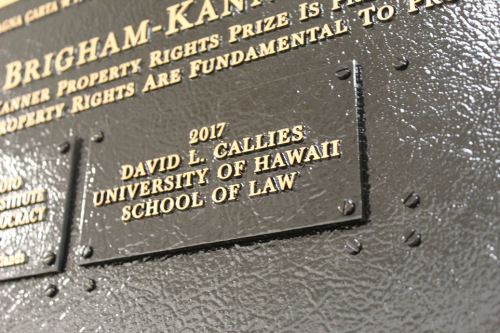
University of Hawaii Law School Professor David Callies last night was presented with William and Mary Law School’s Brigham-Kanner Property Rights Prize which is “presented annually to a scholar, practitioner or jurist whose work affirms the fundamental importance of property rights.” 

As W&M notes about Professor Callies, a “prolific scholar whose work explores land use, property, and state and local government law, Callies has lectured around the world and authored or collaborated on about 90 articles and 20 books. He has been a member of the prestigious American Law Institute since 1990 and is the Benjamin A. Kudo Professor of Law at the University of Hawaiʻi at Mānoa. Prior to entering academia, he was an attorney in private practice and an assistant state’s attorney.”

IMG_3028

We’re spending today in a series of panels which explore and build upon Professor Callies’ lifetime of work. Michael Berger, a past Prize winner, kicked off

Continue Reading Professor David Callies Awarded William & Mary Law’s Brigham-Kanner Property Rights Prize

ALI-CLE2018

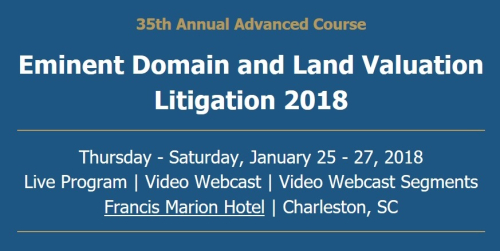
It’s not too early to reserve your spot at the 35th Annual ALI-CLE Eminent Domain and Land Valuation Litigation Conference, to be held at the Francis Marion Hotel in historic downtown Charleston, South Carolina, January 25-27, 2018. 

We’re finalizing the Conference details, but can report that the program will, as usual, feature expert presenters from across the nation, and both an in-depth update on the subjects we love, and a “101” track for those new to the field or who would appreciate a refresher. Check out some of the topics:

  • Takings and Damaging by Flood: Case Selection Advice For Savvy Practitioners
  • Quarterbacking the Case: Blocking Defenses, Controlling the Witnesses, and Converting for Verdicts
  • We’ve Been Working on the Railroad: Utility Crossing Disputes
  • Protecting Your Record,and Anticipating Appeals
  • Lucas 25 Years Later: Property Rights in the Age of Global Warming
  • Building and Growing Your Eminent Domain Practice With


Continue Reading 2018 ALI-CLE Eminent Domain Conference: Early-Bird Registration Discount Now Posted

DSCF3369

Back when the opinion was first released, we posted a list of Murr v. Wisconsin links. Now that Court is nearly back from its summer vacation, here’s an updated list:

Will there be more? No doubt. Murr is the takings case that keeps on giving. Continue Reading The Takings Case That Keeps On Giving: Murr Round-Up, Continued

Topdowloads

We received a nice (although automatic) email note this morning from SSRN, letting us know that our draft article on Murr v. Wisconsin, Restatement (SCOTUS) of Property: What Happened to Use in Murr v. Wisconsin?, “was recently listed on SSRN’s Top Ten download list for: Property, Land Use & Real Estate Law eJournal.”

Before we got too excited, we remembered that this means only that the article has been downloaded a grand total of 58 times. Which tells us that the “Property, Land Use & Real Estate Law eJournal” is a pretty niche market. But hey, we’ll take accolades where we can get them. We’re at the bottom end of the list, but are just happy to be in such stellar company.  Check it out: there are other things on the list that takings mavens will like reading. Like this article. And this one.  Continue Reading We’re Number 10! We’re Number … 10?