Okay, all you “relevant parcel” mavens, here’s another decision for you (once again involving land in Florida, although, unlike the other case which came out of the Florida court of appeals, this one is out of the U.S. Court of Appeals for the Federal Circuit) .

These decisions provide a measure of sanity to the issue of how much of the property owned by the plaintiff is included when determining whether value has been wiped out under Lucas, or the extent of the economic impact of the regulation on the claimant under Penn Central. These tests require an analysis of the impact of the regulatory action on the “parcel as a whole,” and since Penn Central first made the inquiry relevant, the courts an litigants have been trying to figure out the “denominator” — is it everything the plaintiff owns? Everything nearby? Everything it once owned? The discrete

Continue Reading Federal Circuit: Denial Of Permit To Fill Wetlands Might Be A Taking
pbeard

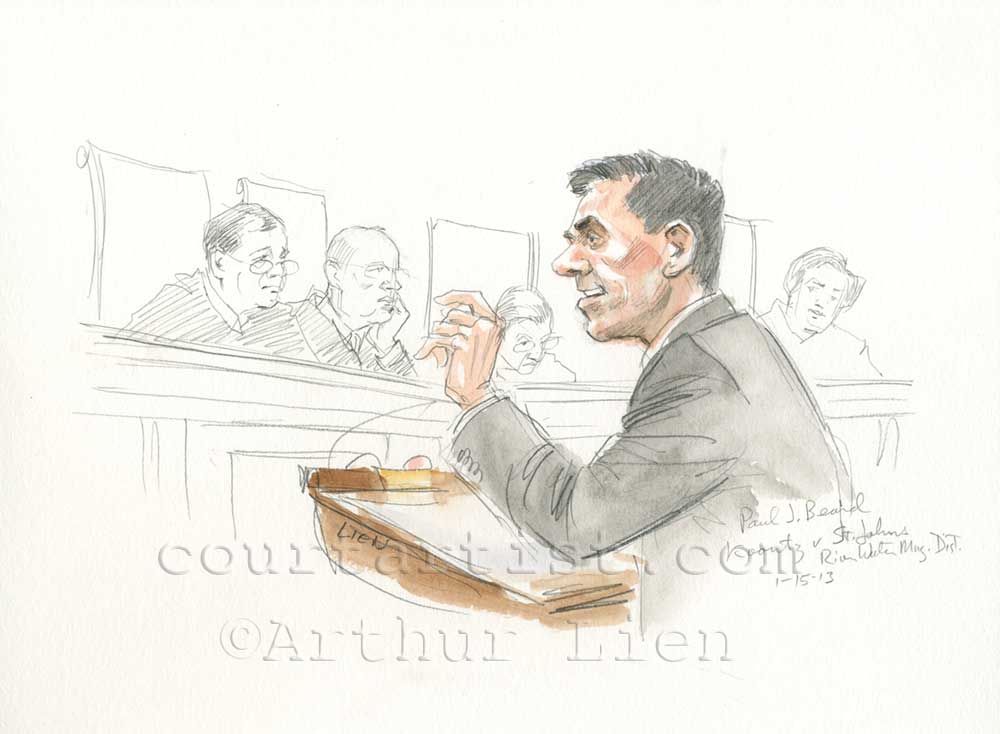
When you are a property owner making a takings argument and Justice Scalia gives you a hard time at oral argument, you would be safe in thinking that you’ve got an uphill battle.

That was the situation today during the oral argument (transcript here) in Koontz v. St Johns River Water Mgmt Dist., No. 11-1447 (cert. granted Oct. 5, 2012), the case in which the Court is considering whether the “essential nexus” and “rough proportionality” standards of Nollan and Dolan are applicable only to exactions for land, or whether they are generally-applicable tests for all exactions.

Justice Scalia, author of the Nollan opinion, did not seem all that concerned with the second Question Presented (whether only exactions of real property are subject to Nollan/Dolan), but more on whether a takings claim can be based on an excessive exaction attached to a permit when the property

Continue Reading SCOTUS Arguments In Monetary Exactions Case: (Sliced) Bread And Circuses

William W. Wade, Ph.D., a resource economist with the firm Energy and Water Economics (Columbia, Tennessee) is a frequent author and speaker on the topic of regulatory takings and is familiar to readers of this blog. (His next gig is a talk on Penn Central and inverse condemnation at the 12th Annual Texas Eminent Domain SuperConference February 11-12, 2013, in Austin.)

Bill fills us in on the Texas Supreme Court’s decision in EdwardsAquifer Authority v. Day, 274 SW.3d 742, (Tex. 2012). The court issued the opinion in February 2012, but recently denied a motion to rehear the case, thus making it final. 

++++++++++++++++++++++++++++++++++

Regulatory Takings, Texas Groundwater, and Hydrofracking

by William W. Wade, Ph.D.

Texasmay have created the takings and condemnation lawyer full-employment act. 

TheTexas Supreme Court in February 2012 reversed a hundred years of water law,changing groundwater ownership rights from a “rule of capture” to ownership of”groundwater

Continue Reading Guest Post: Regulatory Takings, Texas Groundwater, And Hydrofracking

There have been five amicus briefs filed supporting the Water Management District’s arguments in Koontz v. St Johns River Water Mgmt Dist., No. 11-1447 (cert. granted Oct. 5, 2012). That’s the case in which the Supreme Court is considering whether the “essential nexus” and “rough proportionality” standards of Nollan and Dolan are applicable only to exactions for land, or whether they are generally-applicable tests for all exactions.

The property owner’s brief on the merits is available here. The Water Management District’s merits brief is posted here.

The amicus briefs just filed focus on the argument that a government demand for money is not an “exaction” that even triggers takings analysis, and if it is, the multifactor Penn Central test governs, not the NollanDolan test.


Continue Reading Gov’t Amicus Briefs In Koontz: A Demand For Money Is Not An Exaction (And Even If It Is, Penn Central Is The Test)

LgoIt’s time for the annual ALI-CLE (fka ALI-ABA) eminent domain conferences, to be held January 24-26, 2013 in Miami Beach, Florida.

In the “advanced” course, Eminent Domain and Land Valuation Litigation, we’ll be covering topics such as “Condemning Underwater Mortgages,” “An Engineer’s Role in Damage,” “How To Develop and Implement a Business Plan for an Eminent Domain Practice,” and “Condemnor Beware: What Activities Will Make You Liable for Pre-Condemnation Damages.” Along with Pacific Legal Foundation’s Jim Burling and Cornell lawprof Robert Hockett, I’ll be speaking on the panel about underwater mortgages. More details on the agenda and the faculty here.

The companion course, Condemnation 101: How to Prepare an Eminent Domain Case, covers the basics of eminent domain law, and although designed as an overview of condemnation law for the beginner or general practitioner, it’s a great refresher course for the seasoned eminent domain lawyer. More

Continue Reading Upcoming ALI-CLE Eminent Domain Conferences

Here’s the respondent’s brief in Koontz v. St Johns River Water Mgmt Dist., No. 11-1447 (cert. granted Oct. 5, 2012). That’s the case in which the Supreme Court is considering whether the “essential nexus” and “rough proportionality” standards of Nollan and Dolan are applicable only to exactions for land, or whether they are generally-applicable tests for all exactions.

The respondent’s brief argues that the Water District did not demand an exaction, but merely “suggested a range of ways [the] applicant may [have] become eligible for a development permit.” Br. at 40. The brief argues that because the District could have denied the permit outright, it was fine for it to “suggest” ways that the property owner could convince it to issue the permit, without needing to show that there was some relationship between the suggested mitigation measures and the justification supporting the denial. Thus this was not merely the

Continue Reading Brief For The Respondent In Koontz: “Mere Obligation To Spend Money Is Not A Taking”

An opinion worth reading. In Galleon Bay Corp. v. Bd. of County Commissioners, No. 3D11-1296 (Dec. 5, 2012), the Florida District Court of Appeal (Third District), held that the trial court improperly applied the “investment-backed expectations” prong of the Penn Central factors, by not treating the parcels at issue separately from the plaintiff’s other parcel which it had developed “decades earlier.” The appeals court reversed the judgment for the County, and remanded the case, instructing the trial court to enter judgment in favor of the property owner and hold a trial on compensation. It’s a long fact pattern with a relatively short opinion. Check it out.

Pay particular attention to note 9 on page 16, for a flavor of what just might have added to the court of appeals’ determination that the law was on the property owner’s side. The trial court initially ruled in favor of the property

Continue Reading Fla App Applies Penn Central, Finds A Taking: Investment-Backed Expectations Measured Parcel-by-Parcel, Not Against All Property Owned

Here are some thoughts about yesterday’s opinion in Arkansas Game and Fish Comm’n v. United States, No. 11-597 (Dec. 4, 2012), in which a unanimous Supreme Court held that government-induced flooding could be a taking, even if temporary. 

Bad Puns and a “Flood” of Litigation

First, the temptation in flooding cases is to make bad puns (the same seems to hold true for beach cases (‘shifting sands,’ for example  … what is it about property cases that especially inspires these bad puns anyway?), and this one is no exception. Justice Ginsburg’s opinion dismissed the trope that holding in favor of the property owner would result in more litigation or a resistance on the part of government to take flood control measures:

The sky did not fall after [United States v.] Causby[, 329 U.S. 256 (1946)], and today’s modest decision augurs no deluge of takings liability.

Slip op.

Continue Reading More Thoughts On Flooding, Takings, And How To Read A Supreme Court Opinion

The three-part Penn Central test for an ad hoc regulatory taking tasks courts with evaluation of the economic impact of the regulation on the property’s use, the property owner’s distinct investment-backed expectations, and the character of the government action. Throw all of these “factors” into a pot, stir, and voila, the answer of whether the regulation goes “too far” is supposed to emerge. But try as they might, many courts don’t really have a good idea of how to apply this test, even though in Lingle, the Supreme Court affirmed that it remains the “default” analysis to evaluate most takings claims.

The latest regulatory takings opinion from the Ninth Circuit, Laurel Park Community, LLC v. City of Tumwater, No. 11-35466 (Oct. 29, 2012) is another example of a court applying the test, in this case to evaluate property owners’ claims that the enactment of a new zoning

Continue Reading 9th Cir: No Facial Penn Central Taking In Ordinance Creating Mobile Home Zoning

If you understand that headline, congratulations: you are officially a takings geek.

Here’s another piece worth reading, to prepare yourself for next week’s oral arguments in Arkansas Game & Fish Comm’n v. United States, No. 11-597 (cert. granted Apr. 2, 2012): Is the federal government shifting the focus in Arkansas Game & Fish Commission? by my PLF colleague Brian T. Hodges.

Somewhat surprisingly, the central question in this case—whether a physical invasion of private property must continue permanently to take property within the meaning of the Takings Clause—seems to be the least controversial of the questions posed by the parties’ merits briefs.  The question that is drawing the most attention is whether a temporary flood invasion should be treated like all other temporary physical takings (for which the Court has already established a test as set out in the PLF/Cato Institute/ALF amicus brief), or whether the Court should

Continue Reading Shifting Gears In SCOTUS Takings Case: Are Floods Treated As Physical Invasions, Or Analyzed Under Penn Central?