


As noted in this order. Next stop cert petition? More on the case here.Continue Reading Fed Cir Denies Rehearing/En Banc In CCA Case
Links From Today’s IMLA Regulatory Takings Webinar
Here are the links to the cases and other items discussed today at the International Municipal Lawyers Association webinar with Dan Mandelker and Dwight Merriam. Most of these cases are also in your written materials.
- 9th Circuit: California Raisins Were Not Taken (Horne v. U.S.D.A., No. 10-15270 (9th Cir. July 25, 2011))
- Loretto v. Teleprompter Manhattan CATV Corp., 458 U.S. 419 (1982).
- Kaiser Aetna v. United States, 444 U.S. 164 (1979).
- Yee v. City of Escondido, 503 U.S. 519 (1992).
- Lucas v. South Carolina Coastal Council, 505 U.S. 1003 (1992).
- Stop the Beach Renourishment, Inc. v. Fla. Dep’t of Envtl. Prot., 130 S. Ct. 2592 (2010).
- Vandevere v. Lloyd, No. 09-35957 (9th Cir. July 11, 2011).
- Vanek v. State, 193 P.3d 283, 286 (Alaska 2008).
- Brown v. Howard, 2011 WL 2535555, at *1 (S.C. June 21, 2011).
- South Carolina Bar’s
Continue Reading Links From Today’s IMLA Regulatory Takings Webinar
Petition For Rehearing/En Banc In CCA Associates: Time To “Sort Out” Takings Law
Count us in the “not surprised” column: the property owners have sought a panel rehearing or a rehearing en banc from the Federal Circuit in CCA Associates v. United States, No. 2010-5100 -5101 (Nov. 21, 2011).
The petition for rehearing asserts
If any case cried out for en banc review, this is the one. The decisions of this Circuit regarding the effect of the ELIHPA and LIHPRHA statutes are in conflict, not only with each other, but also with settled law on regulatory takings and contract formation. The panel majority acknowledged this conflict but held that it had no choice but to follow the Court’s decisions in Cienega Gardens v. United States, 503 F.3d 1266 (Fed. Cir. 2007) (“Cienega X“) and Ciegega Gardens v. United States, 194 F.3d 1231 (Fed Cir. 1998) (“Cienega IV“).
The exceptionally important issues presented by this petition, including
Continue Reading Petition For Rehearing/En Banc In CCA Associates: Time To “Sort Out” Takings Law
Cal Ct App To City: Either Reverse Your Unconstitutional Spot Zoning, Or Pay. Your Choice.
We’re gearing up for a Supreme Court argument tomorrow, so don’t have time at the moment to digest the entirety of today’s opinion in Avenida San Juan P’ship v. City of San Clemente, No. G043479 (Cal. Ct. App. Dec. 14, 2011). But a quick glance tells us we’re going to like it.
A California trial court concluded that the city’s zoning a 2.85 acre parcel with a density of one house per 20 acres, while the surrounding properties are zoned at a density of four houses per acre was unconsitutional “spot zoning.” The court issued a writ of mandate (remember, this is California) ordering the City to accept the property owner’s application to develop four houses on the parcel.
The trial court also found a Penn Central taking and ordered the City to either comply with the writ or pay $1.3 million in just compensation for the
Federal Circuit: No Regulatory Taking Under Penn Central Test
Here’s the latest from the U.S. Court of Appeals for the Federal Circuit (the court that hears appeals in most regulatory takings claims against the federal government), CCA Associaties v. United States, No. 2010-5100 -5101 (Nov. 21, 2011).
This is an appeal of a Court of Federal Claims decision holding that two federal statutes worked a taking under the three-part Penn Central test because they abrogated the rights of the owner of a Louisiana apartment building to prepay its way out of providing low income housing. The CFC held that the programs set up under the statutes in effect forced CCA to continue to provide low income housing — a public good — and that it was a taking.
The Federal Circuit reversed:
The United States appeals from the decision of the Court of Federal Claims that the Emergency Low Income Housing Preservation Act, Pub. L. No. 100-242, §
Continue Reading Federal Circuit: No Regulatory Taking Under Penn Central Test
Yosemite Seminar Summary – Regulatory Takings: Looking Back And Looking Forward

“Yosemite,” according to California Place Names, Erwin Gudde’s seminal work on the origins of (surprise) California place names, means “they are killers.” It was “[e]vidently a name given to the Indians of the valley by those outside it.”
I raise this historical tidbit because I must admit to feeling a little like “those outside it” when I was invited to speak about regulatory takings at the California State Bar’s Environmental Law Conference at Yosemite. I figured as a conference devoted to environmental law, it was a going to be a decidedly skeptical audience, given my advocacy for property owners and property rights. I accepted the invitation nonetheless, heartened that this conference wasn’t going to be an echo chamber and that they were at least open to hearing competing ideas.
It turns out that my prediction about “they are killers” was not accurate — the audience, while not exactly
Continue Reading Yosemite Seminar Summary – Regulatory Takings: Looking Back And Looking Forward
Links From “Regulatory Takings: Looking Back And Looking Forward” (Cal. State Bar Yosemite Conference)
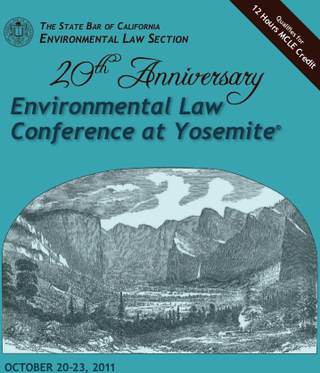 Here are the links to the cases and other items discussed today at the session Regulatory Takings – Looking Back and Looking Forward at the Cal State Bar’s Environmental Law Section’s Environmental Law Conference at Yosemite.
These cases are also in your written materials.
- 9th Circuit: California Raisins Were Not Taken (Horne v. U.S.D.A., No. 10-15270 (9th Cir. July 25, 2011))
- Loretto v. Teleprompter Manhattan CATV Corp., 458 U.S. 419 (1982).
- Kaiser Aetna v. United States, 444 U.S. 164 (1979).
- Yee v. City of Escondido, 503 U.S. 519 (1992).
- Lucas v. South Carolina Coastal Council, 505 U.S. 1003 (1992).
- Stop the Beach Renourishment, Inc. v. Fla. Dep’t of Envtl. Prot., 130 S. Ct. 2592 (2010).
- Vandevere v. Lloyd, No. 09-35957 (9th Cir. July 11, 2011).
- Vanek v. State, 193 P.3d 283, 286 (Alaska 2008).
- Brown v. Howard, 2011 WL
California Bar’s Yosemite Conference: “Regulatory Takings: Looking Back and Looking Forward”
One conference down, one to go.
We’re on the way back from the Brigham-Kanner Property Rights Conference in Beijing, and on our way to the California State Bar Environmental Law Section’s annual conference at Yosemite N.P., which begins later this week. More information about the conference here.
Along with U.C. Berkeley law professor Joseph Sax and Deputy California Attorney General Daniel L. Siegel, I will be speaking about “Regulatory Takings: Looking Back and Looking Forward.” E. Clement Shute will moderate the panel discussion.
We will be discussing the seminal regulatory takings cases from the past 20 years. “The panelists, who have been involved in several of the most significant takings cases since even before the founding of the annual Yosemite Environmental Law Conference twenty years ago, will highlight key decisions, offer their views on the evolution of takings law, and discuss cutting-edge issues raised by more recent
Climate Change And Regulatory Takings In Coastal Hawaii
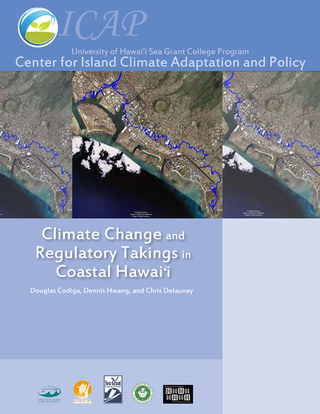
“There is strong consensus in the international scientific community that climate change is occurring and that greenhouse gas emissions from human activities contribute to climate change.”
So begins Climate Change and Regulatory Takings in Coastal Hawaii, a monograph by Douglas Codiga, Dennis Hwang, and Chris Delaunay, published by the University of Hawaii Sea Grant College Program’s Center for Island Climate Adaptation and Policy.
We’re not entering into the debate about whether global warming/climate change is or isn’t happening. But the one certain thing is that every regulatory entity from the U.N. on down to your local neighborhood board believes it is real, and seems to want to do something about it. Thus, the question is how property owners may be affected by those actions, and what they can do in response. This report doesn’t really resolve anything, but it does establish the framework and makes some recommenations. From
Continue Reading Climate Change And Regulatory Takings In Coastal Hawaii
Article: Sources of Regulatory Takings Economic Confusion Subsequent to Penn Central
 Thanks to the folks at the Environmental Law Institute, who have allowed us to reprint an article from a recent Environmental Law Reporter by William W. Wade, Ph.D., a resource economist with the firm Energy and Water Economics (Columbia, Tennessee). Bill is a frequent author and speaker on the Penn Central issue, and he’s brought much needed clarification to an often confusing issue.
In Sources of Regulatory Takings Economic Confusion Subsequent to Penn Central, Mr. Wade writes:
The Federal Circuit Cienega X decision imposes insufficient financial analysis of Penn Central’s two economic prongs to satisfy either economic practice or the Penn Central test. The decision’s imposed change in value measurement evaluates only one prong of the Penn Central test. Change in value satisfies the economic impact prong but does not establish severity of the economic impact vis-à-vis frustration of distinct investment-backed expectations (DIBE). Mere diminution is well-known