As you can tell from the date of the opinion, we’ve been meaning to post the South Carolina Supreme Court’s ruling in Braden’s Folly, LLC v. City of Folly Beach, No. 2022-000020 (Apr. 5, 2023) for a while. Something else always intervened, but it remains a decision worth reviewing.

The city adopted an ordinance that erased lot lines for certain contiguous properties under common ownership, merging two distinct parcels into one and prohibiting their separate sale. The ordinance recognized nonconforming uses. Braden’s properties are covered by the ordinance.

When Braden’s Folly acquired the Lots in 1999, there was a small house on Lot A, and Lot B was undeveloped because it was either underwater or part of the active beach. Following a beach renourishment in 2005, Lot B became developable because it had been transformed into mostly sandy beach. Therefore, between 2006 and 2007, Braden’s Folly received building permits

Continue Reading SC: No Penn Central Taking For City Ordinance Merging Contiguous-But-Separate Parcels

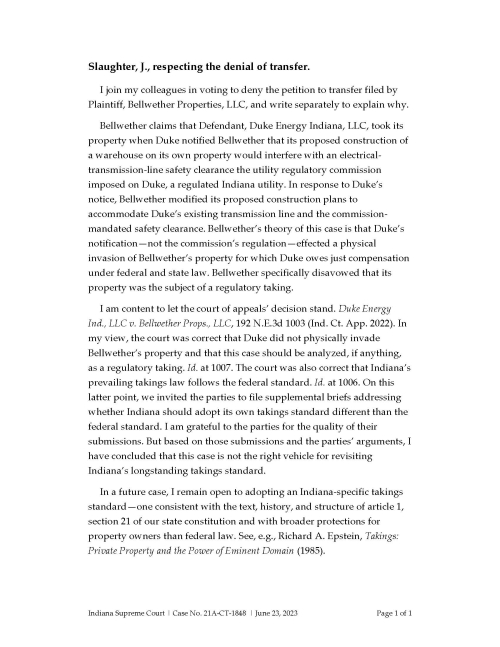
In this Order the Indiana Supreme Court declines to take up the question of when property is taken by regulation. We post it here to note the statement of Justice Slaughter, who agreed that this case isn’t the right vehicle to examine whether Indiana law should adopt a takings test different than the federal test but that he “remains open” to considering it in the right case.

So, Indiana friends, heads-up. Be sure in your next regulatory takings matter, you plead and argue both federal and Indiana takings.

Slaughter_statement

Order at 2.

Order, Duke Energy Indiana,…

Continue Reading Indiana SCT: We’re Not Going To Decide Whether Indiana’s Takings Tests Should Be The Same As Federal Tests (But We’d Like To In A Future Case)

Thanks to lawprof Josh Blackman for the reminder that our un-favorite case, Penn Central Transp. Co. v. New York City, 438 U.S. 104 (1978), turned 44 today.

DSCF3117
If you know, you know.

Time has not treated the opinion well. Practitioners, judges, and legal scholars across the spectrum have called the three-factor Penn Central test for an ad hoc regulatory taking “demanding,” “fuzzy,” a four-part test, “neither defensible as a matter of theory nor mandated as a matter of precedent,” and “problematic” and “mysterious.” Courts mess up the basic meaning of the factors, treat what is supposed to be a fact-centric “ad hoc” test as a legal question decided on the pleadings, and gatekeep most of these cases from juries.

The definitive deconstruction of the case was Gideon Kanner’s “Making Laws and Sausages: A

Continue Reading Sad Birthday Wishes To Penn Central – Some Things Don’t Get Better With Age

Here’s the latest in a case we’ve been following.

In Ideker Farms, Inc. v. United States, No. 21-1949 (June 16, 2023), the U.S. Court of Appeals for the Federal Circuit held that temporary, but recurring government-caused flooding was correctly treated by the Court of Federal Claims as a categorical per se taking, and not under Arkansas Game & Fish‘s Penn-Central-plus multifactor test. The court also held that the property owners are entitled to just compensation for their lost crops.

The opinion is pretty dense (39 single-spaced pages) so we’re not going to provide a blow-by-blow account of the arguments and the court’s reasoning. But we will hit some of the highlights:

  • The Missouri River floods annually. In the 1990s, the Corps of Engineer and Fish and Wildlife Service “began discussions concerning proposed changes to the River designed to mitigate the environmental impact” of the federal flood


Continue Reading CAFED: Temporary But Recurring Flooding Is A Categorical Taking, Not Penn-Central-Plus

Here’s a don’t miss episode of friend and colleague Clint Schumacher’s Eminent Domain Podcast, featuring our Pacific Legal Foundation colleague Jon Houghton. With a title like “Jon Houghton and his Penn Central Quest,” how can we resist listening?

In this episode, Jon Houghton with Pacific Legal Foundation joins to discuss the Penn Central test, why he wants to change it, and what he is doing about it. We also discuss NY Jets football and the big Aaron Rodgers trade.

Listen in!Continue Reading Clint Schumacher’s Eminent Domain Podcast: “Jon Houghton and his Penn Central Quest”

DSCF3117
If you know, you know.

Pacific Legal Foundation (that’s us) has put out a call for papers about “Rethinking Penn Central.” Here’s the details (pdf).

Here’s some of the suggested topics:

  • Can Penn Central be salvaged or does it need to be fully replaced?
  • If it is to be replaced, what should the new test be?
  • Alternatively, what improvements can be made to Penn Central that would address problems raised by critics without uprooting the test entirely?
  • Is economic loss primarily relevant to compensation owed rather than the threshold question of whether a taking has occurred?
  • Can a more categorical approach, like those taken in cases including Cedar Point Nursery v. Hassid, Hodel v. Irving, or Lucas v. South Carolina Coastal Council, adequately address regulatory takings?
  • What insights does the original meaning of the Takings Clause offer regarding how to fix or replace Penn


Continue Reading Rethinking Penn Central: A Call For Symposium Papers

When a court’s opinion (even a trial court’s opinion) starts out with the epigram, “‘Freedom and property rights are inseparable, you cannot have one without the other.’- George Washington,” you know you are in for a ride.

So begins the opinion of the Clay County, Iowa District Court in Navigator Heartland, LLC v. Koenig, No. EQCV034863 (May 3, 2023). The issue was the validity under the Iowa Constitution of Iowa’s precondemnation entry statute, which allows pipeline condemnors to enter property for land surveys:

After the informational meeting or after the filing of a petition if no informational meeting is required, a pipeline company may enter upon private land for the purpose of surveying and examining the land to determine direction or depth of pipelines by giving ten days’ written notice by restricted certified mail to the landowner as defined in section 479B.4 and to any person

Continue Reading Iowa Trial Court: Pipeline Precondemnation Entry Statute Is Facially Unconstitutional

Here’s the latest in a case we’ve been following since its inception, this cert petition seeking Supreme Court review of the U.S. Court of Appeals for the Second Circuit’s affirming the district court’s dismissal of a complaint alleging that New York (state)’s sweeping amendments to its Rent Stabilization (rent control) statute effected categorical and Penn Central takings:

Petitioners’ physical-takings claims would have been allowed to proceed if they were brought in the Eighth Circuit. That is because the Eighth Circuit has correctly held that property owners plead a physical taking under Cedar Point where a law prohibits them from terminating a tenancy at the end of a lease term. See Heights Apartments, LLC v. Walz, 30 F.4th 720, 733 (8th Cir. 2022), reh’g en banc denied, 30 F.4th 720. But the Second Circuit held here—as has the Ninth Circuit—that the physical-takings principles articulated in Cedar Point are

Continue Reading New Cert Petition: Forcing Owners To Rent To Tenants Indefinitely Is A Categorical Taking

Sidewalk

A good opinion from the U.S. Court of Appeals for the Sixth Circuit in Knight v. Metro. Gov’t of Nashville, No. 21-6179 (May 10, 2023), holding that conditions imposed on every development — and not just ad hoc administratively-imposed conditions — must conform to the Nollan-Dolan-Koontz close nexus and rough proportionality standards.

You takings and land use mavens can stop right there, because you know what this means: the Sixth Circuit has added to the growing split in the lower courts about whether legislatively-imposed conditions on development which cover everyone are, as some courts characterize them, mere land use regulations subject only to Euclid‘s rational basis review, or are constrained by N-D-K ‘s requirements (see here, and here for examples). The Supreme Court has been presented with the lower court disagreement, but so far has not stepped in and resolved the issue.

The Sixth Circuit experienced

Continue Reading CA6: Legislative Conditions Are Subject To Nexus-And-Proportionality Requirements

1992 Aerial Photo Island2
Shands Key, with the City of Marathon in the background

This just in: in Shands v. City of Marathon, No. 3D21-1987 (May 3, 2023), Florida’s Third District Court of Appeals held that the city’s downzoning the property (Shands Key, shown above in an exhibit from the Key West trial we participated in in June 2021) from General Use (density: one home per acre) to Conservation Offshore Island (one home per 10 acres; Shands Key is just under 8 acres) effected a Lucas taking.

We’re not going to go into too much detail, because this case is one of ours. Our Pacific Legal Foundation colleague Jeremy Talcott was the lead trial and appellate counsel, backed by Kady Valois.

Shandstrialteam_after
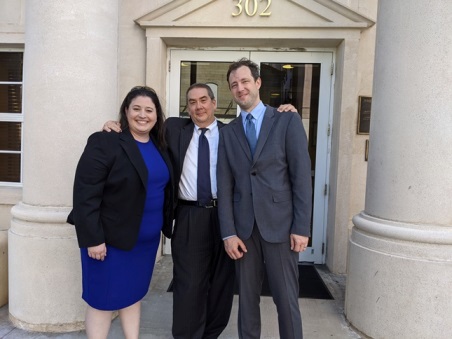
Trial (and appeal) team after closing arguments in Key West:
Valois, inversecondemnation.com, Talcott

But we’re not going to let you go without noting a few highlights from the Court of

Continue Reading This Just In – Florida Appeals Court: TDRs, Beekeeping, And Camping Are Not Economically-Beneficial Uses, So Downzoning Is A Lucas Taking