


Screenshot 2024-11-08 at 07-19-21 Track Appeals NJ Courts

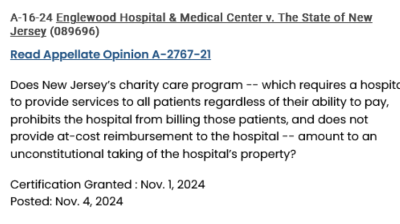
Here’s the latest in a case we’ve been following. The New Jersey Supreme Court has agreed to review the Appellate Division’s decision in Englewood Hospital & Medical Center v. New Jersey

That’s the case where several hospitals challenged a New Jersey statute which requires hospitals to take all patients regardless of their ability to pay, but does not fully reimburse under Medicaid the hospitals for the costs of treating these patients even where it results in the hospitals losing money.

The Appellate Division held this was not a categorical (Cedar Point/Loretto) or an ad hoc (Penn Central) taking.

The hospitals asserted that the statute required them to suffer a physical invasion, because the statute prohibited hospitals from excluding nonpaying patients. The court rejected the argument, in what reminded us of the Yee rent control and PruneYard commercial benefit approach, where the essential reasoning

Continue Reading NJ Supreme Court Grants Review: Is Forcing Hospitals To Operate At A Loss A Taking?
Screenshot 2024-11-04 at 07-50-41 Guns and the Right to Exclude Saving Guns-at-Work Laws from Cedar Point's Per Se Takings Rule The University of Chicago Law Review

The latest issue of the University of Chicago Law Review has this student-authored piece that is worth your time reading. “Guns and the Right to Exclude: Saving Guns-at-Work Laws from Cedar Point‘s Per Se Takings Rule,” 91 U. Chi. L. Rev. 2047 (2024). 

Here’s the Abstract:

The Supreme Court’s decision in Cedar Point Nursery v. Hassid has left considerable uncertainty in the realm of takings law. In Cedar Point, the Court announced a new rule that government-authorized physical occupations of property, even temporary ones, constitute per se takings. But the Cedar Point decision left significant questions unresolved regarding the scope of its per se takings rule and its various exceptions.

To resolve these questions, this Comment looks to the example of guns-at-work laws. Enacted by about half of the states, guns-at-work laws protect the right of a business’s employees, customers, and invitees to store firearms in

Continue Reading New U Chi L Rev Article (Comment): “Guns and the Right to Exclude: Saving Guns-at-Work Laws from Cedar Point‘s Per Se Takings Rule”

Here’s the latest in a case we’ve been following, which asks whether a local ordinance which allowed non-paying tenants to remain in the lessor’s property is a physical taking, or merely the regulation of the lessor/lessee relationship under the Yee theory, which posits that once an owner voluntarily rents property to a tenant, the government then allowing that tenant to remain rent free isn’t facilitating an unauthorized physical occupation, but rather is merely a regulation of the existing lessor/lessee relationship. In short, you let ’em in property owner, so suck it up.

The property owner has now filed this cert petition challenging that rationale.

As we’ve noted previously, some courts’ reliance on Yee in this and similar situations is a misreading of that decision. Besides that, these courts essentially upend the longstanding common law of property governing the owner/tenant relationship, and the contractual nature of that relationship

Continue Reading New Cert Petition: Eviction Moratorium Transferred Possession Easement To Nonpaying Tenants

If there’s a silver lining in the U.S. Court of Appeals for the Sixth Circuit’s opinion in Slaybaugh v. Rutherford County, No. 23-5765 (Sep. 3, 2024), a case about what we call “SWAT takings” (police destroy someone’s property in order to dislodge a criminal suspect), it’s that the court did not adopt the usual “this was a really, really good exercise of the municipality’s police power so there’s no taking” approach.

But even though it applied a different analysis, the result was the same: no taking. Instead of the “police power” rationale, the court dug into the substance a bit more and determined that the police were “privileged” to physically invade and destroy the Slaybaugh property.

The court first acknowledged that owners generally have the right to exclude:

In arguing their prima facie takings claim, the Slaybaughs contend that police infringed on their property rights by invading

Continue Reading No SWAT Takings In CA6: Police’s Power To Arrest Includes Privilege To Damage Property

This would not be authorized.

Here’s the latest in an issue that found new vitality after the U.S. Supreme Court’s decision in Cedar Point affirming that government-authorized physical entry to private property is presumptively a taking.

This is the “precondemnation entry” issue in eminent domain which several courts have addressed:

This is where a condemnor contemplates taking property and wants to get on site to check it out. Do things like surveys, examinations, tests, and sample-taking. Often, the owner of the property doesn’t mind: pay me a bit for my trouble, indemnify me in the event someone gets injured, and you can have limited access to do your business and then go on your way, condemner. But sometimes, an owner says no.

In Betty Jean Strom Trust v. SCS Carbon Transport, No. 30317 (Aug. 21, 2024), SCS is planning a CO2 pipeline though South

Continue Reading S Dakota: Only Way To Read Precondemnation Entry Statute Constitutionally Is Allowing “minimally invasive superficial inspections” and “minor soil disturbances”

Be sure to read the entirety of Lawprof Ilya Somin’s recent post on Volokh,Federal Appellate Court Rules in Favor of Takings Lawsuit Against the CDC’s Covid-Era Eviction Moratorium.”

There, he analyzes the Federal Circuit’s recent 2-1 opinion in Darby Dev. Co., Inc. v. United States, No. 22-1929 (Aug. 7, 2024) (we wrote up the case here: “Deepening A Lower Court Split, Fed Cir (2-1) Reinstates CDC Co-19 Eviction Moratorium Temporary Takings Claim“).

Professor Somin does a better job that we did offering his thoughts on the “authorized” issue, concluding:

To me, the decisive factor should be that the Takings Clause nowhere says that compensation is only required for legal government actions or for those specifically authorized by statute. Rather, the Clause imposes a general rule that compensation must be paid whenever the government takes private property for “public use.” That, of course, can happen

Continue Reading Lawprof Somin: “Federal Appellate Court Rules in Favor of Takings Lawsuit Against the CDC’s Covid-Era Eviction Moratorium”

You remember that old adage (or maybe its a cliché?) that “a conservative is a liberal who has been mugged?” Well, here’s your environmentalist analog.

In Echeverria v. Town of Tubridge, No. 23-AP-291 (Aug. 2, 2024), the Vermont Supreme Court held that property owners’ lawsuit asserting their right to prohibit the town from allowing bicycling on hiking trails on their land, and to prohibit it from allowing members of the public onto the property to maintain the trails, is ripe. The owners asserted that as the owners, they alone have the authority “whether and how to maintain the legal trails that cross their property.” Slip op. at 2. Here are the details: the owners assert

sole and exclusive authority to decide whether and how to maintain the legal trails that cross their property. They alleged that the expected entry onto their property by volunteers seeking to exercise

Continue Reading A Property Rights Advocate Is An Environmentalist Who Has Been Overregulated: Anti-Takings Advocate Argues For The Right To Exclude

20151205_145921

This one is a must-read.

In Darby Dev. Co., Inc. v. United States, No. 22-1929 (Aug. 7, 2024), the U.S. Court of Appeals for the Federal Circuit held that the Court of Federal Claims should not have dismissed Darby’s complaint for failure to state a physical invasion takings claim.

The short takeaways:

  • Takings claims do not require the government action be legally authorized (here, the courts invalidated the government action, after which the plaintiff sued for a taking), only that the government action was “authorized” and thus can be “chargeable to the government.”
  • Prohibiting evictions is not merely a regulation of the landlord-tenant relationship. Yee v. City of Escondido is distinguishable, and does not categorically exempt all actions that implicate the landlord-tenant relationship from physical takings challenge.

We think the longer story is worth your time. Here it is.

As you may recall, the Center for Disease Control purported

Continue Reading Deepening A Lower Court Split, Fed Cir (2-1) Reinstates CDC Co-19 Eviction Moratorium Temporary Takings Claim

Check out this decision, entered by a Rhode Island Superior Court (a general jurisdiction trial court) denying the State’s motion for summary judgment. The court concluded that a recently-adopted statute shifting the boundary between public and private property on RI’s beaches is a taking.

We won’t be commenting in too much detail because this is one of ours (PLF colleague Dave Breemer represents the plaintiffs). But here’s what you need to know:

  • Until recently, RI law used the high water mark (mean high-tide line) as the boundary between the public beach and private property.
  • In 2023, the RI Assembly adopted a statute that redefined that boundary, and moved it shorewards to where “the land held in trust by the state for the enjoyment of all of its people ends and private property belonging to littoral owners begins.”
  • As a consequence, the public may enter and use “where


Continue Reading Statute Allowing Public To Access Formerly Private Portions Of Rhode Island Beaches Is A Taking

Worth reading: a student-authored piece in the latest issue of the Harvard Journal of Law & Public Policy, “Original Understanding of ‘Background Principles’ in Cedar Point Nursery v. Hassid.

From the Introduction:

But in Cedar Point, when considering a regulation that authorized union organizers to enter certain businesses, the Court held that even a temporary physical occupation was a per se taking requiring compensation.

The Court’s shift to a per se rule is significant because it means a landowner can receive “just compensation” without satisfying Penn Central’s high bar required for regulatory takings. For governments, the Cedar Point holding could pose a heavy financial burden if they must compensate landowners for temporary intrusions authorized under existing regulations. Due to this imposing financial burden, some have suggested that Cedar Point threatens existing civil rights regimes, which at first blush resemble the labor rights regulation at

Continue Reading New Article: “Original Understanding of ‘Background Principles’ in Cedar Point Nursery v. Hassid“