


This morning, the Supreme Court declined to review a case we’ve been following, Like v. Transcontiental Gas Pipe Line Co., No. 18-1206. 

This is the one in which landowners are challenging the district court’s issuance of an injunction in a Natural Gas Act taking which allow a private condemnor to obtain immediate possession of the land being condemned even though the Natural Gas Act does not delegate to pipeline condemnors the quick-take power. We filed this amici brief in support of the property owner. 

The game is still afoot for several reasons, even though this is the second case presenting the same issue that the Court declined to review. First, the issue isn’t going away; there is at least one more case in the petition pipeline, involving the Mountain Valley pipeline. Second, other courts get it, why doesn’t the Supreme Court? And finally, there’s Knick. That

Continue Reading Cert Denied In Immediate-Possession-By-Injunction Case (But There’s One More In The Pipeline)

North Dakota, as you might expect, can be cold in the winter. So cold that railroad switches need to be heated, else they get… frozen. The railroad uses refillable propane tanks, but these need to be refilled from time to time. And North Dakota is so cold in the winter that sometimes, the propane trucks can’t get to the tanks to refill them. Frozen switches. 

Enter MDU, the Montana-Dakota Utilities Company. The railroad asked MDU to install a natural gas pipeline, “believing that natural gas by pipeline would increase reliability and decrease the cost associated with heating the switch.” The cheapest and most practical place to locate this pipeline was on Behm’s land: “MDU claimed that other routes for the pipeline would be too expensive or might in the future require modification or removal of the pipeline. 

Behm didn’t see it that way. He objected, asserting the taking was not

Continue Reading Frozen: “Necessity” In Eminent Domain Can Mean Mere Convenience (Or Anything Else The Condemnor Says)

Here’s what we’re reading today, in between real work:

Continue Reading Friday Reading: Pipeline Injunctions, Justifying Kelo, And Maui Groundwater Case

The Arizona Court of Appeals’ opinion in Arizona Electrical Power Cooperative v. DJL 2007 LLC, No. 1 CA-CV 16-0097 (May 9, 2019), is about the date of valuation in eminent domain, but beyond that is interesting to us because it sheds light on a case we’ve been following about natural gas pipelines and the use of the federal courts’ injunction power to effect immediate possession

In the Arizona case, the owner purchased land from the BLM subject to the private electric company’s 30-year easement on which it had installed high-voltage transmission lines. The grant of easement expired in 2011, but the electric company did not remove the lines. In 2014, it instituted an eminent domain action to condemn the easement. 

The trial court rejected the utility’s request for immediate possession. Instead, it granted a preliminary injunction allowing the utility to continue to operate and maintain the transmission lines.

Continue Reading AZ App: Private Utility Does Not Effect A Taking “until after trial and payment”

Here’s the Reply Brief in a case which we’ve been following (and in which we filed this amici brief). This is the one in which landowners are challenging the district court’s issuance of an injunction in a Natural Gas Act taking which allow a private condemnor to obtain immediate possession of the land being condemned even though the Natural Gas Act does not delegate to pipeline condemnors the quick-take power.

The Reply responds to the Brief in Opposition, and argues:

These decisions conflict with the basic structure of eminent domain, which grants condemnors the power to buy land by force—not occupy it by federal injunction. The decisions let pipeline companies exercise a formidable power that Congress has not given them. And for landowners in the path of pipeline projects, the decisions create grave burdens to which no other federal condemnee is subjected. Because only this Court can correct

Continue Reading SCOTUS Reply Brief Clears Up Misconception About Eminent Domain Actions

Here’s the Brief in Opposition, in Like v. Transcontinental Gas Pipe Line Co., LLC, No. 18-1206 (Apr. 17, 2019), the case which we’ve been following (and in which we filed this amici brief). 

This is the case in which landowners are challenging the district court’s issuance of an injunction in a Natural Gas Act taking which allow a private condemnor to obtain immediate possession of the land being condemned even though the Natural Gas Act does not delegate to pipeline condemnors the quick-take power.

Here’s the Question Presented as framed by the pipeline: 

Whether the decision of the court below affirming the issuance of an injunction granting possession of specific rights of way on each of the Petitioners’ properties by the district court under the Natural Gas Act, after a two day hearing, and after the district court granted partial summary judgment and determined that Transco had

Continue Reading BIO In “Take-First-Pay-Later” Natural Gas Act Condemnation

Here’s the amici brief of the Owners’ Counsel of AmericaNew Jersey, Virginia, and West Virginia property owners; Cato Institute, and NFIB Small Business Legal Center which urges the Supreme Court to grant cert in a case we’ve been following for a while.  

As regular readers understand, several federal courts of appeals recently have upheld giving prejudgment possession of property to a private pipeline condemnor once a district has ruled in favor of the pipeline that it qualifies under the three predicates in 15 U.S.C. § 717f(h). These courts conclude that summary judgment grants a pipeline a “substantive” right, and therefore there’s no reason to not give it possession now by granting a Rule 65 injunction. 

But a close read of the language of section 717f(h) shows it is only about whether a private pipeline company may institute an eminent domain lawsuit to take property. In

Continue Reading New SCOTUS Amici Brief In Pipeline Case: Courts Keep Using “Order of Condemnation.” We Do Not Think It Means What They Think It Means

0401191044b_HDR

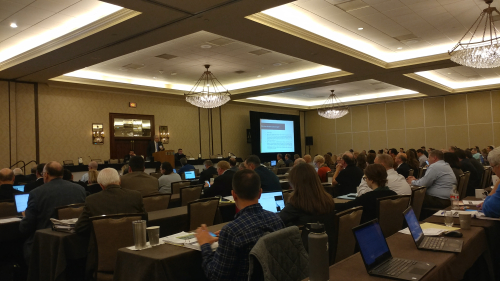
Great crowd today in Austin for CLE International’s Eminent Domain seminar, co-chaired by our colleagues Chris Clough, Sejin Brooks, and Christopher Oddo. We spoke about “National Trends and Developing Issues in Eminent Domain.” 

Here are the cases I referred to which are not included in your written materials:


Continue Reading Materials And Links From Today’s Austin Eminent Domain CLE

Here’s the cert petition filed recently in yet another case (seeking review of the Eleventh Circuit’s opinion) which challenges a federal court issuing an injunction in a Natural Gas Act taking allowing a private condemnor to obtain immediate possession of the land being condemned, even though the NGA does not delegate to pipeline condemnors the quick-take power. 

You know where we are on this issue. If not, check out our amicus brief which we filed in the Third Circuit which has the details of why we think this is wrong. 

There’s another cert petition on the same issue pending, and another likely coming.

Here’s the Question Presented:

The Court has long emphasized the strict construction of condemnation statutes, especially as against corporate delegates of this sovereign power. By the plain, undisputed terms of the Natural Gas Act, 15 U.S.C. § 717f(h), a pipeline company obtains title and

Continue Reading Another Cert Petition Challenging Quick-Take-By-Injunction In Gas Pipeline Takings

IMG_0123

Last week, author Howard Mansfield joined us at the William and Mary Law School for two sessions about his recently-published book, “The Habit of Turning the World Upside Down – Our Belief in Property and the Cost of That Belief.”  His book is about property, property rights, and what he has discovered about how these ideas are processed by the American psyche.

The first session was open to the entire student body, faculty, and public, and the highlight was Mr. Mansfield reading some of his favorite passages from his book. The second session was a student-only chat about some of the themes that he emphasizes. 

If you were not able to join us in-person, listening will be able to give you a sense of why we think this book is a timely rumination on what “property” means, both good and not-so-good. 

If you can’t stream the audio above, Continue Reading Audio: Readings From “The Habit of Turning The World Upside Down”