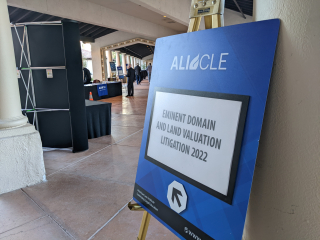
Here it is, the official agenda and program for the 40th ALI-CLE Eminent Domain & Land Valuation Litigation Conference, February 2-4, 2023 (with a special event the evening of Wednesday, February 1, 2023 to entice you to arrive early).
Screenshot 2022-11-18 at 13-35-13 ALI CLE PA NY VA TX FL Continuing Legal Education

Here’s the brochure with the complete agenda, schedule, and faculty listing. But to tempt you, here are some of the highlights of the program:

  • Everything Old is New Again: Why Today’s Practitioners Need to Understand the Original Meaning of the Takings and Just Compensation Clauses
  • Private Utility Takeovers – Lessons From a 67 Day Trial

  • Valuation Issues When Billboards and Signs are Condemned

  • Setting Client Expectations and Identifying Red Flags

  • Developing Property Right Issues in Texas – Questions and Answers from the Bench: A View From the Bench (with Texas Supreme Court Justice Jimmy Blacklock)

  • Eminent Domain and Regulatory Takings Updates: Important Decisions You Need to Know

  • Ethics:


Continue Reading Here’s The Program For The 40th ALI-CLE Eminent Domain & Land Valuation Litigation Conference, Feb 1-4, 2023, Austin

Been meaning to post this one for a while.

The plaintiff in Northwest Landowners Ass’n v. North Dakota, No. 20210148 (Aug. 4, 2022), challenged North Dakota’s adoption of a statute about “pore space,” which is “a cavity or void, whether natural or artificially created, in a subsurface sedimentary stratum.” Whoa.

The problematic part of the statute “allows an oil and gas operator to use subsurface port space and denies the surface owner the right to exclude others or to demand compensation for this subsurface use.” Slip op. at 2. The statute also amended the definition of “land” to exclude pore space, and barred tort claims for injection or migration of substances into pore space. Frack!

The Association sued, asserting that the statute effected a facial taking because “it strips landowner of their right to possess and use the pore space within their lands and allows the State

Continue Reading Shades Of Mahon From North Dakota: Fracking Statute “constitutes a per se taking”

Here’s a recently-filed cert petition in a pipeline case. This one asks whether an agency — here, FERC — has primary administrative jurisdiction over a facial challenge to Congress’ delegation of federal eminent domain authority to a private party. 

Here are the Questions Presented:

Whether a facial challenge to Congress’s delegation of eminent domain power to private parties is properly filed in district court, as this Court held in PennEast Pipeline Co. v. New Jersey, 141 S. Ct. 2244 (2021), or with FERC, which has admitted it has no jurisdiction to adjudicate the constitutionality of this delegation.

Whether a facial challenge to Congress’s overly broad delegation of legislative power to FERC is properly filed in district court or with FERC, which has admitted it has no jurisdiction to adjudicate the constitutionality of this delegation.

Whether a facial challenge to Congress’s delegation of eminent domain power to FERC is properly

Continue Reading New Takings Cert Petition: Can An Agency Decide Constitutionality Of Delegation Of Federal Eminent Domain Power?

Screenshot 2022-09-13 at 14-12-11 Feed LinkedIn

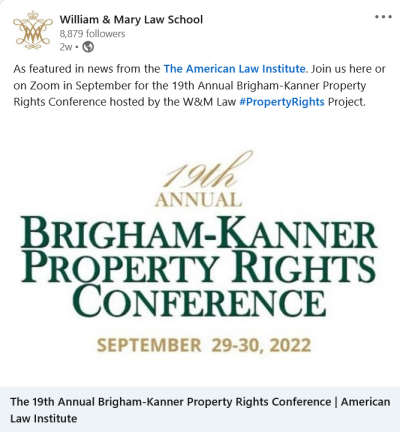
One last reminder that there’ still time to register for the upcoming Brigham-Kanner Property Rights Conference at the William and Mary Law School in Williamsburg, Virginia, September 29-30, 2022. If you can’t make it to the historic campus, there’s an option to attend remotely.

In our opinion, the Conference is the best of its kind because it brings together legal scholars and the practicing bar to talk dirt law theory and practice. We also a have a full supplemental program for law students, that covers property law and careers in eminent domain law, a recruiting session, a program on international property rights, and a program on land use law.

Registration for the Conference is ongoing, and you can sign up here.

Here is the full agenda. (We’ll be speaking on Panel #2, “Reshaping the Framework Protecting Property Under the Roberts Court.”)

Come on, join us!

Continue Reading Still Time To Join Us (In-Person Or Remote) For The 19th Annual Brigham-Kanner Property Rights Conference

Here’s the latest in a case we’ve been following. The U.S. Court of Appeals recently heard oral arguments in a case where a private Natural Gas Act condemnor (the Sabal Trail pipeline) exercised the delegated federal power of eminent domain to take the property of a Florida owner.

As we reported here, the issue is whether federal or state law applies in these cases. The big reason why the question of whose law applies is that under the Fifth Amendment, “just compensation” does not include attorneys’ and other fees, while under the Florida Constitution’s “full compensation” provision (which we noted here), a property owner may recover fees and costs. The District Court held that Florida law, not federal, applied, and Sabal Trail appealed to the Eleventh Circuit.

The arguments are worth listening to. Is this a question of “choice of law?” Or does it go

Continue Reading CA11 Oral Arguments In Pipeline Taking: If Florida Law Says The Owner Gets Compensation Plus A Car, Does A Federal Court Have To Recognize That?

Here’s the latest in a case we’ve been following.

In City of Oberlin v. FERC, No. 20-1492 (July 8, 2022), the U.S. Court of Appeals for the D.C. Circuit held FERC adequately explained why, in granting a certificate of public convenience, it relied in part on evidence that some of the natural gas in the pipeline was slated to go to Canada. 

Earlier, the court held FERC had not explained why well enough (or at all), and sent the case back down to give FERC the chance to do so. The handwriting was on the wall in the remand order because the court pointedly did not vacate FERC’s order granting the certificate: “we remand without vacatur, because we find it plausible that the Commission will be able to supply the explanations required, and vacatur of the Commission’s orders would be quite disruptive, as the Nexus pipeline is

Continue Reading DC Circuit OK’s Pipeline That’s Already Built

Screenshot 2022-07-07 at 13-44-38 The Brigham-Kanner Property Rights Conference

By now, you know that the 19th Brigham-Kanner Property Rights Conference is set for September 29-30, 2022, at the William and Mary Law School in Williamsburg, Virginia (register here – space is limited – fee ranges from free to $195 – a bargain!). And you know that our colleague Jim Burling is this year’s B-K Prize winner.

But now you know who is speaking at the Conference, and the topics: here’s the full agenda. The list of speakers is too long to list here but check out these topics:

  • Panel 1: The Importance of Property Rights: A Tribute to James S. Burling
  • Panel 2: Reshaping the Framework Protecting Property Under the Roberts Court (that’s the panel we’re speaking on)
  • Roundtable: Emerging Issues in Takings and Property Rights Litigation
  • Panel 3: Choosing A Property Regime
  • Panel 4: Property Rights in Times of Scarcity and Crisis

Who can

Continue Reading Here’s The Full Speaker And Topic List For The Brigham-Kanner Property Rights Conference (Sep 29-30, 2022)

On one hand, there’s nothing terribly surprising about the Texas Supreme Court’s opinion in Hlavinka v. HSC Pipeline Partnership, LLC, No. 20-0567 (May 27, 2022) holding that yes, “polymer-grade propylene” qualifies as an “oil product” under Texas statutes that allow a private pipeline company to take property to transport oil products, and that yes, a private pipeline counts as a public use. After all, the first sentence of the opinion sets the context for those of you who may not realize how important the energy industry is to that state:

Recognizing the important role that pipeline development plays in meeting our state’s manufacturing and energy needs, the Legislature grants common carriers the right to condemn private property for the construction of pipelines that transport certain products.

Slip op. at 1.

But on the other hand, the very last portion of the opinion gives a hint that maybe the court

Continue Reading Texas: At Least One Customer Is Served So Pipeline Is A Public Purpose, But Let’s Loosen Valuation Rules For Energy Corridors

PXL_20220127_144224442

After a two-year absence in which we went remote, in the last week of last month (our usual spot on the calendar, between the playoffs and Super Bowl), we once again met in-person for the American Law Institute-CLE Eminent Domain and Land Valuation Litigation Conference.

Approximately 200 lawyers, judges, legal scholars, appraisers, law students, right-of-way agents, relocation experts, property owners, and other related professionals gathered in-person–yes, in-person–at the Scottsdale (Arizona) Resort at McCormick Ranch, to get reacquainted, learn stuff, and renew ties last made in-person in Nashville in 2020. In addition to the live attendance, we also welcomed about 50 remote colleagues, who joined the live webstream.

This was the 39th edition of the Conference, one of the most-established and successful conferences in the ALI-CLE stable of programs.

To those who joined us – thank you. This conference reminded us of why this program is so

Continue Reading 2022 ALI-CLE Eminent Domain And Land Valuation Litigation Conference, Scottsdale: You Should Have Been There!

If you ever get the opportunity to teach in a law school — either as a full-time legal scholar, or part-time as an expert adjunct practitioner — take it if you can. You might think you know a lot about a particular subject, but there’s nothing like spending time at the lectern in a law classroom in front of sharp and eager lawyers-in-training to sharpen your thoughts, and get you to truly understand a subject.

And folks calling you “professor” can evoke a smile.

Sensei

But if there’s one downside to the law school experience from the teacher’s side of the lectern, it’s grading. Especially at a law school like William and Mary that has a pretty strict mandatory curve. In upper-division courses that we handle like Eminent Domain and Property Rights Law and Land Use — where we’re dealing with some very high-level stuff and the quality of the

Continue Reading The Circle Is Now Complete: A Sampling Of Final Paper Topics From William and Mary Law’s Eminent Domain & Property Rights, And Land Use Courses